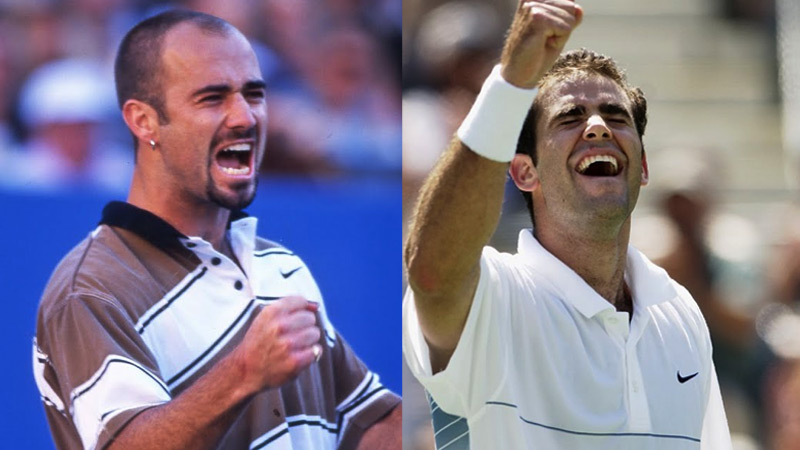
The rivalry between Pete Sampras and Andre Agassi stands as one of the defining dualities in modern sports history.
Throughout the 1990s and into the early 2000s, these two American legends clashed on the world’s biggest stages, presenting a contrast in playing styles, personalities, and career trajectories.
On one side stood Sampras: methodical, quiet, possessing an unstoppable serve-and-volley attack engineered for fast-court dominance.
On the other stood Agassi: charismatic, expressive, armed with a devastating return game and baseline precision that translated across every playing surface. Evaluating who was genuinely better requires looking beyond simple surface-level comparisons.
While standard metrics favor Sampras’s sheer volume of major titles and weeks at the top of the rankings, Agassi’s achievements in surface versatility, career longevity, and modernizing baseline mechanics present a compelling counter-argument.
The Statistical Summary: Side-by-Side Comparison
To evaluate both players objectively, examining their career records across majors, world rankings, head-to-head encounters, and tournament achievements provides a clear foundation.
| Metric | Pete Sampras | Andre Agassi | Comparative Context |
|---|---|---|---|
| Grand Slam Titles | 14 | 8 | Sampras held the all-time men’s record at retirement. |
| Career Grand Slam | No (Lacked French Open) | Yes (All 4 Majors) | Agassi is one of the few men in history to win all four. |
| Olympic Gold Medal | 0 | 1 (1996 Atlanta) | Completes Agassi’s Career Golden Slam. |
| Weeks at World No. 1 | 286 | 101 | Sampras held supreme dominance at the top rank. |
| Year-End No. 1 Finishes | 6 consecutive (1993–1998) | 1 (1999) | Sampras set an unprecedented streak of annual consistency. |
| Head-to-Head Record | 20–14 | 14–20 | Sampras held the advantage across their 34 meetings. |
| Grand Slam Finals H2H | 4–1 | 1–4 | Sampras won four of their five major final clashes. |
| Year-End Championships | 5 titles | 1 title | Sampras dominated the elite season-ending event. |
| Masters Series Titles | 11 | 17 | Agassi secured six more Masters titles outside majors. |
| Career Duration | Retired at ~31 (2002) | Played until 36 (2006) | Agassi demonstrated extended high-level longevity. |
Pete Sampras: The Standard of Peak Dominance
Major Championship Mastery and Fast-Court Authority
Pete Sampras built his career around an offensive style that maximized speed, power, and precise placement. Winning 14 Grand Slam singles titles, Sampras set what was then the record for men’s major championships upon his retirement.
His dominance was especially pronounced on fast surfaces, where his lethal serve and transition game left opponents with minimal reaction time.
At Wimbledon, Sampras collected seven titles in eight years between 1993 and 2000, establishing a level of grass-court authority rarely equaled.
His power game was equally effective on hard courts, capturing five US Open titles, including his debut major victory in 1990 against Agassi and his final career match in the 2002 US Open final, also against Agassi.
Ranking Supremacy and Unbroken Consistency
While individual major titles capture headlines, sustained excellence is reflected in world ranking metrics. Sampras held the World No. 1 ranking for 286 total weeks. Even more impressive was his achievement of finishing as the Year-End No. 1 player for six consecutive seasons from 1993 through 1998.
This six-year streak demonstrated an ability to maintain peak physical and mental condition across full grueling tour calendars.
During this period, Sampras routinely defeated top-ten competition, secured multiple ATP Year-End Championships (winning five titles), and successfully defended ranking points across varying global venues.
Pete Sampras's Six Consecutive Year-End No. 1 Finishes (1993–1998)
┌──────┐  ┌──────┐  ┌──────┐  ┌──────┐  ┌──────┐  ┌──────┐
│ 1993 │─>│ 1994 │─>│ 1995 │─>│ 1996 │─>│ 1997 │─>│ 1998 │
└──────┘  └──────┘  └──────┘  └──────┘  └──────┘  └──────┘
  (Sustained Peak Dominance: 286 Total Weeks at World No. 1)
Strategic Weaponry: The Unreturnable Serve and Volley Excellence
The foundation of Sampras’s game was widely considered the most effective running-serve complex in modern tennis history. His action yielded both immense speed and unpredictable disguise; he could hit flat, slice, or kick serves to either corner with identical throwing mechanics.
- First Serve Impact: Allowed him to score free points consistently, easing pressure on his service games.
- Second Serve Aggression: Sampras frequently went for high-risk second serves, hitting heavy kickers or flat bombs that prevented opponents from attacking.
- Net Coverage and Running Forehand: When forced away from the net, Sampras possessed a running forehand that could turn defensive positions into immediate winners.
- Clutch Overhead: His leaping “slam dunk” overhead became a signature physical weapon whenever opponents attempted to lob him.
Andre Agassi: All-Surface Versatility and Evolution
The Career Grand Slam and the Olympic Golden Slam
If Sampras represented the ultimate peak of fast-court dominance, Andre Agassi embodied complete, all-surface excellence. Agassi earned 8 Grand Slam titles, but the defining feature of his trophy cabinet is its breadth.
By capturing the 1999 French Open title, Agassi became one of the few male players in tennis history to complete the Career Grand Slam by winning all four major tournaments: the Australian Open, French Open, Wimbledon, and the US Open.
In addition to his four major titles, Agassi earned the Olympic Gold Medal at the 1996 Atlanta Games. This combination gave him the coveted Career Golden Slam—an achievement that eluded Sampras due to his struggles on clay courts.
             ┌────────────────────────────────────────┐
             │       ANDRE AGASSI'S GOLDEN SLAM       │
             └───────────────────┬────────────────────┘
                                 │
     ┌─────────────────┬─────────┴─────────┬─────────────────┐
     ▼                 ▼                   ▼                 ▼
Australian Open   French Open          Wimbledon          US Open
 (1995, '00-'03)    (1999)               (1992)         (1994, 1999)
     │                 │                   │                 │
     └─────────────────┴─────────┬─────────┴─────────────────┘
                                 │
                                 ▼
                    1996 Olympic Gold Medal
Redefining the Service Return and Baseline Play
Agassi revolutionized how baseline tennis was played against elite servers. Widely regarded as one of the greatest service returners in the history of the sport, Agassi took the ball earlier than almost any player before him.
Standing inside or right on the baseline, he took short, compact backswings to redirect high-velocity serves directly back to the server’s feet.
This ability to take time away from opponents transformed his return into an offensive stroke. Against serve-and-volley players like Sampras, Agassi forced low volleys or difficult half-volleys, neutralising the advantage of the serve. This aggressive baseline style laid the technical framework for subsequent generations of baseline players.
Longevity, Career Resurgence, and Adapting Across Eras
Agassi’s career was defined by remarkable resilience and adaptability. After dropping outside the top 100 in the world rankings in 1997, Agassi underwent a rigorous fitness overhaul, rebuilt his game on the Challenger circuit, and returned to the top spot in world tennis.
His longevity allowed him to remain competitive deep into his 30s, competing at the highest level until his retirement in 2006 at age 36.
During the final phase of his career, Agassi captured multiple Australian Open titles (2000, 2001, 2003) and reached the 2005 US Open final at age 35, proving his endurance against emerging champions of the next generation.
Tactical Breakdown: Serve/Volley vs. Baseline Return
The Sampras-Agassi matchup presented a classic tactical clash: the game’s best serve-and-volley player against its best baseline returner.
Analyzing how their styles collided across different environments highlights why their head-to-head record shifted depending on tournament conditions.
                  THE TACTICAL BATTLEGROUND

     PETE SAMPRAS                        ANDRE AGASSI
┌──────────────────────┐            ┌──────────────────────┐
│ Devastating Serve    │            │ World-Class Return   │
│ Net Rush & Volleys   │  <======>  │ Early Ball-Taking    │
│ Fast-Court Edge      │            │ All-Court Baseline   │
└──────────────────────┘            └──────────────────────┘
           │                                   │
           ▼                                   ▼
 Fast Hard & Grass Courts              Slow Hard & Clay Courts
 (Wimbledon / US Open)                 (French Open / Rome)
Surface Speed and Match Dynamics
The rivalry was heavily influenced by court speed and bounce height:
- Grass and Fast Hard Courts (Wimbledon & US Open): Fast court conditions favored Sampras’s low-bouncing, high-velocity serve. On grass and fast hard courts, Sampras could glide to the net behind his serve, leaving Agassi minimal time to set his feet. This structural advantage translated to Sampras winning four out of five Grand Slam finals against Agassi.
- Clay Courts and Slow Hard Courts (French Open & Rome): Slower conditions gave Agassi the upper hand. Clay courts absorbed the speed of Sampras’s serve and bounded higher into Agassi’s strike zone. This enabled Agassi to engage in longer baseline exchanges where his lateral movement, stamina, and groundstroke consistency could wear Sampras down. While Sampras achieved notable clay victories—winning the Italian Open in Rome and scoring wins over French Open champions like Sergi Bruguera and Jim Courier—he never reached a French Open final, whereas Agassi conquered Paris in 1999.
Head-to-Head Headliners
Across 34 professional meetings, Sampras led their head-to-head series 20–14.
- Grand Slam Clashes: Sampras maintained an impressive 6–3 record against Agassi in Grand Slam tournaments, including a 4–1 mark in Grand Slam finals.
- Crucial Matchups: Sampras won their first major final at the 1990 US Open in straight sets, their 1995 US Open final, their 1999 Wimbledon final, and their iconic career finale in the 2002 US Open final. Agassi’s signature major final victory over Sampras occurred at the 1995 Australian Open, where his return game wore down Sampras in four sets.
Analytical Comparison: Beyond the Grand Slam Count
Determining who was the greater player requires balancing Sampras’s higher peak achievements against Agassi’s broader competitive footprint.
The Argument for Pete Sampras
The primary argument for Sampras relies on raw statistical dominance in top-tier metrics:
- Major Distinction: 14 Grand Slam titles compared to Agassi’s 8. In major sports, title count remains a standard measure of individual greatness.
- Sustained No. 1 Status: 286 total weeks at World No. 1 and six consecutive year-end No. 1 finishes demonstrate an unmatched annual consistency that Agassi (101 weeks, 1 year-end No. 1) did not replicate.
- Direct Matchup Success: A winning 20–14 head-to-head record and a 4–1 record in Grand Slam finals show that when both reached the biggest stage simultaneously, Sampras emerged victorious more often.
The Argument for Andre Agassi
The counter-argument for Agassi emphasizes structural completeness, versatility, and non-slam success:
- Surface Completeness: Agassi conquered all four major surfaces (Career Grand Slam) plus the Olympics, whereas Sampras was unable to adapt his game to win on French Open clay.
- Masters Series Dominance: Agassi won 17 Masters Series titles compared to Sampras’s 11, illustrating superior consistency across week-in, week-out tour events.
- Evolving Longevity: Agassi enjoyed high-level performance across two distinct decades, winning majors in his early twenties and continuing to win titles well into his thirties.
- Impact on Modern Style: Agassi’s compact return mechanics and baseline groundstrokes served as a tactical template for modern players like Novak Djokovic and Rafael Nadal.
Technical Styles: Contrast of Mechanics
Examining their specific shot mechanics shows how two contrasting physical profiles achieved Hall of Fame success.
Pete Sampras: Classical Power and Precision
- Serve Technique: Exceptional shoulder flexibility and fluid service motion provided max disguises, hiding spin and placement until the moment of contact.
- Volley Execution: Clean punch volleys with minimal backswing, relying on precise footwork and quick reflexes to shut down passing lanes.
- Movement Profile: Explosive forward movement designed to reduce rally lengths and control the center of the court.
Andre Agassi: Compact Baseline Timing
- Return Technique: Short backswings using the opponent’s pace, exceptional hand-eye coordination taking the ball at the apex of the bounce.
- Groundstroke Mechanics: Flat, penetrating forehands and backhands struck early, keeping opponents pinned behind their baseline.
- Conditioning Profile: Exceptional lateral court coverage and physical endurance designed to outlast opponents in grueling baseline rallies.
Strategic Verdict: The Final Assessment
Choosing between Pete Sampras and Andre Agassi ultimately depends on which criteria are emphasized: peak dominant achievements or all-surface completeness.
- Pete Sampras remains the choice for peak career greatness. His 14 Grand Slam titles, six consecutive Year-End No. 1 finishes, 286 weeks atop the world rankings, and 20–14 head-to-head advantage reflect a career defined by winning when stakes were highest. On fast courts, Sampras played a style of tennis that remains one of the most effective in history.
- Andre Agassi stands as the ultimate exemplar of versatility and longevity. His Career Golden Slam, 17 Masters Series titles, baseline innovations, and ability to stay competitive across two generations demonstrate a well-rounded career profile that transcended specific court speeds.
While Agassi achieved a broader distribution of hardware across every surface, Pete Sampras’s superior major total, ranking stability, and head-to-head performance give him the definitive edge as the greater overall player. Together, their contrasting talents elevated the sport, creating a rivalry that defined an era of modern tennis history.