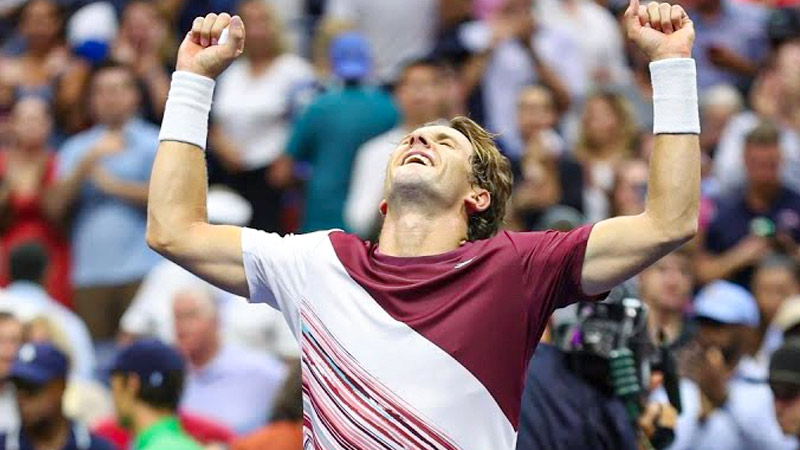
The landscape of professional tennis is often dominated by a select few individuals who redefine the limits of athleticism and precision.
Among these elite competitors, Casper Ruud stands as a paragon of consistency, technical discipline, and surface mastery.
Once ascending to the position of World No. 2 in September 2022, Ruud has carved out a distinct legacy that balances a traditional clay-court pedigree with a modern, high-percentage approach to the game.
To understand the true caliber of his talent, one must look beyond the basic scorelines and examine the tactical architecture of his play and his evolution on the global stage.
The Statistical Landscape: A Career Defined by Excellence
When evaluating the quality of a top-tier professional, the primary metrics are titles and longevity. Ruud’s resume is characterized by a remarkable efficiency in securing tournament victories. To date, he has secured 14 ATP singles titles, a feat that places him in an elite bracket of active players.
A deeper analysis of these victories reveals a significant specialization. Twelve of these titles were earned on clay courts, reinforcing his reputation as a premier force on the red dirt.
This surface demands a specific brand of physical endurance and tactical patience, qualities that Ruud possesses in abundance. However, it would be a reductive analysis to label him exclusively as a specialist.
His two titles on hard courts, coupled with his appearance in the US Open final, demonstrate a versatile baseline game that can be weaponized across different environments.
His performance in Grand Slam tournaments further validates his standing. Reaching multiple major finals—most notably at the French Open and the US Open—proves that he can maintain a high level of performance over the grueling two-week format required at the sport’s highest level.
The Anatomy of a Playing Style: Technical Mastery
The “Ruud Blueprint” is built upon a foundation of baseline consistency and high-percentage tennis.
Unlike players who rely on erratic bursts of power, Ruud employs a strategic approach designed to minimize unforced errors while gradually dismantling his opponent’s defenses.
The Heavy Forehand: A Primary Weapon
The centerpiece of Ruud’s technical arsenal is his heavy forehand. This shot is not merely a tool for transition; it is a definitive weapon that dictates the terms of engagement.
By generating massive topspin and finding sharp angles, Ruud is able to force opponents deep behind the baseline or wide into the alleys.
This high-rotation forehand is particularly effective on slow, high-bouncing clay surfaces, where the ball “kicks” after the bounce, making it difficult for opponents to time their returns or find a comfortable strike zone.
By consistently landing deep groundstrokes, he creates a territorial advantage that allows him to control the center of the court.
Rally Tolerance and Strategic Patience
Ruud’s effectiveness is also rooted in his solid baseline play. He operates as a high-percentage player, relying on rally tolerance rather than attempting low-probability winners early in a point.
This disciplined style of play often induces fatigue and frustration in opponents, who find themselves forced to play “just one more ball” in every exchange.
Navigating the Surface Spectrum: Beyond the Clay
The transition from a “clay specialist” to a multi-surface threat is a journey few players successfully complete. Ruud’s career trajectory shows a concerted effort to adapt his heavy topspin game to the faster requirements of hard courts.
- Clay Court Dominance: The clay surface is where Ruud finds his highest win rate and maximum comfort. The extra time afforded by the slower surface allows him to set up his forehand and utilize his superior lateral movement to defend the court.
- Hard Court Breakthroughs: His success at the US Open was a pivotal moment in his career. It proved that his baseline resilience and heavy rotation could be adjusted for the quicker bounce of a hard court, allowing him to compete with the world’s best on their preferred surfaces.
- The Grass Court Challenge: Despite his versatility, the transition to grass remains a significant hurdle. Historically, Ruud has struggled to find form on grass courts, where the low bounce and extreme speed of the surface neutralize his heavy topspin and favor a more aggressive, serve-oriented style of play.
Identifying the Competitive Ceiling: The Elite Barrier
To reach the pinnacle of the sport and secure a Grand Slam title, a player must be able to defeat the “absolute elite”—the powerhouse players who combine raw speed with overwhelming power. This is the area where public and professional opinion on Ruud remains divided.
The Serve Dynamic
One of the primary critiques of Ruud’s game is the lack of a dominant, short-point serve. In modern tennis, a powerful serve acts as a “safety net,” allowing a player to hold service games quickly and conserve energy for return games.
Against elite opponents like Carlos Alcaraz or Jannik Sinner, who are exceptional returners, the absence of an “unreturnable” serve places a higher physical burden on Ruud.
He is often forced to engage in long, taxing rallies on his own serve, which can lead to a deficit in energy over a best-of-five major tournament.
Best-of-Five Challenges
In the context of Grand Slam events, the margins for error become razor-thin. While Ruud’s consistency is a major asset in standard tour events, critics suggest that he may lack the “extra gear” of raw power needed to overwhelm top-tier opponents in the later stages of a major. This has led to mixed perceptions on tennis forums regarding his ultimate “ceiling” as a competitor.
Professional Evolution: Ranking vs. Quality
A fascinating aspect of Ruud’s current career phase is his own self-assessment. Despite currently sitting lower in the rankings than his career-high of No. 2, Ruud has stated that he believes he is a better player now than he was during that peak in 2022.
This suggests a process of professional maturation. A player’s quality is not always reflected by a fluctuating ranking point system. Instead, it is found in their tactical depth, their ability to handle pressure, and their physical conditioning.
By Ruud’s own metric, his game has evolved, becoming more sophisticated and better prepared for the demands of the modern tour.
The Legacy of Consistency
In a sport that often prioritizes highlights and viral power shots, Casper Ruud represents the triumph of professionalism and process. He is a player who has maximized his natural talents through rigorous training and tactical discipline.
His contribution to the sport is undeniable:
- Norwegian Pioneer: He has placed Norway on the global tennis map, achieving milestones previously unseen in his nation’s history.
- Model of Consistency: His 14 titles and multiple Grand Slam finals are a testament to a level of reliability that few can match.
- Technical Reference: For aspiring players, Ruud is a masterclass in how to use topspin and court positioning to control a match.
Conclusion
Casper Ruud is undeniably a top-tier professional whose career is defined by a rare blend of humility and high-level execution.
Whether he is dominating a clay-court draw with his heavy forehand or grinding out a win on a hard court through sheer baseline resilience, he remains one of the most difficult opponents to face on the ATP tour.
While the debate regarding his “ceiling” against the game’s absolute powerhouses will likely continue, his record of 14 titles and a peak ranking of No. 2 speaks for itself.
Ruud is not a player who relies on luck or favorable draws; he is a player who has built a career on the back of exceptional consistency and tactical intelligence.
As he continues to refine his game, he remains a formidable contender for any title, proving that in the world of professional tennis, disciplined process is just as valuable as raw power.