The search for reliable bench depth is a perennial challenge for Major League Baseball front offices.
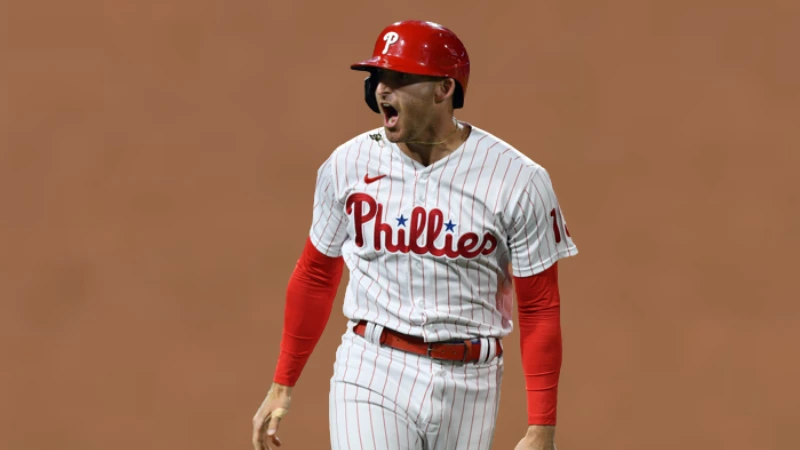
For the Philadelphia Phillies, this search led to the acquisition of Brad Miller, a versatile veteran whose journey to the City of Brotherly Love involved a mix of opportunistic trades and calculated free-agent signings.
Understanding how the Phillies “got” Brad Miller requires looking at two distinct periods: his initial arrival via a minor-league trade in 2019 and his return as an established free agent in 2021.
The 2019 Acquisition: A “Cash Considerations” Masterstroke
The story of Brad Miller becoming a Phillie began in the early summer of 2019. At the time, the Phillies’ front office was identifies a critical need to bolster bench depth.
The team was looking for a specific profile: a left-handed bat who possessed the defensive flexibility to play multiple positions, allowing the manager more tactical freedom during the middle and late innings of games.
The Path Through the American League
Before landing in Philadelphia, Miller’s 2019 season was a whirlwind of transactions. According to the sources, Miller began the year with the Cleveland Indians, but he was eventually designated for assignment (DFA) by the club.
(Information not from the sources: In MLB terms, a DFA is a roster move where a player is removed from the 40-man roster. The team then has seven days to trade the player or place him on waivers. This often signals that a team no longer sees a fit for the player on their active roster, making them available to other clubs for a relatively low cost.)
Following his departure from Cleveland, Miller found himself in the New York Yankees organization. While he did not immediately crack the Yankees’ major league roster, he was performing at an elite level for their Triple-A affiliate, the Scranton/Wilkes-Barre RailRiders.
At the time the Phillies came calling, Miller was “hitting the cover off the ball,” posting a .294 batting average with 10 home runs and 29 RBIs in just 41 games.
The June 13 Trade
On June 13, 2019, the Phillies officially acquired Miller from the Yankees. The cost of the acquisition was cash considerations. In the world of professional baseball, a “cash considerations” trade typically involves one team paying the other a pre-determined amount of money rather than exchanging players.
Because Miller was currently in the minor leagues for the Yankees and had previously been DFA’d by Cleveland, the Phillies were able to buy low on a player who was clearly finding his rhythm at the plate.
Analyzing the “Why”: Bench Production and Versatility
The sources highlight that the primary motivation for this trade was a struggling bench. In the National League (prior to the universal designated hitter), bench players were vital for pinch-hitting roles and defensive substitutions.
Key attributes Miller brought to the Phillies:
Left-Handed Power
The ability to provide a power threat from the left side of the plate is a luxury for any manager, especially when facing right-handed relief pitching.
Defensive Flexibility
By being capable of playing multiple positions, Miller acted as a “safety net” for the starting lineup.
Whether the team needed a spot start at third base, second base, or in the outfield, Miller’s versatility ensured the Phillies didn’t have to carry extra specialized players.
Veteran Presence
(Note: This is an insight not found in the sources) Teams often value “journeyman” utility players for their ability to stay “warm” despite irregular playing time—a skill that is difficult for younger players to master.
The 2021 Reunion: Addressing the Bench Crisis (Again)
While Miller’s 2019 stint was productive, his tenure with the Phillies was not continuous. He spent the 2020 season with the St. Louis Cardinals. However, the Phillies’ bench issues persisted into the following year.
The Free Agency Signing
In February 2021, the Phillies decided to bring Miller back into the fold, this time via the free-agent market rather than a trade. The team signed him to a one-year, $3.5 million contract.
The logic behind the 2021 signing was identical to the 2019 trade: the Phillies needed to improve the team’s bench production, which the sources note was “struggling at the time”. By committing $3.5 million, the Phillies were banking on Miller’s proven track record as a high-utility player who could provide immediate offensive impact.
The Mechanics of the Transaction (Outside Perspective)
During this era, the “Three True Outcomes” (home runs, walks, and strikeouts) were at an all-time high. A player like Miller, who showed significant power in Triple-A (10 HRs in 41 games), was highly valued because he could change the score with a single swing.
Furthermore, the Phillies’ acquisition of Miller from the Yankees’ Triple-A team in Scranton was geographically convenient.
Scranton is a short drive from Philadelphia, allowing Miller to join the active roster almost immediately after the June 13 trade was finalized.
This “shuttle” between local affiliates and the big-league club is a common strategy for East Coast teams looking for quick roster fixes.
Conclusion: The Utility Man as a Solution
The Phillies’ acquisition of Brad Miller serves as a textbook example of how a Major League team uses different acquisition channels—trades for cash and short-term free-agent contracts—to patch holes in their roster.
By targeting a player with multi-positional capability and a strong left-handed bat, the Phillies were able to address their struggling bench production effectively. Miller wasn’t just a “fill-in”; he was a targeted solution for a team that needed versatility and power.
His journey from being designated for assignment in Cleveland to becoming a multi-million dollar contributor in Philadelphia highlights the value of the modern MLB utility player.
Through opportunistic scouting and a willingness to spend on proven veteran depth, the Phillies ensured they had the “left-handed bat” necessary to compete in the National League.