In the high-stakes landscape of Major League Baseball, the margin between a career-defining breakout and a season-altering setback is often razor-thin.
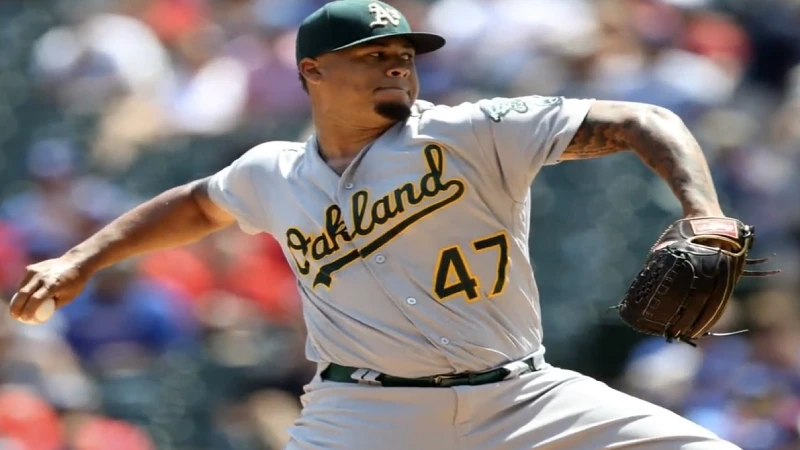
For the Oakland Athletics and their burgeoning ace, Frankie Montas, this reality became a stark lesson in June 2019.
The suspension of Montas serves as a critical case study in the rigorous enforcement of the league’s drug policies and the organizational resilience required to navigate the loss of a top-tier performer.
The Atmospheric Shift: From Victory to Violation
The Oakland Athletics’ clubhouse was a place of high energy on the night of Thursday, June 20, 2019. The team had just secured a dramatic 5-4 walk-off victory against the Tampa Bay Rays, a win punctuated by the exuberance of a roster that felt its postseason momentum building.
However, this celebratory environment was short-lived. By the following Friday afternoon, a somber mood had replaced the previous night’s excitement.
The Office of the Commissioner of Baseball made a definitive announcement that Friday: Frankie Montas, the 26-year-old right-hander who had become the linchpin of the Oakland rotation, was suspended for 80 games without pay.
This discipline was the result of a positive test for Ostarine, a substance explicitly prohibited under Major League Baseball’s Joint Drug Prevention and Treatment Program.
The suspension was effective immediately, ending Montas’ regular-season contributions and fundamentally altering the trajectory of the Athletics’ summer campaign.
Analysis of a Breakout Interrupted
To understand the magnitude of this suspension, one must examine the professional ascent Montas was experiencing at the time of the violation.
Having transitioned through multiple organizations early in his career, Montas appeared to have finally found his rhythm in Oakland.
His 2019 campaign was not merely good; it was statistically elite. At the time the suspension was handed down, he boasted a 9-2 record with a 2.70 ERA.
His efficiency on the mound was underscored by 97 strikeouts against only 21 walks across 90 innings of work.
Perhaps most telling of his value was his 2.9 Wins Above Replacement (WAR), as calculated by FanGraphs, which ranked him as the fourth-best qualified starter in the entire league.
He was widely considered a legitimate candidate for the All-Star Game and was the undisputed leader of the Oakland pitching staff.
The suspension did more than just sideline a player; it removed a top-five pitcher from a team actively fighting for a playoff berth.
The Substance and the Defense: Unpacking Ostarine
The catalyst for the suspension was Ostarine, a banned performance-enhancing substance. Following the positive test, Montas provided an explanation that has become a recurring theme in professional sports: the unintentional ingestion of a contaminated supplement. In a statement released through the MLB Players Association, Montas expressed deep sadness over the results.
Montas asserted that he never intended to consume a prohibited substance. His defense centered on an over-the-counter supplement purchased at a nutrition store within the United States, which he claimed was contaminated.
While reports indicated that his argument was viewed as credible, the strict liability nature of the Joint Drug Agreement remains an unforgiving standard for professional athletes.
Under these rules, players are ultimately responsible for what enters their bodies, regardless of intent or the source of the contamination.
Faced with the evidence and the protocol of the Joint Drug Agreement, Montas opted to waive his right to an appeal.
Though he had initially engaged in an unsuccessful appeal process before the news went public, he eventually accepted the standard 80-game penalty for a first-time violation.
His statement emphasized a respect for the rules and an acceptance of full responsibility for the mistake, accompanied by an apology to the organization, his teammates, and the fans.
Strategic Impact: The Cost to the Athletics
The timing of the suspension placed the Oakland Athletics in a precarious strategic position. At 40-37, the team sat just two games behind the Boston Red Sox for the second American League wild-card spot.
Losing a pitcher of Montas’ caliber created an immediate void in a rotation that had relied on his consistency to stay competitive in a crowded division.
One of the most significant aspects of the penalty was the postseason disqualification. Under MLB rules, any player suspended for a PED violation during the season is ineligible to participate in the playoffs that same year.
This meant that even if the Athletics successfully navigated the regular season without their ace, they would be forced to face elite October lineups without the man who had been their most effective weapon on the mound.
General Manager David Forst and Manager Bob Melvin were tasked with managing both the emotional and tactical fallout of the news. Melvin noted that the suspension was a “shock to everybody,” but he appreciated the remorse Montas showed when addressing the team.
Forst expressed disappointment on multiple levels—personally for the player and professionally for a team that had worked through a difficult first half to put themselves in a position to win.
Organizational Resilience: The “Next Man Up” Philosophy
The Oakland Athletics have long cultivated a culture of internal depth and adaptability. In the wake of the Montas suspension, David Forst leaned into this organizational identity, citing a “next man up” motto that had served the club well in previous seasons.
The task was to replace elite production with a combination of emerging prospects and returning veterans.
Immediately following the announcement, the team recalled right-hander J.B. Wendelken from Triple-A Las Vegas to fill the roster spot.
However, replacing a starter required a more comprehensive plan. The organization looked toward its high-ceiling prospects and its injured reserve list for long-term solutions:
- Jesus Luzardo: The team’s top prospect was a primary candidate for the rotation. Though he had missed the start of the season with a shoulder injury, he was scheduled to begin a Triple-A assignment with the goal of building his pitch count to 100.
- A.J. Puk: Another dynamic left-hander, Puk was in the process of rebuilding his arm strength at the High-A level following Tommy John surgery. His power pitching profile offered a potential high-impact replacement if his recovery remained on track.
- Sean Manaea: The veteran lefty, who had been the staff ace in 2018, was nearing the end of a long recovery from shoulder surgery. Manaea had recently completed a successful 60-pitch simulated game and was preparing for a minor league rehab assignment. He remained optimistic about returning to the big league roster shortly after the All-Star break.
- Internal Rotation Shifts: The team also considered moving Aaron Brooks back into a starting role or utilizing Triple-A starters like Daniel Mengden and Paul Blackburn, both of whom had previous experience with the major league club.
The Long-Term Perspective on Professional Conduct
The Frankie Montas suspension is a reminder of the fragility of professional success and the absolute necessity of diligence in an era of strict athletic regulation.
For Montas, the 80-game ban resulted in significant lost wages and the loss of what likely would have been his first All-Star selection. It also cast a shadow over a “breakout” season that had otherwise been a testament to his growth as a pitcher.
For the Athletics, the situation tested the strength of their “next man up” philosophy. The organization chose to support the league’s drug prevention program while also maintaining a path for Montas to return once his discipline was served.
Management’s focus shifted toward supporting the remaining 24 men on the roster, emphasizing that the team’s postseason goals remained unchanged despite the loss of their primary starter.
Ultimately, the event highlights the complex intersection of individual responsibility and team dynamics. As Montas looked toward a return in late September, the Athletics were forced to prove that their success was built on a foundation deeper than a single player.
The suspension remains a pivotal moment in the 2019 MLB season, serving as both a cautionary tale for athletes regarding over-the-counter supplements and a showcase of how a professional organization manages an unexpected crisis in the heat of a playoff race.