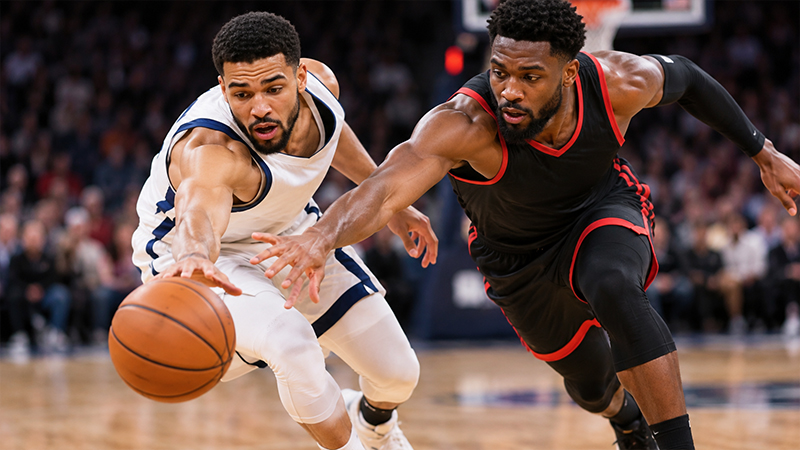
In the high-stakes environment of competitive basketball, the box score serves as a diagnostic tool for performance. While casual observers often gravitate toward shooting percentages or individual scoring totals, seasoned tacticians look elsewhere.
They focus on the turnover column because, unlike many statistics that are influenced by the caliber of the opponent, turnovers provide a clear, unfiltered indication of a team’s fundamental execution and discipline.
A turnover represents a critical failure in the offensive sequence: it is the loss of possession before a shot is even attempted.
For a coach, a turnover is more than a missed opportunity; it is a “lost possession” that prevents a team from ever realizing its offensive potential during that trip down the court.
To master the game, players and coaches must understand the mechanics of these errors, categorize their impact, and implement rigorous training protocols to ensure ball security.
The Fundamental Framework: Defining the Turnover
At its core, a turnover occurs whenever the offensive team cedes the ball to the opposition before a field goal attempt or a trip to the free-throw line.
This shift in possession can be attributed to three primary factors: a defensive steal, an unforced error such as an errant pass, or a technical violation of the rules.
In the official record, turnovers are tracked as both team and individual statistics. This dual tracking highlights the collaborative nature of basketball; while one player might physically lose the ball, the error often stems from poor spacing, lack of movement, or a failure in team communication.
The immediate penalty for any turnover is a change in possession, allowing the opposing team a fresh opportunity to score.
Categorization of Errors: Live-Ball vs. Dead-Ball
To address the root causes of turnovers, they must first be categorized by how play continues—or stops—immediately following the error. This distinction is vital because the strategic consequences of each type differ significantly.
1. Live-Ball Turnovers: The Transition Threat
Live-ball turnovers are arguably the most damaging to a team’s defensive integrity. These occur during active play, meaning the whistle does not blow, and the defense gains immediate possession with the ability to transition into an offensive attack.
- Steals: These are perhaps the most recognizable live-ball errors. A defender may legally intercept a pass or physically take the ball from an offensive player’s dribble.
- Bad Passes: When a pass intended for a teammate is intercepted by an opponent or thrown directly to them, it constitutes a live-ball turnover.
- Lost Balls: Often the result of a “fumble,” these occur when a player loses control of the ball while driving to the basket or executing a move, allowing the defense to recover the loose ball.
The danger of the live-ball turnover lies in the “immediate chance to score” it provides the opponent. Because the defense is already in motion and the offense is often caught out of position while trying to score, live-ball turnovers frequently lead to high-percentage fast-break opportunities.
2. Dead-Ball Turnovers: The Procedural Halt
Dead-ball turnovers occur when an illegal action triggers a referee’s whistle, stopping the clock and play. While they still result in a loss of possession, they allow the defense to set their half-court alignment because the ball must be thrown in from the sideline or baseline.
- Rule Violations: This includes common infractions such as traveling (taking too many steps without a dribble), double dribbling (starting a second dribble after stopping), or carrying.
- Time Violations: Basketball is governed by strict temporal constraints. Failing to advance the ball past half-court within the allotted time, three-second lane violations, or failing to release a shot before the shot clock expires are all dead-ball turnovers.
- Offensive Fouls: If an offensive player commits an illegal act against a defender—such as charging or setting an illegal screen—the ball is awarded to the defense.
While dead-ball turnovers prevent the “fast-break” scoring associated with live-ball errors, they remain “a certain recipe for disaster” because they eliminate a team’s chance to put points on the board during that possession.
Analyzing the Root Causes: Why Turnovers Occur
Understanding why players lose the ball is the first step toward remediation. Most player errors can be traced back to two specific areas of technical proficiency: dribbling and passing.
Dribbling Vulnerabilities
Many turnovers are the result of poor dribbling mechanics or fumbles during high-speed drives. A common weakness is an over-reliance on a dominant hand.
If a player cannot drive or handle pressure with their weak hand, defenders can “sit” on the dominant side, forcing the player into uncomfortable situations that lead to steals or fumbles.
Furthermore, stationary dribbling skills often fail to translate to game scenarios where a live defender is applying pressure and disrupting the player’s rhythm.
Passing Deficiencies
Errant throws and intercepted passes are frequently the product of poor decision-making under pressure.
Without the ability to read a defense or utilize techniques like the pass fake, players often telegraph their intentions, making it easy for defenders to jump the passing lane.
Strategic Solutions: Coaching and Training for Ball Security
The most effective way to reduce turnovers is through intentional, high-pressure practice environments. Coaches must move beyond traditional, low-intensity drills to prepare players for the realities of the game.
Weak-Hand Development and Live Dribbling
To cut down on dribbling-related turnovers, players must develop their non-dominant hand so they can drive in either direction with equal confidence. However, skill development should not stop at stationary work.
To ensure these skills translate to game success, players must practice dribbling against active defenders. Engaging in 1-on-1 drills is an excellent method for exposing ball-handling weaknesses in a controlled environment, forcing players to protect the ball while navigating defensive pressure.
Realistic Passing Environments
Much like dribbling, passing must be practiced against live opposition. While partner passing is useful for teaching basic mechanics, it does not prepare a player for the timing and angles required in a game.
By incorporating defenders into passing drills, players naturally learn the necessity of the pass fake—a tool that is difficult to value without a defender present to react to it.
The Power of Overloaded Drills
One of the most effective strategies for fostering composure is the use of “overloaded drills.” In these scenarios, the offense is forced to score against a defense that has more players on the floor (e.g., a 4-on-5 or 2-on-3 situation).
This artificial pressure forces the offense to:
- Move constantly to find open space.
- Execute crisp, accurate passes with perfect timing.
- Use the dribble effectively to escape traps or improve passing angles.
By creating practice situations that are more difficult than those found in an actual game, players become more confident and remain composed when facing tough, high-pressure defensive schemes.
The Analytical Edge: Why the Turnover Stat Matters
In the modern game, efficiency is the ultimate goal. Every possession has a theoretical “expected point value.” A turnover reduces that value to zero. This is why many coaches prioritize the turnover column over shooting percentages.
A team can be shooting exceptionally well, but if they are turning the ball over 20 times a game, they are voluntarily giving up 20 opportunities to score while simultaneously providing the opponent with extra possessions.
Furthermore, turnovers have a psychological impact. Frequent errors can lead to a loss of team rhythm, frustration among teammates, and a breakdown in defensive focus.
Conversely, a team that values the ball and executes with precision often forces the opponent into a state of fatigue and desperation.
Frequently Asked Questions (FAQ)
What is the most common turnover in basketball?
While it varies by level of play, violations such as traveling and player errors like bad passes or lost balls are among the most frequent.
Does a shot clock violation count as a turnover?
Yes. A shot clock violation is a dead-ball turnover because the offensive team failed to attempt a shot within the regulated timeframe, resulting in a loss of possession.
Are all steals considered turnovers?
From the perspective of the offensive player who lost the ball, yes. A steal is a live-ball turnover that immediately shifts possession to the defense.
Can a team eliminate turnovers?
It is virtually impossible to eliminate them due to the speed and physical nature of the game. However, through disciplined training and focusing on fundamentals like weak-hand development and pass fakes, they can be minimized significantly.
Conclusion: The Path to Offensive Efficiency
There is arguably no greater detriment to an offensive unit than a turnover. Whether caused by a technical violation or a skill-based error, the result remains the same: a lost opportunity to score and a potential momentum shift for the opponent.
While perfection is unattainable, excellence in ball security is a choice. By prioritizing live-action drills, developing bilateral handling skills, and training under overloaded conditions, teams can build the composure necessary to thrive under pressure.
The teams that master the art of possession are the ones that ultimately control the outcome of the game. Minimizing turnovers is not just about avoiding mistakes; it is about maximizing every opportunity to win.