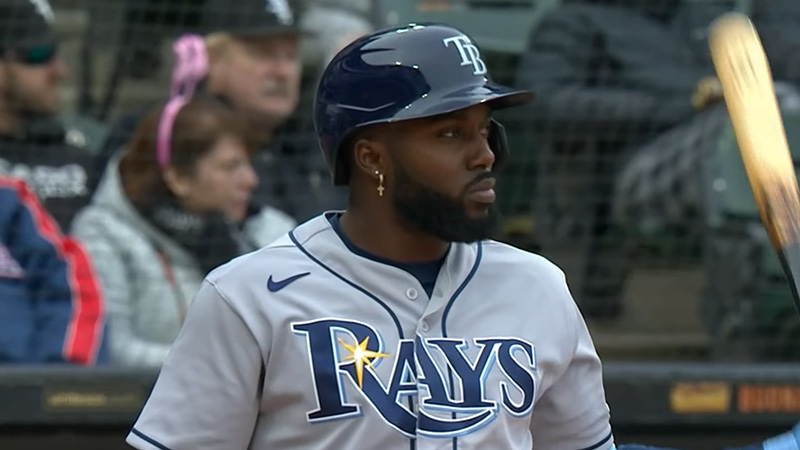
Randy Arozarena chose Mexico out of gratitude. The country took him in after he left Cuba in 2015, gave him his first professional paycheck, and became home to his daughter and many of his closest friends.
If you watched the 2023 World Baseball Classic, you remember the image. Arozarena stood in the outfield in a green Mexico jersey, arms folded across his chest, staring into the crowd after yet another big play.
Fans in Mexico adopted that pose almost overnight. To many casual viewers, though, one question followed right behind it: why was a Cuban-born star playing for Mexico at all?
The short answer is gratitude. The longer answer is a story about a dangerous crossing, a second chance, a family rooted in Mexican soil, and a public campaign for citizenship that reached the country’s president.
The Journey at a Glance
Arozarena’s path from Cuba to Team Mexico took about eight years, from his 2015 departure to his 2023 World Baseball Classic debut.
| Year | Milestone |
|---|---|
| 2015 | Leaves Cuba by boat and reaches Mexico |
| 2016 | Plays professionally in Mexico, then signs with the St. Louis Cardinals |
| 2020 | Traded to the Tampa Bay Rays; sets a single-postseason record with 10 home runs |
| 2021 | Wins American League Rookie of the Year; asks Mexico’s president on Instagram for help with citizenship |
| 2022 | Receives Mexican citizenship in April |
| 2023 | Debuts for Mexico at the World Baseball Classic as the team reaches the semifinals |
| 2026 | Represents Mexico again at the World Baseball Classic |
From Cuba to Mexico: The 2015 Crossing
Arozarena’s story with Mexico began in 2015, when he left Cuba by boat to chase a professional career he could not build at home. For Cuban players of that era, leaving the island was often the only route to Major League Baseball, and it came with real danger and real sacrifice.
He grew up in Cuba playing baseball, but the system there offered limited pay and almost no access to the major leagues. Players who wanted more usually had to defect, cut ties with the national program, and accept that returning home could be complicated for years.
The crossing itself is the kind of risk most athletes never face. Many Cuban players who took this route described rough water, uncertain arrivals, and long stretches of waiting before they could sign anywhere. When Arozarena reached Mexico, he arrived with talent and determination, but little else.
That is the first key to understanding his choice. Mexico was not a country he visited on a road trip or a place he picked on paper. It was the place that opened its doors when he had nowhere else to go.
Mexico as a Career Launchpad
Mexico gave Arozarena his first stage as a professional. In 2016 he played in Mexican baseball, including a stint with the Toros de Tijuana, and that exposure led the St. Louis Cardinals to sign him later that year for a reported $1.25 million.
Those months in Mexico mattered more than a typical minor stop. Scouts got to see him against experienced professionals, he adjusted to a new style of play, and he proved he belonged outside Cuba.
Without that platform, his path to a major league contract would have been slower and far less certain.
What followed is well known to baseball fans:
- Cardinals system (2016 to 2019): He climbed through the minors and reached the majors in 2019.
- Tampa Bay breakout (2020): After a January trade to the Rays, he hit 10 home runs in the 2020 postseason, a record for a single postseason, and was named ALCS MVP.
- Rookie of the Year (2021): He won the American League award and became one of the faces of the sport.
- Seattle (2024 onward): A midseason trade in 2024 sent him to the Mariners.
Arozarena has never treated that success as separate from Mexico. In his telling, Mexico is where the professional version of Randy Arozarena was born, and representing the country is a way of honoring that starting point.
Family First: A Daughter, a Home, and Lasting Friendships
The most personal reason behind Arozarena’s choice is his family. He has said he wanted to represent Mexico in honor of his daughter, who lives there, along with the friends he made and the part of his career he spent in the country.
That detail changes how the decision reads. For Arozarena, wearing Mexico’s jersey is not a flag of convenience. It is the national team of his child’s home, and the team she can grow up watching him play for.
Fans have picked up on this, too. Across baseball discussion boards, the common view is that his commitment reflects real appreciation for Mexico welcoming him, and a wish for his Mexican children to see their father play for their home country.
Friendships carry weight as well. Players who move countries often lean on teammates, coaches, and neighbors who help them adjust to new slang, new food, and a new routine.
The people who did that for Arozarena in Mexico became part of his story, and he has named those friendships as one reason for his choice.
The Citizenship Campaign: An Instagram Plea to the President
Arozarena did not wait quietly for paperwork. In 2021 he posted a public message on Instagram asking then-President Andrés Manuel López Obrador for help becoming a Mexican citizen, so he could play for Mexico in the World Baseball Classic.
That move tells you how much the decision meant to him. Most athletes handle eligibility through agents and federations, out of public view.
Arozarena put his request in front of his fans and the country’s highest office, in the same year he became a household name.
The effort worked. He officially received Mexican citizenship in April 2022, which made him eligible for Team Mexico starting with the 2023 World Baseball Classic.
The timing matters here. By the spring of 2022 he was already an established big league star with options and a growing profile. He did not need a national team to raise his status. He pursued citizenship because he wanted the connection to be official, not just emotional.
Why Not Cuba?
A natural question is why Arozarena did not wait to play for the country where he was born. The answer comes down to history, politics, and personal loyalty.
For decades, Cuba’s baseball federation kept players who left the island off its national team. Defecting meant giving up the chance to wear the Cuban uniform in international play.
That policy began to soften ahead of the 2023 World Baseball Classic, when Cuba included a few major leaguers who had left, such as Yoán Moncada and Luis Robert Jr.
By then, Arozarena had already made his decision public and secured his Mexican citizenship. His bond with Mexico was built during the hardest years of his life, and that kind of loyalty does not switch because a door opens somewhere else.
World Baseball Classic rules also give players flexibility. Eligibility can come from citizenship, birthplace, or family heritage, which is why many players have more than one option. Arozarena used that flexibility not to chase the strongest roster, but to stand with the country that stood with him.
The Payoff: Arozarena on the World Baseball Classic Stage
Arozarena’s first tournament for Mexico, the 2023 World Baseball Classic, became the best run in the country’s history at the event. Mexico reached the semifinals for the first time, and he was one of the main reasons why.
Highlights from that run included:
- A statement win over the United States in pool play, 11 to 5.
- A comeback quarterfinal victory over Puerto Rico, 5 to 4, that sent Mexico to the final four.
- A thrilling semifinal against Japan, lost 6 to 5 on a walk-off double, in which Arozarena made a leaping catch at the wall.
- A spot on the All-WBC Team, recognizing him as one of the tournament’s standout players.
The folded-arms pose turned into a cultural moment. Mexican fans copied it in the stands and online, and it came to stand for confidence and pride in the national team.
He then returned for the 2026 World Baseball Classic, showing that his commitment was not a one-time gesture. Each appearance reinforces the same message: Mexico is his team for the long run.
What His Choice Says About Baseball Identity Today
Arozarena’s decision shows that national identity in modern baseball is often built, not just inherited. Birthplace still matters, but so do the places that shape a player’s life.
The World Baseball Classic has made this more visible than ever. Rosters now include players representing the country of a parent or a grandparent, or, as in Arozarena’s case, the country that gave them a second start. Fans have largely embraced these stories because they are honest about how real lives work.
For Mexico, his choice carries extra weight:
- Star power: A Rookie of the Year and postseason record holder raises the team’s profile worldwide.
- Inspiration for young players: Kids in Mexico see a star who chose them, which strengthens interest in the sport at home.
- A model of gratitude: His story reminds fans that loyalty can be earned through how a country treats people when they need it most.
For readers trying to make sense of it all, the takeaway is simple. Arozarena did not reject Cuba. He embraced the country that became his home, his career base, and his family’s foundation.
Final Thoughts: A Choice Made From the Heart
Randy Arozarena chose Mexico because Mexico chose him first. It gave him refuge after he left Cuba in 2015, launched his professional career in 2016, became home to his daughter and close friends, and granted him citizenship in April 2022.
Every step he took afterward, from the public appeal to the president to the folded arms in the outfield, points to the same conclusion.
This was never a calculated move for a better roster. It was a thank-you, delivered on the biggest international stage baseball has.