Randy Arozarena turned 2026 into the best season of his career. Playing left field for the Seattle Mariners, he hit .281 with a .381 on-base percentage, 26 home runs, 26 stolen bases, and an American League-leading 113 runs scored.
That production earned him his first AL Silver Slugger Award and his third career All-Star selection.
Then he made the biggest business decision of his career. In November 2026, Arozarena turned down Seattle’s one-year, $23.15 million qualifying offer and stepped into free agency as one of the most intriguing outfielders on the market.
If you have only followed him casually, those headlines are just the latest chapter. His path runs from a 2015 defection from Cuba, through a record-setting October in 2020, a Rookie of the Year Award, a midseason trade to Seattle, and a starring role for Mexico on the international stage. Here is the full story of what he did, why it matters, and what could come next.
Randy Arozarena’s 2026 Season by the Numbers
Arozarena’s 2026 campaign stood out because it combined durability, discipline, power, and speed in one package. He appeared in 154 games, which meant Seattle could pencil him into the lineup almost every day.
| Category | 2026 total |
|---|---|
| Games played | 154 |
| Batting average | .281 |
| On-base percentage | .381 |
| Slugging percentage | .484 |
| Home runs | 26 |
| RBIs | 79 |
| Stolen bases | 26 |
| Runs scored | 113 (led the AL) |
Three numbers deserve a closer look:
- The .381 on-base percentage. Reaching base nearly four times in every ten trips to the plate is elite territory for a corner outfielder. It also explains the next number.
- The 113 runs scored. Leading the American League in runs takes two things: getting on base constantly and running aggressively once there. Arozarena did both, turning walks and singles into scoring chances with his legs.
- The 26-26 line. Matching his home run and stolen base totals made 2026 his sixth straight season with at least 20 of each. Very few players can point to that kind of consistent power-speed production over such a long stretch.
Why His First Silver Slugger Award Matters
The Silver Slugger honors the best offensive players at each position in each league, as voted by managers and coaches. Winning one in November 2026 placed Arozarena among the American League’s top-hitting outfielders for the season.
The timing makes it even more meaningful. Arozarena had been known as a dangerous all-around player for years, yet this was the first time he collected the league’s top offensive honor at his position.
Earning it in a contract year handed him powerful evidence for free agency: his bat did not just hold steady into his 30s, it reached a new peak.
For Seattle, the award confirmed exactly what the July 2024 trade was meant to deliver. The Mariners wanted a top-of-the-order presence who could change a game with one swing or one stolen base, and that is what they got.
Why He Turned Down Seattle’s $23.15 Million Qualifying Offer
Arozarena declined the offer because he is betting the open market will value him more than a single guaranteed season. That is the core logic behind most rejected qualifying offers.
A qualifying offer is a one-year contract a team can extend to an eligible free agent. Its value is set each year from the average salary of baseball’s top earners, which is how this offseason’s figure landed at $23.15 million.
A player who accepts gets that salary for one year; a player who declines becomes a free agent, and his former club becomes eligible for draft-pick compensation if he signs elsewhere.
For Arozarena, the math favored saying no for three reasons:
- Long-term security. A one-year deal would have sent him back to free agency a year older. A multi-year contract now could lock in guaranteed money through the rest of his prime.
- Peak leverage. He is coming off a career year, a Silver Slugger, and an All-Star appearance. His market value will rarely be clearer than it is right now.
- A one-time tag. Under the rules in place for this offseason, a player can receive a qualifying offer only once in his career. Any future trip to free agency would come without draft-pick strings attached.
There is a trade-off. Clubs that sign a player who rejected a qualifying offer typically give up draft capital, which can cool interest from some teams. Even so, Arozarena’s decision signals confidence that his production will outweigh that hurdle.
From Cuba to the Major Leagues
Arozarena’s rise is one of baseball’s most remarkable journeys. Born in Cuba, he left the island in 2015 and made his way to Mexico, where he kept playing and kept chasing a professional opportunity with no guarantee it would come.
That chance arrived in 2016, when the St. Louis Cardinals signed him. He worked his way through their minor league system and made his MLB debut in 2019, getting a brief first taste of the big leagues.
Before the 2020 season, St. Louis traded him to the Tampa Bay Rays. At the time, the move drew modest attention. Within months, it would look like one of the most consequential trades of the decade.
October 2020: The Postseason That Made Him a Star
Arozarena’s breakout came on baseball’s biggest stage. In the 2020 postseason, he hit 10 home runs, setting the MLB record for a single postseason, and piled up 29 hits along the way.
His power carried Tampa Bay through the American League bracket. He was named ALCS MVP after the Rays beat the Houston Astros in seven games, and Tampa Bay advanced to the World Series, where it fell to the Los Angeles Dodgers.
What made the run so striking was its timing. He was still technically a rookie, with only a few dozen regular-season MLB games behind him.
Few players have ever introduced themselves to a national audience so forcefully, and October 2020 remains the moment most fans picture when they hear his name.
Rookie of the Year and the 20-20 Standard
Because his 2020 regular-season playing time stayed under the rookie limits, Arozarena entered 2021 still eligible for rookie honors. He made the most of it, winning the American League Rookie of the Year Award.
That 2021 season also launched the streak that now defines his career. He reached at least 20 home runs and 20 stolen bases, then did it again in 2022, 2023, 2024, 2025, and 2026.
Six straight 20-20 seasons speak to more than talent; they point to durability, steady preparation, and an aggressive style that has held up year after year.
For fans trying to understand what kind of player Arozarena is, this streak is the clearest answer. He is not a slugger who clogs the bases or a speedster without pop. He is a genuine dual threat, and opponents have had to account for both sides of his game for six years running.
The Seattle Chapter: 2024 to 2026
In July 2024, Tampa Bay traded Arozarena to the Seattle Mariners. By then he was already an established star, having earned his first All-Star selection with the Rays in 2023, and Seattle wanted his bat and competitive fire for its push toward October.
His time in Seattle produced some of his best work. He earned his second All-Star selection in 2025, then followed it with the 2026 season that brought his third All-Star nod and his first Silver Slugger.
Over roughly two and a half seasons, he became a fixture near the top of the Mariners’ lineup and one of the club’s most recognizable personalities. That is exactly why his free agency decision carries so much weight in the Pacific Northwest.
Representing Mexico on the International Stage
Mexico gave Arozarena a home after he left Cuba, and he has repaid that bond by representing the country in international play, including the World Baseball Classic. His 2023 tournament turned him into a national favorite.
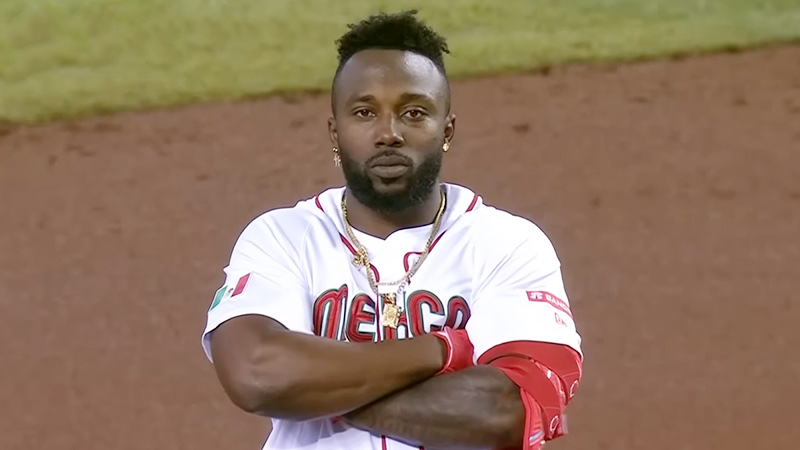
That event was a landmark for Mexican baseball. Mexico reached the semifinals before falling to eventual champion Japan, and Arozarena’s hitting, defense, and celebrations, including his trademark crossed-arms pose, became signature images of the run.
His international role adds another layer to his story. For fans across Mexico and the wider Latin American baseball community, he stands for perseverance and national pride, not just a stat line.
Career Snapshot
Arozarena’s career totals show a player whose value comes from steady, all-around production rather than one standout tool.
| Timeframe | Batting average | Home runs | RBIs | Stolen bases |
|---|---|---|---|---|
| 2026 season | .281 | 26 | 79 | 26 |
| Career (through 2026) | .255 | 144 | 469 | 157 |
The gap between his 2026 average and his .255 career mark shows how much his contact and on-base skills sharpened in his walk year.
| Year | Milestone |
|---|---|
| 2026 | First AL Silver Slugger; third All-Star selection; led the AL with 113 runs; declined a $23.15 million qualifying offer |
| 2025 | Second All-Star selection, his first with Seattle |
| 2024 | Traded from Tampa Bay to Seattle in July |
| 2023 | First All-Star selection; starred for Mexico in the World Baseball Classic |
| 2021 | AL Rookie of the Year; first of six straight 20-20 seasons |
| 2020 | Traded to Tampa Bay; record 10 postseason home runs; ALCS MVP |
| 2019 | MLB debut with St. Louis |
| 2016 | Signed by the St. Louis Cardinals |
| 2015 | Left Cuba for Mexico |
What Comes Next in Free Agency
Arozarena enters the market with a rare set of credentials: a fresh Silver Slugger, a league-leading run total, six straight 20-20 seasons, and 154 games of availability in his walk year. Those are precisely the qualities front offices pay for.
He will play the 2027 season at age 32, so interested clubs will weigh how long his speed and power can hold up. Many teams prefer to limit long-term risk for players in their 30s, which could shape the length of any offer. On the other side of the ledger, plate discipline and on-base skills tend to age better than raw speed, which strengthens his case for a multi-year commitment.
His next move likely follows one of two paths:
- A return to Seattle. The Mariners know him best, have seen his impact up close, and would not give up draft capital to bring him back.
- A fresh start with a contender. Teams that need a corner outfielder and a top-of-the-order bat may decide his production is worth the draft-pick cost.
If he does leave, Seattle would collect draft-pick compensation, but it would also need to replace a Silver Slugger in left field and its American League-leading run scorer. That is not an easy gap to fill.
The Bottom Line
So, what did Randy Arozarena do? In short, he:
- Put together a career-best 2026 season with Seattle, hitting .281/.381/.484 with 26 home runs and 26 steals.
- Led the American League with 113 runs scored.
- Won his first AL Silver Slugger Award and earned his third All-Star selection.
- Extended his streak of 20-20 seasons to six.
- Turned down a $23.15 million qualifying offer to test free agency.
Behind those headlines is a player who left Cuba with no guarantees, rewrote the postseason record book as a rookie, and became a hero for Mexico on the international stage. Whatever uniform he wears in 2027, he heads into it at the peak of his powers.