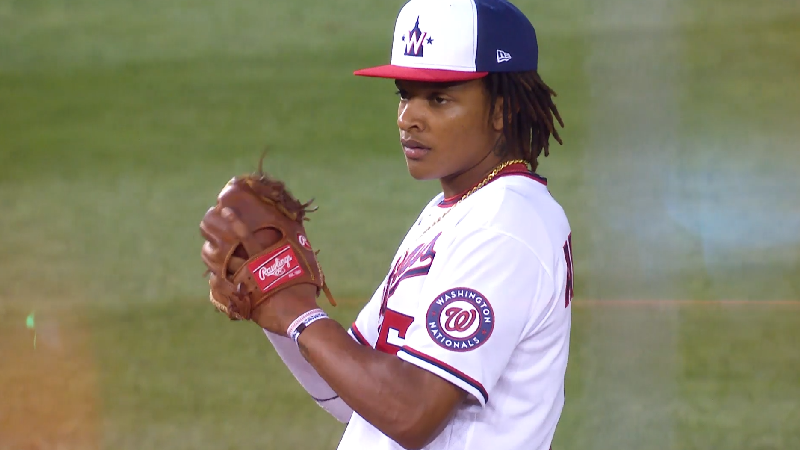
CJ Abrams answered the biggest question about his career in 2026. The Washington Nationals infielder hit 33 home runs, stole 34 bases, posted an .833 OPS and produced 5.1 WAR on his way to a second All-Star selection.
For years, the debate centered on whether his elite speed and quick hands would ever add up to a complete offensive player. That debate is largely settled.
The new question is harder. Was 2026 the start of a star-level run, or a career year that will drift back toward the middle? The answer shapes everything from Washington’s rebuilding timeline to how fantasy managers value him next spring.
This breakdown walks through his four-year progression, separates the repeatable skills from the ones that still need proof, and lays out a realistic projection.
The short version: Abrams projects as a perennial All-Star caliber middle infielder, most likely a 20-plus homer, 30-plus steal threat. His long-term value depends on a smooth move to second base and how much of his new power holds.
The 2026 Breakout by the Numbers
Abrams’ 2026 season was the most complete of his career, and nearly every category moved in the right direction at once.
Across 152 games and 579 at-bats, he hit .261 with a .336 on-base percentage and a .497 slugging percentage. That production added up to 33 home runs, 106 RBIs, 34 stolen bases and 5.1 WAR.
Context makes those totals more striking. His RBI count jumped by 46 from 2025, and his slugging percentage climbed 64 points.
His isolated power, which is slugging minus batting average, rose from .176 to .236. That single change moved him from a solid power-speed player into rare territory for a middle infielder.
Few players reach 30 home runs and 30 stolen bases in the same season. Joining that group at 25 years old, while also earning a second All-Star selection, marked Abrams as one of the most dynamic young players in the National League.
Four-Year Progression: Reading the Trend
Abrams improved steadily from 2023 to 2025, then took a major leap in 2026. All four seasons came with the Nationals.
|
Season |
G |
AB |
AVG |
OBP |
SLG |
OPS |
HR |
RBI |
SB |
SO |
|---|---|---|---|---|---|---|---|---|---|---|
|
2026 |
152 |
579 |
.261 |
.336 |
.497 |
.833 |
33 |
106 |
34 |
158 |
|
2025 |
144 |
580 |
.257 |
.315 |
.433 |
.748 |
19 |
60 |
31 |
125 |
|
2024 |
138 |
541 |
.246 |
.314 |
.433 |
.747 |
20 |
65 |
31 |
128 |
|
2023 |
151 |
563 |
.245 |
.300 |
.412 |
.712 |
18 |
64 |
47 |
— |
Four patterns stand out:
- Batting average climbed every season, from .245 to .261.
- On-base percentage rose from .300 to .336, with the biggest gain in 2026.
- Slugging held flat at .433 in 2024 and 2025 before jumping to .497.
- Stolen bases never dipped below 31 in a full season.
Those patterns matter for any projection. The gains in average and on-base percentage arrived gradually, which points to real skill growth.
The power spike is different. It arrived in a single season after two years of nearly identical slugging, which is why it deserves a closer look.
Speed: His Most Dependable Tool
If one skill gives Abrams a high floor, it is his speed. He has stolen at least 31 bases in every full season from 2023 through 2026, including a career-high 47 in 2023.
Sprint speed generally peaks early in a career and declines gradually. Abrams enters his age-26 season in 2027, so he should have several strong running years ahead.
His steal totals also held steady as his power rose, a sign that the added slugging has not come at the expense of his aggressiveness on the bases.
Speed also helps in ways that never appear in the steal column. It turns slow grounders into infield hits, pressures defenses into mistakes and adds extra bases on singles and doubles.
For a hitter whose average sits in the .250s, those hidden hits help steady his production in seasons when the power cools.
The one caution is volume. His steals dropped from 47 in 2023 to the low 30s afterward. That shift could reflect more selective running or simple variance rather than lost speed, but it makes 30 to 35 steals a more realistic yearly expectation than a return to the high 40s.
Is the Power Real? Breakout Versus Baseline
The 33 home runs are the most important number in any Abrams projection, and also the most uncertain.
Analysts view his 2026 power as likely above his true baseline. Based on his underlying contact and power quality, most expectations center on 20 to 24 home runs and a .250 to .255 batting average going forward.
There are good reasons for caution:
- One-year spike: He hit 18, 20 and 19 home runs in his three prior full seasons. Reaching 33 was a 65 percent jump over his previous best.
- Rate change: He homered once every 17.5 at-bats in 2026, compared with once every 30.5 at-bats in 2025.
- Strikeouts rose too: His strikeouts climbed from 125 to 158, a sign the added damage came with more swing-and-miss.
There are also reasons for optimism. He was 25 during the breakout, an age when many hitters add strength and learn to lift the ball more consistently. His walk gains point to better pitch selection, and hitters who swing at better pitches tend to make harder contact.
The realistic view sits in between. Abrams likely added real power in 2026, but some of those 33 home runs probably came from favorable variance. A baseline of 20 to 24 home runs, with occasional seasons pushing higher, is a sound expectation.
Plate Discipline: The Quiet Change That Matters Most
The most encouraging part of Abrams’ 2026 season may not be the home runs. It may be the walks. He drew 57 of them, up from a range of 32 to 40 in his previous full seasons.
That change lifted his on-base percentage to .336, the first time he cleared .320 in a full season. For a hitter near the top of the order, on-base percentage drives value more directly than almost any other number.
Every extra trip to first base also creates another chance to steal, which multiplies the value of his speed.
The tradeoff is strikeouts. His 158 strikeouts were a career high by a wide margin. More walks paired with more strikeouts usually signals a hitter working deeper counts and swinging with more intent.
That approach can sustain production, but it raises the stakes on contact quality. If the power fades while the strikeouts stay high, his average could slip toward the .240s.
Walk rate is generally one of the steadier skills from year to year, so these gains are more likely to stick than the power gains. Even if he settles at 45 to 50 walks, his on-base percentage should stay comfortably above his early-career levels.
The Move to Second Base: Short-Term Cost, Long-Term Gain
Washington began shifting Abrams from shortstop to second base in August 2026. The goal was twofold: address his defensive struggles at shortstop and protect the value of his bat.
The move carries a small cost on paper. Under the standard positional adjustments used in WAR, shortstop earns about five more runs of credit than second base over a full season, or roughly half a win.
Abrams will need to hit slightly better at second base to post the same WAR he would at shortstop.
In practice, the move should pay off. Second base eases the demands on his throwing and range, the two areas that gave him trouble at shortstop. Scouts have long viewed second base as his best long-term defensive home.
An average or better second baseman often delivers more total value than a below-average shortstop, because the runs saved on defense can outweigh the positional adjustment.
The shift may help in less visible ways too. Fewer difficult throws and less ground to cover can reduce physical wear across a long season. If Abrams settles in as a reliable defender, his blend of power and speed would rank among the best at the position.
Projecting CJ Abrams: Floor, Median and Ceiling
Our median projection has Abrams hitting about .253 with 20 to 24 home runs and 30-plus steals per season, worth roughly 3 to 4 WAR a year at second base. The table below shows the full range of outcomes over the next several seasons.
|
Scenario |
AVG |
OBP |
SLG |
HR |
SB |
WAR |
What it requires |
|---|---|---|---|---|---|---|---|
|
Ceiling |
.265 |
.345 |
.500 |
30+ |
35 |
5.0–6.0 |
Power holds, walks stick, solid defense at second |
|
Median |
.253 |
.322 |
.445 |
20–24 |
30–34 |
3.0–4.0 |
Power settles, discipline gains hold |
|
Floor |
.240 |
.305 |
.410 |
16–18 |
28–30 |
1.5–2.5 |
Power fades fully, strikeouts stay high |
The median is the most likely outcome, and it still describes a very good player. A second baseman with 20-plus home runs, 30-plus steals and an on-base percentage in the low .320s is an All-Star contender in most seasons.
The ceiling is not out of reach. Abrams is young enough that 2026 could mark a genuine step forward rather than a peak.
If his walk gains hold and his power lands near 30 home runs, he would profile as one of the most valuable second basemen in baseball.
The floor keeps the projection grounded. Even in the downside case, his speed and improved discipline should keep him an everyday regular rather than a part-time player.
What It Means for the Nationals and Fantasy Managers
For Washington, Abrams is a core piece of the next competitive window. A 26-year-old middle infielder with All-Star production gives the organization a building block to plan around.
The shift to second base also signals that the club views his bat as the priority. The next step is surrounding him with enough talent to turn strong individual seasons into team success.
For fantasy managers, his value is easier to pin down than his real-life ceiling:
- Category coverage: He contributes in runs, home runs, RBIs and stolen bases, a range few hitters can match.
- Draft approach: Price him on his median projection, not his 2026 line. Paying for 33 home runs leaves little room for profit.
- Position flexibility: Depending on league rules, he may carry both shortstop and second base eligibility in 2027.
- Points leagues: His rising strikeout total carries more weight in formats that penalize strikeouts.
The Verdict: How Good Will CJ Abrams Be?
CJ Abrams will be very good, and for a stretch of seasons he may be great. His speed gives him a reliable floor, his improved plate discipline gives him a stable on-base foundation, and his 2026 power surge shows the upside that once made him one of baseball’s top prospects.
The most likely path is a perennial All-Star caliber second baseman who hits 20 to 24 home runs, steals 30 or more bases and posts an on-base percentage in the low .320s. If the power proves more real than random, he becomes one of the best all-around middle infielders in the game.
The 2027 season will be the test. Watch three markers: his home run pace through the first half, whether his walk total stays near the 2026 level, and how comfortable he looks at second base over a full season. Together, they will reveal which version of Abrams is here to stay.