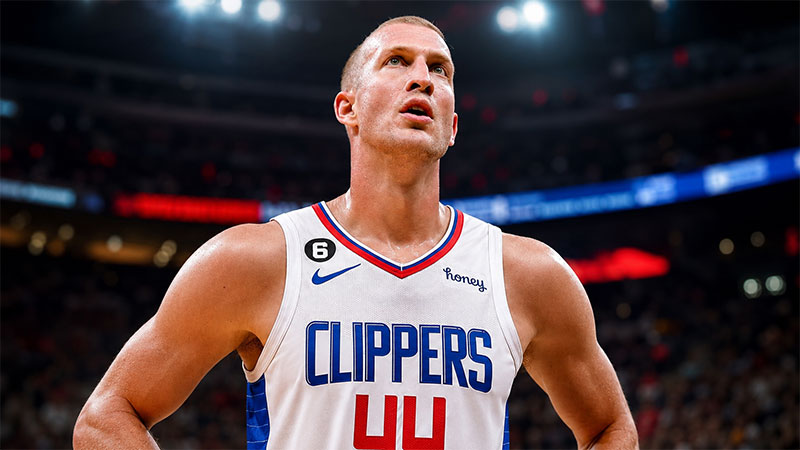
Mason Plumlee is a name synonymous with NBA longevity. At 36 years old, the former Duke standout has carved out a 12-year career by evolving from a high-flying athlete into a savvy, high-IQ veteran.
Currently anchoring the deep bench for the San Antonio Spurs, Plumlee represents a specific archetype of player: the reliable professional who provides value beyond the traditional box score.
To answer whether he is still “good,” one must look past the modest 1.6 points per game and examine his role as a passing hub and mentor in a league that increasingly prizes specialized basketball intelligence.
Defining Mason Plumlee’s Current NBA Standing
The question of whether a player is “good” often depends on the expectations of their specific role within a roster.
For Mason Plumlee, those expectations have shifted significantly from his days as a double-double threat to his current position as emergency frontcourt depth.
In the 2025-26 season, he serves as a vital insurance policy for the San Antonio Spurs, specifically providing a veteran presence behind generational talent Victor Wembanyama.
While his statistical output has dipped to career lows, his presence is a calculated move by the organization to instill professional habits in its younger core.
The Transition from High-Impact Starter to Depth Specialist
In the prime of his career, Plumlee was known for his “bouncy” athleticism and ability to run the floor with elite speed for a seven-footer. However, as he enters his 13th league season, the realities of age and the physical toll of professional basketball have altered his utility.
Now 36 years old, Plumlee has transitioned into a “high-IQ depth piece” who understands how to impact the game in short, focused bursts rather than extended minutes.
This evolution is common among successful NBA veterans who manage to stay relevant long after their peak physical tools have begun to fade.
Analyzing the 2025-26 Season Statistics
When looking at the raw data provided by the San Antonio Spurs, Plumlee’s numbers appear modest at first glance. He is currently averaging 1.6 points, 2.7 rebounds, and 1.0 assist per game.
These figures are a direct reflection of his limited playing time, as he typically sees under nine minutes of action per night and only plays sporadically depending on the matchup or injury report.
However, for a 12-year veteran, these “per-minute” contributions still signal a player who can fill a specific gap when his name is called.
The Passing Specialist: A Rare Offensive Engine
Plumlee’s primary differentiator in the modern NBA remains his playmaking. In an era where “point centers” like Nikola Jokic have revolutionized the position, Plumlee continues to process the game at an elite level, even in his limited role.
This ability to act as an offensive connector allows the Spurs to maintain a level of flow when their primary playmakers are off the floor.
His high-IQ approach from the top of the key or out of the short roll makes him a unique asset that many traditional defensive centers simply cannot replicate.
The Mechanics of the “Offensive Connector”
| Attribute | Impact on Team Offense |
|---|---|
| Short Roll Passing | Finds open shooters and cutters when the primary ball-handler is doubled. |
| Top-of-the-Key Hub | Acts as a stationary playmaker to initiate hand-off sequences and screens. |
| Game Processing | Extremely fast decision-making that prevents the offense from stagnating. |
Plumlee is highly regarded as an exceptional passing center who understands the nuances of spacing and timing. By functioning as a playmaker, he creates high-quality looks for teammates, which is a trait that coaching staffs value immensely in a backup big man.
Screening and Efficient Rim Finishing
Beyond his passing, Plumlee remains a disciplined and physical screen setter. In the modern pick-and-roll-heavy NBA, the quality of a screen can be the difference between an open three-pointer and a contested mid-range jumper.
Plumlee uses his 254-pound frame to create space for his guards, often sacrificing his own scoring opportunities for the better of the team.
When he does look to score, he remains highly efficient around the rim, typically shooting an incredibly high percentage from the floor because he understands his limitations and stays within his offensive range.
Defensive Realities and Physical Challenges
No objective analysis of Mason Plumlee is complete without addressing the natural decline of a 7-foot frame after over a decade in the league. While his size remains a deterrent in the paint, his lateral mobility has become a target for modern, high-speed offensive schemes.
This physical decline is the primary reason he is no longer considered a high-impact rotation player, but rather a situational tool for coach Gregg Popovich.
The Impact of Age and Recent Injuries
Recent seasons have been challenging for Plumlee from a health perspective. He underwent groin surgery earlier this season, an injury that is particularly difficult for aging players to recover from fully.
This surgery, combined with his 36 years of age, has significantly hampered his foot speed. In his prime, he could switch onto smaller players and hold his own; today, he is increasingly vulnerable when asked to defend out in space or recover against quicker guards on the perimeter.
Navigating Defensive Limitations in the Modern NBA
Despite these limitations, Plumlee provides “physical toughness” that young teams often lack. He is a 7’0″, 254-pound presence who can absorb contact and provide a level of rim protection through positioning rather than raw leaping ability.
While he is not an elite rim protector by modern standards, his “readiness” to provide a physical foul or a hard box-out is a form of veteran reliability that keeps him on NBA rosters.
The Intangible Asset: Why the Spurs Keep Him
In the NBA, a player’s value is not always found in the box score. For a team like the San Antonio Spurs, who are in the midst of a significant rebuild around young stars, the “locker room value” of a player like Mason Plumlee is immeasurable.
His professionalism and willingness to stay ready despite inconsistent minutes make him an ideal mentor for the next generation of NBA talent.
- Veteran Leadership: Having seen every type of defensive scheme and offensive trend over 12 years, Plumlee serves as an “on-bench coach” for younger players.
- Professionalism: His ability to maintain a high level of conditioning and readiness after surgery is a blueprint for younger athletes on how to sustain a long career.
- Mentor Role: Specifically, his presence allows Victor Wembanyama to have a physical, veteran presence to practice against and learn from in daily team sessions.
Overcoming Weaknesses: The “Quirky” Work Ethic
One of the most fascinating aspects of Mason Plumlee’s career—and a reason many consider him a “good” professional—is his willingness to adapt to his own flaws.
Most famously, he has historically struggled from the free-throw line, a weakness that often made him a liability in late-game situations.
Instead of accepting this, Plumlee made the drastic move of switching shooting hands during his career to try and correct the issue. This level of dedication to self-improvement, even as a veteran, signals the “high-IQ” and “professional” traits that coaches admire.
The Lack of Outside Shooting Range
While many centers have transitioned into “stretch bigs” who can shoot from the perimeter, Plumlee has remained a traditionalist. He has virtually no outside shooting range, which can sometimes make offensive spacing difficult when he is on the floor.
However, by leaning into his strengths—passing and screening—he manages to remain a “solid, highly reliable” asset even without a three-point shot.
Frequently Asked Questions About Mason Plumlee
Q: Why does Mason Plumlee play so few minutes for the Spurs?
A: At 36 years old and coming off groin surgery, Plumlee is utilized as emergency depth behind Victor Wembanyama and other younger frontcourt players. His role is to provide a physical presence and high-IQ playmaking in short stretches rather than sustained minutes.
Q: What makes Mason Plumlee a “passing specialist”?
A: Plumlee is highly regarded for his ability to process the game quickly. He excels at finding cutters and open shooters from the top of the key or the short roll, acting as a connector that keeps the team’s offense moving.
Q: Has Mason Plumlee’s athleticism declined?
A: Yes. While he was once a highly mobile and bouncy athlete, his foot speed has declined significantly with age and recent injuries. This makes him more vulnerable on defense when switched onto quicker guards.
Q: Why did Mason Plumlee switch shooting hands?
A: To combat his historical struggles from the free-throw line, Plumlee famously switched his shooting hand. This is often cited as an example of his dedication and willingness to adapt to stay competitive in the league.
Is Mason Plumlee Good for Your Roster? The Final Verdict
To conclude whether Mason Plumlee is “good,” we must use a nuanced lens. If you are evaluating him as a starting center or an elite rim protector, the answer is no; his days of high-impact rotation minutes have passed.
However, if you are looking for a 4th or 5th big man who brings size, exceptional passing, and a steadying locker room presence, Plumlee is still considered an excellent and respected professional.
He is a specialist who does a few things—passing, screening, and leading—better than almost anyone in his specific tier of the league.