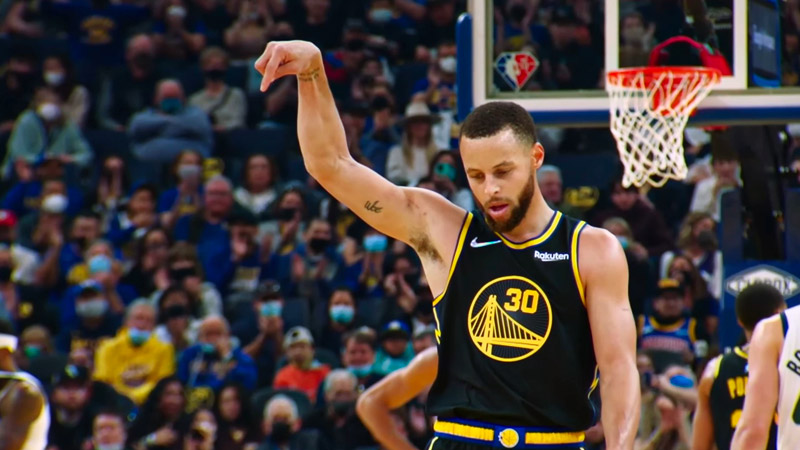
Stephen Curry’s ascent in the NBA marked the end of basketball’s traditional era and the birth of a perimeter-dominated landscape. Before Curry, the three-point shot was often a secondary weapon used to supplement an interior-focused offense.
By demonstrating that high-volume, hyper-efficient shooting from extreme distances could lead to multiple championships, he fundamentally altered the geometry of the court.
His career highlights a shift where skill, conditioning, and shooting mechanics replaced raw size and verticality as the primary drivers of success.
He didn’t just play the game; he reinvented its strategic DNA, providing a championship-winning proof of concept for modern analytics.
The Strategic Pivot: From Situational to Dominant
To understand how Curry redefined basketball, one must analyze the statistical environment of the early 2010s. In 2012, NBA league leaders were attempting only about 23 three-pointers per game, with the Warriors sitting significantly lower on that list.
While the league was slowly moving toward a higher volume of perimeter shots, Curry acted as the primary accelerator, proving that what was once considered a “gimmick” could be the foundation of a dynasty.
This shift transformed the game from a congested, paint-focused battle into a wide-open display of “pace and space”.
The Acceleration of Analytics and Volume Shooting
The trend toward the three-pointer was arguably inevitable, but Curry’s specific brilliance moved the timeline forward by at least a decade.
While figures like Mike D’Antoni and executives like Daryl Morey pushed for higher volume, their systems often prioritized volume over the specific aesthetic and accessible skill set Curry possessed.
Between 2013 and 2017, teams like the Houston Rockets began “cranking up” their attempts to 40 per game, yet it was Curry’s efficiency that made the strategy truly devastating for opponents.
Efficiency as the Ultimate Differentiator
The core of the Curry revolution is not just the quantity of shots, but the unprecedented efficiency maintained at high volume.
Many players can attempt a high number of shots, but Curry redefined what was possible by shooting above 40% on more than 10 attempts per game—a feat he has achieved five times.
To put this in perspective, in the history of the NBA, this level of efficiency at such volume has only been reached seven times total, with Curry accounting for five of those instances.
This mathematical advantage created a gap that traditional offenses simply could not bridge.
Redefining Court Geometry: The Power of Range and Gravity
Curry’s influence is most visible in how defenses are forced to react to his presence before he even crosses the logo.
His unique shooting profile creates a phenomenon known as “gravity,” where multiple defenders are pulled toward him regardless of whether he has the ball, leaving lanes open for his teammates.
This warping of defensive shells has changed the fundamental “calculus” of NBA coaching, forcing a total reimagining of defensive spacing and help-side rotations.
The Normalization of the “Logo Shot”
Before the Curry era, a shot taken from 30 to 35 feet was considered a poor decision that would likely lead to a player being benched.
Curry transformed these “logo shots” into efficient offensive weapons, demonstrating that they could break NBA defenses by forcing the point-of-attack defender to engage at the half-court line.
This extended range makes defensive rotations significantly longer and more difficult to execute, as the amount of ground a defender must cover increases exponentially.
Off-Ball Movement and Conditioning
A major component of Curry’s game that is often overlooked in favor of his shooting is his relentless movement without the basketball.
He changed how star players behave when the ball is not in their hands, using constant sprinting through a maze of screens to wear out defenders.
This active, dynamic style of play forces defenses to remain versatile and mobile, as a single second of relaxation results in an open look for the greatest shooter in history.
| Metric | Pre-Curry Era (2012-13) | Modern Era (2025-26) |
|---|---|---|
| Average NBA Team 3PA / Game | 20.0 | ~35.0 – 40.0+ |
| Curry’s Personal Season High | 272 Made 3s (Record then) | 402 Made 3s (Record) |
| Primary Offensive Focus | Congested paint/Mid-range | Deep perimeter spacing |
The Tactical Fallout: The Death of the Traditional Big Man
The rise of the perimeter-first game forced an evolutionary crisis for traditional, paint-bound big men. Centers who once dominated the rim became defensive liabilities when forced to guard Curry on “islands” at the perimeter.
This shift led to the revaluation of non-mobile bigs and birthed a new generation of versatile frontcourt players who must defend the perimeter and hit three-pointers themselves to stay on the floor.
- The End of the “Drop” Coverage: Traditional centers who stay near the rim (playing “drop” coverage) now give up “practice shots” to elite shooters like Curry.
- The Rise of Switching Defenses: To combat Curry’s range, teams have moved toward “switch-everything” schemes, prioritizing players with long wingspans and lateral mobility.
- Small-Ball Dominance: The Warriors proved that smaller, more skilled lineups could neutralize traditional size through speed and superior point-per-possession efficiency.
- The Evolutionary Leap: Modern big men like Nikola Jokic or Victor Wembanyama represent the “post-Curry” big man—players with elite size who possess the perimeter skills Curry normalized.
Beyond the NBA: The Cultural Blueprint and Youth Impact
The “Steph Effect” has permeated every level of the sport, from high school gyms to local pickup games.
Unlike some superstars whose dominance is purely physical and seemingly “genetically created,” Curry’s success feels accessible through the mastery of skill and conditioning.
This has led to a global shift in how the game is taught, with a heavy emphasis on shooting range and advanced ball-handling from a young age.
The “Green Light” for the Next Generation
Curry’s success as a lead guard who wins championships while taking high-volume, off-the-dribble shots provided a blueprint for current stars.
Players like Trae Young, Darius Garland, and LaMelo Ball have been given a “green light” by their coaches that would not have existed without Curry proving it was a viable winning style.
He essentially normalized the process of a point guard acting as the primary scoring threat from deep, rather than just a facilitator.
Impact on Grassroots Player Development
Walk into any youth gym today and you will see players practicing pull-up threes from the hash mark rather than traditional post moves. While this has led to some criticism regarding shot selection, it has also elevated the overall skill floor of the league.
Players are entering the professional ranks with more refined shooting mechanics and a deeper understanding of space than any generation before them, directly as a result of emulating Curry’s game.
Analytical Validation: Curry as the Proof of Concept
While the value of three-pointers over long two-pointers had been understood by analysts for decades, the league required a championship-winning model to fully adopt the strategy.
Curry was the “unanimous” proof of concept that a team could not only compete but dominate while relying on the three-pointer as its primary engine. His career validated the “3 > 2” math in a way that resonated with coaches, players, and fans alike.
The Golden State Warriors’ Dynasty as Evidence
The Warriors’ philosophy, anchored by Curry, yielded four NBA championships and the only unanimous MVP award in league history.
This level of success made the NBA a “copy-cat league,” where every franchise began hunting for personnel that could replicate the Warriors’ spacing and shooting.
Teams that did not increase their three-point volume found themselves unable to keep pace with the modern scoring output, leading to a league-wide strategic overhaul.
Redefining the “Good Shot”
Ultimately, Curry changed the definition of what coaches consider a “good” or “bad” shot. By making high-difficulty, off-the-dribble, and deep-range shots at a high clip, he forced the basketball world to acknowledge that “good” is relative to the skill of the shooter.
What was once an erratic play is now a strategic cornerstone, provided the player has put in the work to master the mechanics.
Frequently Asked Questions about the Curry Revolution
Did Steph Curry create the three-point era alone?
While the league was already trending toward higher volume due to analytics and coaches like Mike D’Antoni, Curry was the primary accelerator.
He provided the “proof of concept” by winning championships with this style, which encouraged the rest of the league to follow suit much faster.
How did Curry affect the value of big men in the NBA?
He effectively ended the era of the slow-moving, rim-protecting center. Because Curry can draw these players out to the perimeter and exploit them in space, modern big men must now be mobile enough to switch onto guards and skilled enough to shoot from the outside.
What is “Curry Gravity”?
“Gravity” refers to the way Curry’s elite shooting threat draws defenders toward him even when he doesn’t have the ball. This creates massive openings and high-quality shots for his teammates because the defense is terrified to leave him open for even a second.
Why is Curry’s impact considered different from other great shooters like Ray Allen?
While previous greats were elite, they often relied on “catch-and-shoot” opportunities. Curry pioneered the “off-the-dribble” three-pointer from extreme distances, proving that a lead guard could use the shot as a primary ball-handling weapon rather than just a finishing move.
The Unanimous Legacy: A Game Reborn
Stephen Curry’s legacy is not just recorded in the history books through his titles and MVP trophies; it is written into the very way the game is played every night across the globe.
He dismantled the long-standing belief that championships must be won from the inside out, proving that a 6’2″ guard with historic hand-eye coordination and flawless mechanics could be the most dominant force in the sport. He expanded the boundaries of the court, literally and figuratively, making the impossible seem routine.
As the game continues to evolve, the fingerprints of the Curry revolution remain everywhere. From the “logo shots” seen in professional arenas to the skill-heavy focus of youth development, the sport has been permanently altered.
He didn’t just change the game; he ushered in an era where skill is the ultimate equalizer, ensuring that the architecture of basketball will never look the same again.
Curry remains the gold standard for how a single player can transform a global sport through the power of a perfect jump shot.