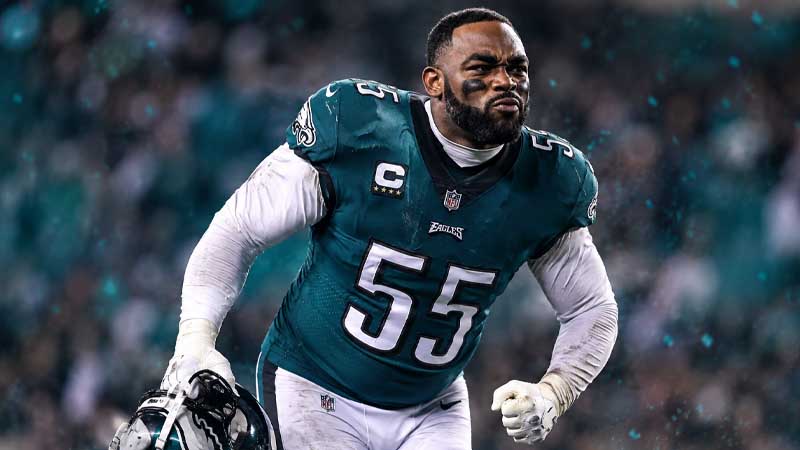
In the modern landscape of professional football, where highlights are dominated by flash and high-volume statistics, the true essence of defensive greatness is often obscured.
For over a decade, Philadelphia has witnessed a unique phenomenon: a player whose impact on the game transcends the box score, yet whose national recognition remains a fraction of his actual worth.
Brandon Graham, the long-standing defensive end for the Philadelphia Eagles, represents a fascinating case study in how the sports world often fails to measure elite performance accurately.
The disparity between Graham’s internal value to a championship-winning organization and his external perception by the national media is vast.
While casual observers fixate on year-end awards and double-digit sack totals, football analysts and those within the Eagles’ facility recognize him as the “underrated architect” of one of the league’s most consistently competitive defensive units.
The Statistical Paradox: Beyond the Sack
The primary reason Brandon Graham is frequently overlooked stems from a fundamental misunderstanding of defensive line metrics.
For years, the traditional metric for an edge rusher’s success was the raw sack total. This narrow focus ignores the immense pressure and disruption a player can cause without actually bringing the quarterback to the ground.
Graham’s career is defined by consistent pressure and elite analytical metrics that often outperformed bigger-name defenders who received more national attention.
While a sack is a singular, flashy event, consistent pressure forces errant throws, interceptions, and internal offensive discord.
Graham’s ability to affect the game on nearly every snap is what has made him a foundational piece of the Eagles’ franchise for so long.
Impact Comparison: Traditional vs. Comprehensive Metrics
| Metric Category | Traditional View (The “Flash”) | The Graham Profile (The “Function”) | Impact on Winning |
|---|---|---|---|
| Pass Rush | Focuses solely on Sack Totals | Prioritizes Consistent Pressure & QB Hits | Forces early throws and turnovers |
| Run Defense | Secondary to pass-rushing stats | Elite run-stopping and gap integrity | Neutralizes the opponent’s ground game |
| Snap Count | Often limited to “Third Down Specialists” | High-motor, three-down versatility | Maintains defensive stability and fatigue management |
| Versatility | Sticks to one specific edge role | Seamlessly shifts between inside and outside | Creates mismatches across the offensive line |
| Clutch Factor | Regular season stat padding | Delivering in the highest-leverage moments | Directly secures championship victories |
Overcoming the “Bust” Narrative and Early Career Misconceptions
To understand why Graham remains underrated, one must look back at the beginning of his journey. His professional career began under a cloud of intense scrutiny and unfair expectations.
Because he was drafted ahead of other high-profile stars, fans and media outlets were quick to label him a disappointment during his developmental years.
This “bust” label was not only premature but also ignored the complexities of transitioning to the professional level. Graham’s resilience in the face of this early criticism is a testament to his character.
Rather than folding under the pressure of external expectations, he focused on a gradual development process that eventually saw him become an indispensable leader for the team.
Key Elements of Graham’s Professional Resilience
- Adaptability: He transitioned through multiple defensive coordinators and different schematic philosophies without a dip in effort.
- Role Fluidity: Graham demonstrated a rare ability to shift seamlessly between different roles on the line, whether playing as a traditional defensive end or reducing inside on passing downs.
- Mental Fortitude: He ignored the popularity contests associated with Pro Bowl selections, focusing instead on team success and consistency.
The Master of “Dirty Work” and Run Defense
While sack totals get the headlines, run defense is the bedrock of a successful unit. Graham’s excellence in this area is perhaps his most underrated attribute.
He is widely considered an elite run-stopper who excels at “setting the edge,” a technical requirement that involves holding a physical position to prevent a ball carrier from reaching the sideline.
This type of play is often referred to as “dirty work” because it rarely shows up in highlight reels or on a standard stat sheet.
However, by blowing up plays in the backfield and maintaining strict gap integrity, Graham allows his teammates to roam free and make tackles. His high-motor style ensures that he is a constant presence in the opponent’s backfield, disrupting the timing of the offense.
The Technical Skillset of a Versatile Tactician
- Gap Integrity: Graham’s discipline ensures that he never abandons his assignment for the sake of a personal statistic, a trait highly valued by coaches.
- Inside/Outside Flexibility: His physical strength allows him to move to the interior of the line on passing downs, where he can use his speed to overwhelm slower offensive guards.
- Longevity through Technique: By relying on elite technique and tactical intelligence, he has managed to extend his career with high-level play well into his late 30s.
The Popularity Contest: Why Pro Bowls Don’t Tell the Whole Story
It is a striking irony of modern football that a player of Brandon Graham’s caliber has only earned a single Pro Bowl selection during a career that has spanned over a decade. This lack of mainstream accolades is a primary driver behind his underrated status.
The Pro Bowl is often a popularity contest influenced by national media narratives and raw, surface-level statistics.
Because Graham’s value is rooted in versatility, leadership, and run defense, he frequently lost out to defenders who may have had more sacks but were less impactful in the overall defensive scheme.
This systemic bias toward “glamour stats” has led to a national under-appreciation of a player who consistently outperformed his more famous peers in analytical evaluations.
The Ultimate Legacy: Super Bowl LII and Beyond
Despite the lack of individual awards, Graham’s place in history is secured by one of the most significant defensive plays in the history of the sport.
During the closing minutes of Super Bowl LII, with the game hanging in the balance, it was Graham who delivered the clutch strip-sack of Tom Brady.
This moment served as a microcosm of his entire career:
- Persistence: He battled throughout the game, providing the pressure that finally broke through at the most critical moment.
- Skill: The play required the exact blend of pass-rush technique and “high-motor” effort that has defined his tenure in Philadelphia.
- Impact: This single play directly led to the first Super Bowl title in the franchise’s history.
Yet, even after this legendary performance, Graham’s overall career remains significantly more respected within the city of Philadelphia than it is across the broader national landscape.
He remains the “underrated architect” of the defense—a player whose contributions are felt deeply by those who study the game but are often missed by those who only watch the highlights.
Final Verdict: The Standard of Defensive Excellence
Brandon Graham is the personification of the “unselfish star.” In an era of professional sports often defined by individual branding and statistical inflation, he has remained a high-motor leader focused on the collective success of his team.
His ability to adapt to changing schemes, master the “dirty work” of run defense, and deliver in the most high-pressure moments imaginable makes him one of the most valuable defenders of his generation.
For those looking to understand the true nature of defensive dominance, Graham’s career provides the perfect blueprint.
He proves that greatness isn’t always found in the loudest voices or the most crowded stat sheets—sometimes, it’s found in the consistent, elite, and versatile play of a man who simply refuses to be outworked.