
The landscape of the National Football League is defined by a relentless pursuit of efficiency and the cold reality of roster mathematics.
For the New Orleans Saints, a franchise that enjoyed nearly two decades of unprecedented stability at the quarterback position, the post-Drew Brees era necessitated a series of high-stakes evaluations.
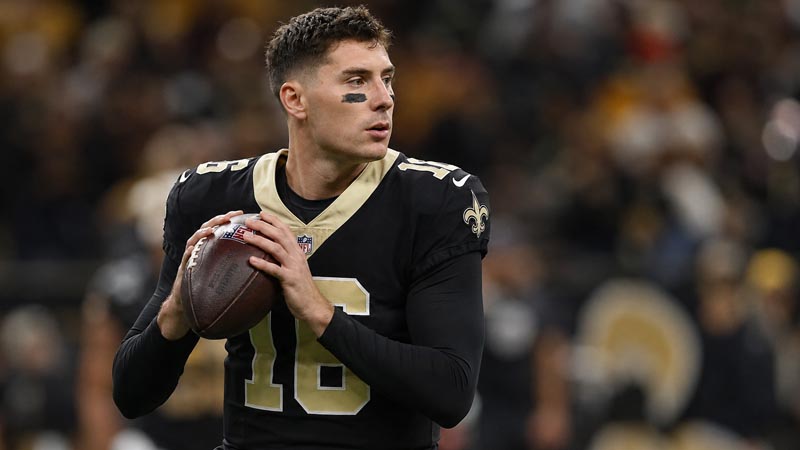
One of the most discussed chapters in this transition was the brief tenure and subsequent departure of Ian Book.
Understanding why a highly decorated collegiate athlete—the winningest quarterback in Notre Dame history—was unable to secure a long-term role in New Orleans requires a multi-dimensional analysis.
This exploration examines the intersection of performance metrics, organizational philosophy, and the brutal mechanics of the NFL’s 53-man roster deadline.
The Conclusion of a Developmental Project
On August 30, 2022, the New Orleans Saints officially moved in a different direction at the quarterback position by waiving Ian Book.
This decision was not an isolated event but the culmination of an intensive evaluation period that began with his selection in the fourth round of the 2021 NFL Draft.
The move coincided with the league-mandated deadline for teams to trim their active rosters to the regular-season limit of 53 players. In the high-pressure environment of professional football, every roster spot is a valuable asset.
For the Saints’ front office and coaching staff, the decision to release Book was a calculated move to prioritize immediate veteran stability over long-term developmental upside.
The 2021 Catalyst: A Difficult Introduction
To understand the decision-making process in the summer of 2022, one must first look back at the winter of 2021.
The professional debut of Ian Book is often cited by analysts as one of the most challenging circumstances a rookie quarterback has faced in recent memory.
In December 2021, the Saints were ravaged by a major COVID-19 outbreak that decimated the depth chart. With the primary starters unavailable, Book was thrust into a “trial by fire” against a relentless Miami Dolphins defense.
The results were statistically taxing: Book was sacked eight times and threw two interceptions in a losing effort.
While the organization recognized that the surrounding circumstances were suboptimal, the game film from that night provided the first data points on Book’s ability to process professional-speed blitzes and manage a collapsing pocket.
In the NFL, “fairness” is often secondary to “readiness,” and this performance set a difficult baseline for his future evaluation.
The 2022 Evaluation: Preseason Metrics and Consistency
Heading into the 2022 training camp, the narrative surrounding Book was centered on his “Year 2 Jump.” The Saints provided him with significant opportunities during the exhibition schedule to demonstrate growth in his decision-making and ball security.
However, the 2022 preseason did not yield the progress the coaching staff required. Over the course of three exhibition games, Book struggled to find a consistent rhythm, a deficiency highlighted by his turnover rate. He recorded two interceptions and two lost fumbles during this critical evaluation window.
In a professional offense, the “floor” for a backup quarterback is established by their ability to protect the football.
When a player on a developmental curve continues to struggle with turnovers in preseason play, it creates a significant barrier to trust for the coaching staff. For the Saints, these mistakes outweighed the flashes of athleticism Book displayed during his collegiate career.
Organizational Philosophy: The Shift to Veteran Stability
The departure of Ian Book was as much about the players the Saints kept as it was about the player they let go.
Following the retirement of Drew Brees, the organization felt an urgent need to remain competitive in a wide-open NFC South. This led to a strategic pivot toward veteran experience.
The Saints leadership team decided to move forward with a quarterback room headlined by Jameis Winston and Andy Dalton.
- Jameis Winston offered high-caliber arm talent and previous experience as a starter.
- Andy Dalton provided the “steady hand” of a long-term veteran who could mentor a starter or step in with minimal disruption to the offensive scheme.
By opting for this veteran-heavy structure, the Saints signaled that they were no longer in a position to carry a “project” quarterback on the active roster.
The 53-man roster is a zero-sum game; keeping Book would have required the team to cut a contributing player at a different position, such as a special teams ace or a rotational defensive lineman.
The Mechanics of the Waiver Wire and Beyond
The NFL’s waiver system is designed to allow players who are cut a chance to find new opportunities quickly.
The fact that Ian Book did not remain a free agent for long speaks to the league’s recognition of his collegiate pedigree.
Immediately after being waived by New Orleans, Book was claimed off waivers by the Philadelphia Eagles.
This transition marked the beginning of his journey as a journeyman signal-caller. Following his stint in Philadelphia, he spent time with other NFL organizations, continuing to compete for a role in the league’s highly competitive backup market.
His journey highlights a common trend in the modern NFL: the “second draft.” Often, a player’s second or third team is where they find a niche after the initial pressure of their draft status has faded.
For New Orleans, however, the Book chapter was a necessary closure to finalize a roster they believed could compete immediately.
The Quarterback Economy: Lessons from the Book Era
The Saints’ experience with Ian Book offers several insights into the broader “quarterback economy” of the NFL:
- Draft Pedigree vs. Professional Readiness: Being a successful collegiate winner does not always translate to the processing speeds required at the professional level.
- The Impact of Environment: A rookie’s first start can have a lasting impact on their perceived value within an organization.
- Roster Utility: For a third-string quarterback, the ability to contribute to the scout team and maintain a “clean” preseason sheet is often more valuable than raw potential.
Final Analysis: A Necessary Evolution
The decision to move on from Ian Book on August 30, 2022, was a reflection of the Saints’ commitment to an “immediate-win” culture.
While Book possessed the mobility and winning history that made him an intriguing prospect out of Notre Dame, the lack of consistency in preseason play and the organizational shift toward veteran depth made his roster spot untenable.
In the high-stakes world of professional football, the “Book” on his time in New Orleans closed not because of a lack of talent, but because of a misalignment between his developmental timeline and the franchise’s urgent competitive window.
As the Saints continue to navigate the complexities of the post-Brees era, this move remains a textbook example of the difficult choices required to maintain a championship-caliber roster.






