
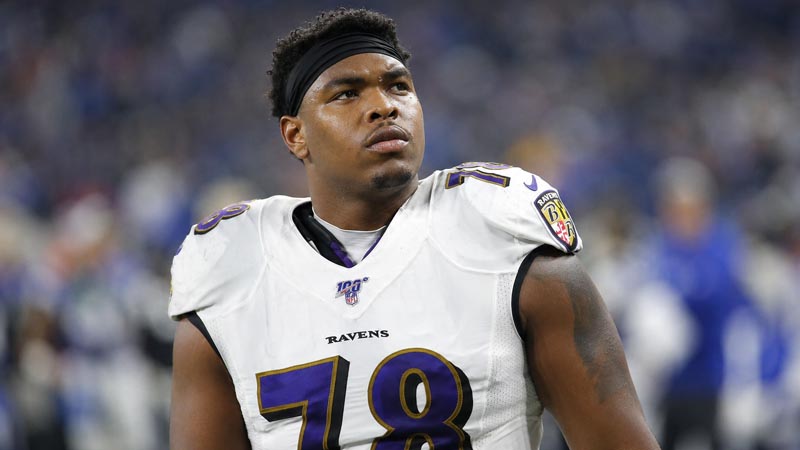
The NFL is a league defined by cold efficiency, yet every so often, a transaction occurs that is fueled entirely by the human spirit.
In April 2021, a trade sent shockwaves through the AFC: the Baltimore Ravens traded Pro Bowl tackle Orlando Brown Jr. to their primary rivals, the Kansas City Chiefs.
On the surface, the move seemed counterintuitive. Brown was a beloved figure in Baltimore, playing for the team that drafted him and the franchise where his father, the legendary Orlando “Zeus” Brown Sr., had cemented his own legacy.
However, this transition was not a simple contract dispute or a pursuit of a different climate. It was the culmination of a decade-long vow made by a son to his late father. It was a strategic refusal to accept a career path that, while successful, did not align with a deathbed promise.
To understand why one of the league’s most consistent tackles forced his way out of a winning situation, one must look past the stat sheets and into the heart of a promise made at a funeral in 2011.
The Historical Conflict: Right Side Production vs. Left Side Destiny
Orlando Brown Jr. entered the NFL with a specific identity. Despite being the son of an elite right tackle, his path was strictly delineated by his father’s instructions.
Orlando Sr. was a commanding force who played 129 games on the right side, but he harbored a different vision for his son. In the Brown household, the left tackle position was the only one that truly mattered.
A Legacy of Pressure and Purpose
The transition away from Baltimore was rooted in a foundational belief system established during Brown’s childhood.
Orlando Sr. was so adamant about his son playing the left side that he once removed him from a high school offense because the coach planned to play him elsewhere.
This created a mental blueprint: playing left tackle was synonymous with greatness, leadership, and fulfilling his family’s potential.
| Factor | The Right Tackle Experience (Baltimore) | The Left Tackle Vision (Kansas City) |
|---|---|---|
| Primary Responsibility | Often used for run-heavy sets; road-grading for Lamar Jackson. | Protecting the blindside of a high-volume passer like Patrick Mahomes. |
| Market Valuation | Historically lower-tier compensation compared to the blindside protector. | Top-tier financial compensation and prestige. |
| Personal Connection | Walking in his father’s actual footsteps on the right side. | Fulfilling his father’s aspirational wish for him to be a Left Tackle. |
| Technical Feel | Described as “unnatural” for a left-handed athlete. | Allows his dominant hand to engage the defender first. |
The Ronnie Stanley Roadblock
The primary professional obstacle in Baltimore was the presence of Ronnie Stanley. Stanley, an All-Pro caliber player, was the established cornerstone of the Ravens’ offensive line.
When the Ravens committed to Stanley with a massive long-term contract extension, it effectively signaled that the left tackle spot was occupied for the foreseeable future.
For Brown, this presented a crisis of identity. In 2020, following a season-ending injury to Stanley, Brown moved to the left side and proved he could perform at a Pro Bowl level in that role.
This brief window of opportunity changed everything. After a victory against Washington that season, Brown was moved to tears, calling his close friend and mentor Jammal Brown to say, “I got to play left tackle”.
- The Technical Epiphany: Brown realized that his 6-foot-8, 345-pound frame was more effective on the left side.
- The Refusal to Revert: Once the 2020 season concluded, Brown publicly stated, “I’m a LEFT Tackle,” and informed the Ravens he would not return to the right side even when Stanley recovered.
- The Market Reality: Brown understood that while he was a great right tackle, he could be a legendary left tackle, and the Ravens simply did not have an opening for him in that capacity.
Redefining the Prototype: The “Worst Athlete” at the Most Important Position
One of the most compelling aspects of Brown’s move to Kansas City was the defiance of traditional scouting metrics. His departure from Baltimore was partly fueled by the desire to prove the “experts” wrong on the biggest stage possible.
The Combine Narrative vs. On-Field Reality
In 2018, Brown had what many considered a catastrophic performance at the NFL Scouting Combine.
He recorded the slowest 40-yard dash of the year and the lowest vertical and broad jumps of any participant. Critics claimed he lacked the “quick feet” necessary to survive on the left side in the NFL.
However, Brown’s approach to the position is analytical rather than explosive. He famously refers to himself as “the worst athlete in the NFL,” yet he possesses a unique understanding of leverage and reach.
- Massive Reach: Once Brown gets his hands on a defender, his size (345 lbs) makes it almost impossible to disengage.
- Geometric Advantage: He understands that pass rushing is about Point A to Point B. By occupying space efficiently, he forces defenders to take much longer paths to the quarterback.
- The Left-Handed Edge: A critical detail in Brown’s transition is that he is naturally left-handed. Playing on the left side allows his strongest hand to be the lead hand in a punch, providing a level of control he never felt on the right side.
The Kansas City Fit: Protecting the Gold Standard
When the Baltimore Ravens realized the impasse was permanent, they permitted Brown to seek a trade. The Kansas City Chiefs were the perfect landing spot for several strategic reasons.
Following their defeat in Super Bowl LV, where pass protection was a glaring weakness, the Chiefs were desperate for a reliable left tackle to protect Patrick Mahomes.
Why Kansas City Took the Risk
While other teams might have been deterred by Brown’s combine numbers or his lack of traditional “bend,” the Chiefs’ front office saw a player who was immovable once set.
General Manager Brett Veach noted that while it might not “always look pretty,” Brown’s ability to shut down bull rushes and force defenders into “playing games” was exactly what their high-octane offense needed.
The Strategic Alignment in Kansas City:
- Scheme Fit: In a pass-heavy offense, Brown’s size acts as a persistent shield that wears down defenders over four quarters.
- Positional Assurance: Unlike Baltimore, the Chiefs offered a clear, uncontested path to the starting left tackle role.
- Legacy Fulfillment: By moving to Kansas City, Brown was no longer just “Baby Zeus” following in his father’s tracks; he was becoming the player his father always told him he should be.
A Son’s Vow: The Emotional Core of the Trade
To fully grasp why Brown walked away from his hometown team, one must revisit the funeral of Orlando Brown Sr. at age 15. Orlando Jr. stood before mourners and promised to take care of his mother and brothers by becoming a Hall of Fame left tackle.
His father’s standards were famously high. Orlando Sr. was known to walk out of his son’s games if he felt Orlando Jr. was being “timid” or not using his massive size to dominate.
This “animal” mentality on the field was something Orlando Jr. felt he could only fully realize on the left side, where the responsibility—and the pressure—was highest.
“My dad understood the magnitude of [being a left tackle], often being the captain of the offensive line… It was just kind of ingrained in me at a young age.” — Orlando Brown Jr.
Leaving Baltimore was an act of validation for all the work “Zeus” had put into his son. It wasn’t about the material things the Ravens could provide; it was about the mentality to work and achieve the specific goals his father had set.
Comparative Timeline: The Road to the Trade
| Year | Event | Significance |
|---|---|---|
| 2011 | Death of Orlando Brown Sr. | Orlando Jr. makes a formal promise to become a left tackle. |
| 2015-17 | Oklahoma University | Starts 40 games at left tackle, validating his collegiate potential. |
| 2018 | NFL Draft | Labeled a “bad athlete” after the combine; drafted by Baltimore in the 3rd round. |
| 2018-19 | Ravens RT | Performs at a Pro Bowl level but remains on the right side due to Ronnie Stanley. |
| 2020 | The Shift | Stanley is injured; Brown moves to LT and realizes he cannot go back. |
| 2021 | The Trade | Traded to the Chiefs to become their permanent blindside protector. |
The Professional Impact: Positional Value in the Modern NFL
Beyond the emotional narrative, there is a stark professional reality regarding the value of a left tackle. In the hierarchy of the NFL, the left tackle is often considered the second most important position on the field after the quarterback.
- Financial Leverage: Left tackles consistently command higher salaries in the open market than right tackles.
- Leadership Expectations: The left tackle is often viewed as the “captain” of the offensive line, a role Orlando Sr. wanted for his son.
- Skillset Specialization: Protecting a right-handed quarterback’s backside requires a specific mental and physical rhythm that Brown found more natural on the left.
By demanding a trade, Brown was betting on himself. He was betting that his “atypical” athleticism would hold up in a pass-first system and that his production would eventually lead to a contract that reflected his status as a premier blindside protector.
Conclusion: A Legacy Secured
Orlando Brown Jr.’s departure from Baltimore was a rare moment where a professional athlete chose a more difficult path to satisfy a personal mandate.
He could have remained a Pro Bowl right tackle in Baltimore, playing in his hometown for a winning franchise with deep family ties. Instead, he chose the uncertainty of a trade to the Kansas City Chiefs to fulfill the “Baby Zeus” prophecy.
By moving to the left side, Brown did more than just change his position on the line of scrimmage. He validated the vision of his father, Orlando “Zeus” Brown Sr., who saw greatness in his son that surpassed his own.
In Kansas City, protecting the league’s most valuable asset, Brown proved that legacy isn’t just about where you come from—it’s about having the courage to go where you were always meant to be.






