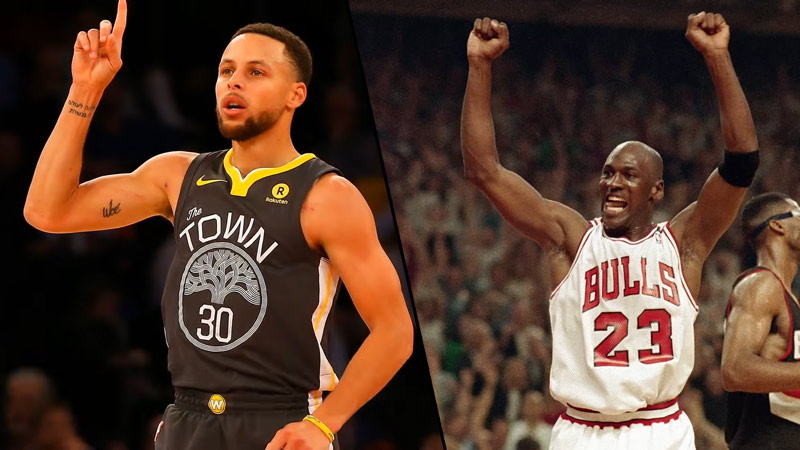
Michael Jordan has the better overall stats, while Stephen Curry has the better shooting stats. That is the short answer to the Curry vs Jordan debate when you look only at the numbers.
Both players changed basketball. Jordan won six championships with the Chicago Bulls in the 1990s. Curry won four with the Golden State Warriors and changed how teams use the three-point line. Fans argue about them all the time, and the numbers are the best way to settle it.
This post compares Curry vs Jordan stats in scoring, shooting, playmaking, defense, playoffs, and awards. Curry’s numbers run through the end of the 2025-26 season. He is still active, so his career totals will keep growing. Jordan’s numbers are final.
Curry vs Jordan Career Stats: Regular Season
The two careers are almost the same length, about 1,070 games each, which makes this a fair side-by-side comparison.
Regular season stat | Stephen Curry | Michael Jordan |
|---|---|---|
Games played | 1,069 | 1,072 |
Points per game | 24.8 | 30.1 |
Rebounds per game | 4.7 | 6.2 |
Assists per game | 6.3 | 5.3 |
Steals per game | 1.5 | 2.3 |
Blocks per game | 0.3 | 0.8 |
Field goal % | about 47% | 49.7% |
Three-point % | 42.2% | 32.7% |
Free throw % | about 91% | 83.5% |
Three-pointers made | 4,248 | 581 |
Total points | about 26,500 | 32,292 |
Player Efficiency Rating (PER) | 23.1 | 27.9 |
Jordan leads in points, rebounds, steals, blocks, field goal percentage, and PER. Curry leads in assists, three-point percentage, free throw percentage, and three-pointers made. Jordan’s career PER of 27.9 is the highest in NBA history.
Scoring: Jordan Holds a Clear Edge
Jordan averaged 30.1 points per game, the highest career scoring average in NBA history. Curry’s 24.8 is very good, but it is more than five points lower.
Jordan won 10 scoring titles, including seven straight from 1987 to 1993. Curry won two, in 2016 and 2021. Jordan’s best scoring season was 1986-87, when he averaged 37.1 points. Curry’s best was 2020-21, when he averaged 32.0.
They scored in very different ways. Jordan did most of his work at the rim and from mid-range. He attacked the basket, drew fouls, and hit pull-up jumpers over defenders. Curry built his scoring on the three-point shot, often from well beyond the line, and on constant movement without the ball.
Curry has aged well as a scorer. He averaged 26.6 points per game in 2025-26 at age 37, though he played only 43 games.
Jordan’s totals include two seasons with the Washington Wizards at ages 38 and 39, when he still averaged 22.9 and 20.0 points. Even with those later years pulling his average down, Jordan stays ahead in every scoring category.
Shooting Efficiency and Three-Point Stats: Curry Wins
Curry is the clear winner in shooting. He has made 4,248 regular season three-pointers, the most in NBA history, at a 42.2% rate. Jordan made 581 threes in his entire career at 32.7%.
Curry made 402 threes in 2015-16 alone, which is still the single-season record. That same season he shot 50.4% from the field, 45.4% from three, and 90.8% from the free throw line. He also became the first unanimous MVP in league history.
His career free throw percentage is about 91%, one of the best marks ever. Jordan shot 83.5% from the line.
Field goal percentage favors Jordan, 49.7% to about 47%. But that stat treats a three-pointer the same as a two-pointer. True shooting percentage counts the extra point on threes and adds free throws.
By that measure, Curry’s career mark is close to 63%, while Jordan’s is about 57%. In simple terms, Curry gets more points out of each shot he takes.
Jordan was very efficient for a high-volume mid-range scorer. Still, on a points-per-shot basis, Curry is the more efficient scorer of the two.
Playmaking and Rebounding Stats
Curry averages 6.3 assists per game to Jordan’s 5.3. That fits their roles. Curry is a point guard who has run the Warriors’ offense for most of his career. Jordan was a shooting guard in the Bulls’ triangle offense, which spread ball handling across several players.
Curry’s best passing season came in 2013-14, when he averaged 8.5 assists. Jordan’s best all-around season was 1988-89, when he averaged 32.5 points, 8.0 rebounds, and 8.0 assists.
Jordan was the better rebounder at 6.2 per game compared with Curry’s 4.7. At 6 feet 6 inches, Jordan was four inches taller than Curry and spent more time near the basket.
The all-around box score leans toward Jordan. Curry’s edge is in passing, where his assist numbers are higher across his career.
Defensive Stats: The Biggest Gap
Defense is where Jordan pulls furthest ahead. He won Defensive Player of the Year in 1987-88, the same season he won MVP and the scoring title. He made the All-Defensive First Team nine times and led the league in steals three times.
His career average of 2.3 steals per game is among the best ever. He also averaged 0.8 blocks per game, a high number for a guard.
Curry has never made an All-Defensive team. He did lead the NBA in steals in 2015-16 with 2.1 per game, and his career average of 1.5 steals is solid. Opponents have often targeted him on defense, and at 6 feet 2 inches he gives up size against bigger guards and wings.
On this side of the ball, the stats and the honors both point to Jordan.
Playoff and NBA Finals Stats
Jordan’s playoff numbers are the strongest part of his case, and they are the hardest for any player to match.
Playoff stat | Stephen Curry | Michael Jordan |
|---|---|---|
Playoff games | 155 | 179 |
Points per game | 26.8 | 33.4 |
Rebounds per game | 5.3 | 6.4 |
Assists per game | 6.1 | 5.7 |
Championships | 4 | 6 |
NBA Finals record | 4-2 | 6-0 |
Finals MVP awards | 1 | 6 |
Jordan’s 33.4 points per game is the highest playoff scoring average in NBA history. He averaged 41.0 points in the 1993 Finals against Phoenix. He never needed a Game 7 in the Finals and won Finals MVP all six times.
Curry also raised his scoring in the playoffs, from 24.8 to 26.8 points per game. His best Finals came in 2022, when he averaged 31.2 points against Boston and won his first Finals MVP. He also holds the record for most three-pointers made in playoff history.
Curry lost two Finals. The 2016 loss to Cleveland came right after a 73-9 regular season. The 2019 loss to Toronto came with Kevin Durant and Klay Thompson injured.
Both players had strong teammates, Jordan with Scottie Pippen and Curry with Thompson, Draymond Green, and Durant. In a stats comparison, though, Jordan’s perfect Finals record and six Finals MVPs give him the edge.
Awards and Accolades: Curry vs Jordan
Jordan leads in nearly every major award category.
Award | Stephen Curry | Michael Jordan |
|---|---|---|
MVP awards | 2 | 5 |
Scoring titles | 2 | 10 |
All-Star selections | 12 | 14 |
All-NBA First Team | 4 | 10 |
All-NBA selections (any team) | 11 | 11 |
Defensive Player of the Year | 0 | 1 |
All-Defensive First Team | 0 | 9 |
Steals titles | 1 | 3 |
Curry’s 2016 MVP was the first unanimous MVP vote in league history. He also won Clutch Player of the Year in 2024 and an Olympic gold medal that same summer.
Jordan won Rookie of the Year in 1985 and two Olympic gold medals, in 1984 and 1992. Curry is still adding to his list, but the gap in MVPs and scoring titles is large.
Era Context: Why Raw Stats Do Not Tell the Whole Story
Comparing players from different decades is tricky, because the game in the 1990s was not the same as the game today.
Pace was slower in Jordan’s title seasons, roughly 90 to 98 possessions per team per game. In Curry’s prime it has run about 96 to 100. More possessions usually mean more chances to score, which makes Jordan’s 30.1 points per game even more notable.
The three-point shot is the biggest change. Teams took roughly 7 to 17 threes per game during Jordan’s title seasons. In recent seasons they take more than 35. Curry is a major reason for that jump, since his success pushed teams to shoot more threes and space the floor in new ways.
Rules changed too. Hand-checking was allowed for much of Jordan’s career and was largely removed by 2004, which made his drives more physical.
Zone defenses were illegal until 2001, though, so help defenders could not crowd him as easily. Curry faces zones, traps, and double teams built to stop his shot far from the basket.
Neither era was easier in every way. The fair approach is to read both players’ stats with these differences in mind.
Final Verdict: Who Is Better, Curry or Jordan?
By the stats, Michael Jordan is the better player overall. He leads in regular season and playoff scoring, rebounds, steals, blocks, PER, MVPs, scoring titles, Finals MVPs, and defensive honors. His 6-0 Finals record is the single strongest point in his favor.
Stephen Curry wins on shooting. He is the career leader in three-pointers, with higher three-point and free throw percentages and a much higher true shooting mark. He is also the better passer by the numbers.
Here is the category count from this comparison:
- Jordan wins: scoring, rebounding, defense, playoffs, and awards
- Curry wins: three-point shooting, overall efficiency, and assists
Curry’s effect on how basketball is played may be larger than any single stat can show. That is a separate question from who has the better numbers, though. On the stats alone, Jordan is better, and Curry is the greatest shooter the game has seen.