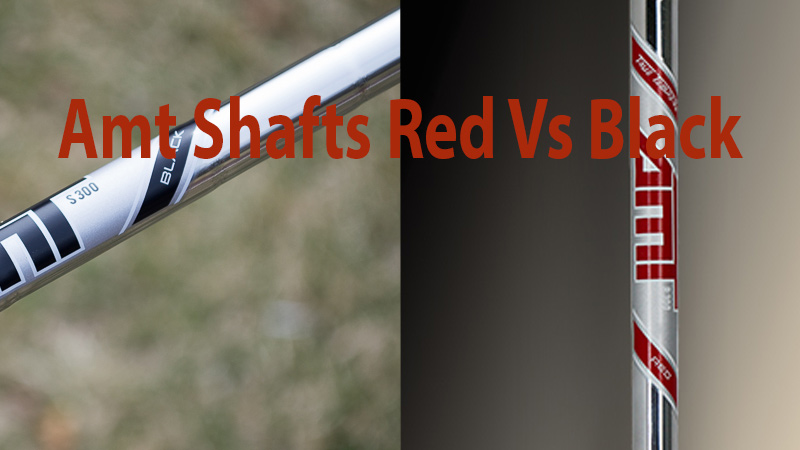
In the pursuit of the perfect iron set, golfers often focus on the clubhead—the aesthetics of a T100 or the forgiveness of a T350. However, elite players and master fitters know a fundamental truth: the shaft is the engine of the golf club.
For Titleist, the engine of choice for a vast majority of players is the AMT (Ascending Mass Technology) series.
Choosing between the AMT Red and the AMT Black is not merely a choice of color; it is a strategic decision that affects your launch window, spin rate, and, ultimately, your ability to hold greens under pressure.
This comprehensive guide breaks down the engineering, the player profiles, and the data-driven performance metrics of these two industry-leading shafts to help you dominate your next round.
The Foundation: Understanding Ascending Mass Technology (AMT)
Before diving into the specific models, it is essential to understand the “AMT” philosophy. Traditional iron shafts are “constant weight,” meaning the shaft in your 4-iron weighs the same as the shaft in your pitching wedge. Titleist’s Ascending Mass Technology flips this script.
In an AMT set, the shafts get progressively heavier as you move from the long irons to the short irons.
- The Benefit in Long Irons: Lighter shafts in your 4, 5, and 6-irons increase clubhead speed and promote a higher launch, making these traditionally difficult clubs easier to hit.
- The Benefit in Short Irons: Heavier shafts in the 8, 9, and PW provide more stability and a tighter dispersion where accuracy and flight control are paramount.
AMT Red: The High-Launch Catalyst
The AMT Red is engineered for the player who needs maximum “help” from their equipment. It is the lightest and highest-launching option in the AMT family.
1. Technical Specifications and Intent
The AMT Red is characterized by high launch and high spin. By utilizing a softer tip section, Titleist engineers have created a shaft that helps “kick” the ball into the air.
This is particularly beneficial for players with moderate swing speeds or those who naturally struggle with a low, “boring” ball flight that fails to stop on firm greens.
2. Overcoming the “Ballooning” Fear
A common concern among golfers is that a high-launch/high-spin shaft will “balloon” or become uncontrollable in the wind.
However, real-world testing and player feedback suggest otherwise. Even with the AMT Red in graphite or steel, skilled players report the ability to flight the ball down into a low punch draw when necessary.
3. Ideal Player Profile: The Distance Seeker
If you find yourself losing distance on calm days or with a tailwind because your trajectory is too low, the Red is your “no-brainer” solution. It optimizes the angle of descent, ensuring that even your long irons land softly on the green rather than skidding off the back.
AMT Black: The Versatile “Goldilocks” Shaft
The AMT Black is often described as the “bridge” shaft. It sits perfectly between the high-launching Red and the low-launching, tour-weighted AMT White.
1. Technical Specifications: Mid-High Launch
The Black offers a mid-high launch with medium spin. It provides a slightly stiffer profile than the Red, which offers a more “piercing” trajectory while still maintaining the easy-launch benefits of the AMT technology in the long irons.
2. The Stability Factor
For golfers whose swing speeds are beginning to trend upward—specifically those moving into the 90+ mph range with a 7-iron—the AMT Black provides the necessary stability to prevent the ball from over-spinning.
It offers a tighter “feel” through the impact zone, which many mid-to-low handicap players prefer for shot-shaping.
3. Ideal Player Profile: The All-Rounder
The AMT Black is for the golfer who wants a balance. You want the speed of a lighter long iron, but you don’t want the “whippy” feel that sometimes accompanies high-launch shafts. It is a favorite for the 9-15 handicap range player who is ball-striking with increasing consistency.
Data-Driven Decisions: Swing Speed and Flex
One of the most critical aspects of shaft selection is understanding that “Flex” and “Model” are two different levers a fitter can pull.
1. The 90 MPH Threshold
As swing speed increases, the load placed on the shaft during the transition increases. A player swinging in the low-to-mid 90s (mph) might be tempted to stick with the AMT Red for the distance, but experts often recommend moving to a stiffer shaft or the AMT Black to manage dispersion.
2. Dispersion vs. Launch
While the AMT Red might give you 5 extra yards of carry, if your dispersion (the width of your miss pattern) increases, those yards are useless.
A shaft that is too soft for your swing speed will lead to a wider dispersion; a shaft that is too stiff may result in a “block” or a fade that loses distance.
3. The Aging Golfer’s Dilemma
Many players in their 50s worry about losing speed over the next decade and are hesitant to move into a “Stiff” (S300) shaft. However, modern fitting focuses on the current data.
If your current speed produces excessive spin and height with a “Regular” (R300) Red shaft, moving to a Black or a stiffer flex is the correct move for now.
The Professional Fitting: Beyond the Spec Sheet
You should never choose a shaft based on a blog post alone. Titleist emphasizes that custom fitting is the only way to truly dial in these variables.
1. Key Metrics to Watch
During a fitting, look at your Angle of Descent. For most irons, a descent angle between 45 and 50 degrees is ideal for holding greens. If your AMT Black numbers are too shallow (e.g., 40 degrees), the AMT Red will help steepen that angle.
2. Trust the Data, Not the Label
A “Regular” flex in the AMT Black might actually feel and perform more like a “Stiff” in the AMT Red. This is why testing at an official Titleist fitting location is vital—they have the launch monitor data (Trackman or GCQuad) to show you exactly how the shaft is reacting to your unique release point.
3. Avoiding Post-Purchase Regret
There are instances where orders are placed incorrectly or a player chooses a shaft based on a single good swing with a demo club. Ensure your fitter verifies the order specs (model and flex) to avoid the 7-week wait for a replacement.
Enhanced FAQ: Your Questions Answered
Q: Can I mix AMT Red and AMT Black in one set?
A: While unconventional, some “combo sets” exist. However, the AMT technology is already designed to be a “combo” by weight. It is generally better to stick to one model and let the ascending mass do the work.
Q: If I play in very windy conditions, is the AMT Red a bad choice?
A: Not necessarily. As noted by Team Titleist members, the Red can still be “flighted down”. The key is ensuring your spin rate isn’t so high that the ball rises uncontrollably. If your spin is within the optimal range, the wind will have less of a negative impact.
Q: Is there a major weight difference between the two?
A: Yes, the AMT Red is the lightest of the three (Red, Black, White), followed by the Black. The weight difference is what helps generate the higher clubhead speed in the Red.
Q: Does the AMT Black come in graphite?
A: While the AMT Red is popular in both graphite and steel, the Black is primarily a steel-focused offering to provide that mid-range stability.
Conclusion: The Final Verdict
The choice between AMT Red and AMT Black comes down to your “Main Miss.”
- Choose AMT Red if: Your main struggle is low trajectory, a lack of “stopping power” on greens, or a swing speed that needs a boost from a lighter, more active shaft. It is the ultimate tool for height and carry distance.
- Choose AMT Black if: You have a moderate-to-fast swing speed, you prefer a more traditional “steel” feel with added stability, and you want a versatile, mid-flight trajectory that works in all conditions.
Ready to find your perfect flight? Don’t guess—get fitted. Visit a Titleist fitting location today to see the data for yourself and ensure your next set of irons is powered by the right engine.