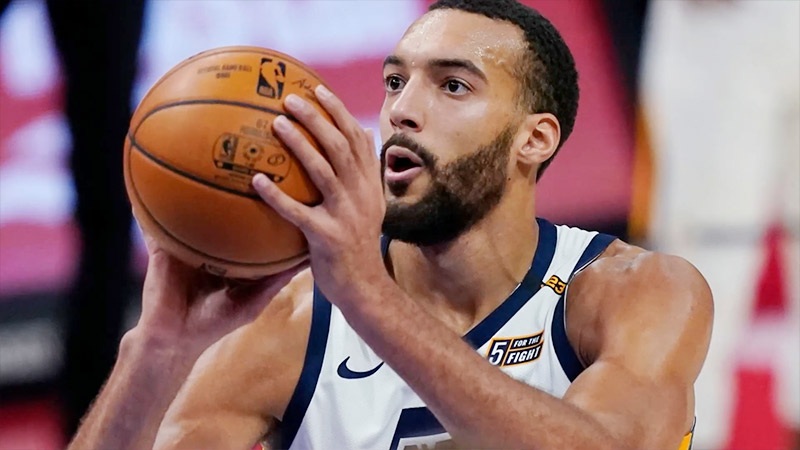
Rudy Gobert maintains a career free throw percentage of 63.3% across 13 professional seasons in the NBA. This baseline figure reflects a player who has worked diligently to overcome early-career struggles, having started with a 49.2% average in his rookie year.
However, his recent efficiency has seen a notable decline, specifically during the 2025-26 season where he shot just 52.6% from the charity stripe.
Analyzing these percentages provides vital insight into his offensive reliability, especially during high-leverage playoff moments where free throw shooting becomes a primary focus for opposing defenses and strategic coaching decisions.
Complete Breakdown of Rudy Gobert Free Throw Percentage Stats
Understanding the nuances of professional basketball statistics requires looking beyond the career average to see how a player adapts over time and under different team systems.
Career Averages and Total Shooting Volume
Over 905 career games, Gobert has established himself as a high-volume target for fouls due to his dominance in the paint.
His career average of 4.9 free throw attempts per game shows that he is a constant presence at the line, making his accuracy a vital component of his team’s offensive rating.
With a total of 11,287 points scored, a significant portion of his production stems from these opportunities, where he has successfully converted 63.3% of his attempts over 13 years.
Seasonal Highs and Historical Performance Peaks
Gobert reached his efficiency peak during the 2021-22 season with the Utah Jazz, where he shot a career-best 69.0%.
This period represented the culmination of years of technical refinement, as he averaged 6.7 attempts per game—one of the highest volumes of his career.
During this peak era, he demonstrated that he could be a near-70% shooter, which significantly mitigated the effectiveness of intentional fouling strategies employed by opposing teams.
Analyzing the Recent 2025-26 Statistical Regression
The most recent data points to a concerning trend in Gobert’s efficiency. In the 2025-26 season, his percentage dropped to 52.6%, a figure that mirrors his struggles from a decade ago.
Despite playing 76 games and maintaining a steady 31.3 minutes per game, his inability to convert at the line at his usual rate has impacted his scoring average, which fell to 10.9 points per game—his lowest since his early years in Utah.
The Evolution of Gobert’s Efficiency Across Different Eras
Tracing the trajectory of an elite center’s shooting requires a detailed look at his environmental changes and how they correlate with his performance at the stripe.
The Developmental Years in Utah (2013–2022)
Gobert’s tenure in Utah was characterized by a steady upward trajectory in both volume and accuracy.
- 2013-14 (Rookie Year): He began his journey with a 49.2% mark on limited attempts, reflecting the raw nature of his offensive game.
- The 2016-17 Breakout: He jumped to 65.3%, coinciding with a massive increase in his minutes (33.9 MPG) and scoring (14.0 PPG).
- Consistent Growth: Between 2017 and 2022, he remained largely consistent, staying within the 63% to 69% range, which solidified his reputation as a reliable enough shooter to stay on the floor during clutch moments.
- Career Game Milestone: On March 22, 2021, against Chicago, Gobert made a career-high 15 free throws, demonstrating his potential to dominate a game purely from the line.
Transitioning to the Minnesota Timberwolves (2022–Present)
Upon moving to Minnesota, Gobert initially maintained his baseline performance before encountering recent volatility.
- 2022-23 Season: He started his Timberwolves career shooting 64.4%, slightly above his career average, on 4.9 attempts per game.
- 2023-24 Season: His efficiency remained stable at 63.8%, showing that his routine was translating well to his new environment.
- 2024-25 Season: He saw a significant spike back toward his peak levels, hitting 67.4% of his shots at the line, which helped the team maintain a strong offensive floor.
- 2025-26 Season Slump: As noted previously, this season saw a sharp regression to 52.6%, ranking him among the lowest high-volume big men in the league for that period.
Detailed Rudy Gobert Free Throw Percentage Data Table
The following table provides a comprehensive historical view of the metrics mentioned in the reports, allowing for a year-by-year comparison of efficiency and volume.
| Season | Team | FT% | FTM | FTA | GP |
|---|---|---|---|---|---|
| 2025–26 | MIN | 52.6% | 2.1 | 4.0 | 76 |
| 2024–25 | MIN | 67.4% | 2.6 | 3.8 | 72 |
| 2023–24 | MIN | 63.8% | 3.3 | 5.1 | 76 |
| 2022–23 | MIN | 64.4% | 3.1 | 4.9 | 70 |
| 2021–22 | UTA | 69.0% | 4.6 | 6.7 | 66 |
| 2020–21 | UTA | 62.3% | 3.3 | 5.3 | 71 |
| 2019–20 | UTA | 63.0% | 3.7 | 5.9 | 68 |
| 2018–19 | UTA | 63.6% | 4.1 | 6.4 | 81 |
| 2017–18 | UTA | 68.2% | 3.6 | 5.3 | 56 |
| 2016–17 | UTA | 65.3% | 3.8 | 5.9 | 81 |
| 2015–16 | UTA | 56.9% | 2.6 | 4.6 | 61 |
| 2014–15 | UTA | 62.3% | 2.1 | 3.3 | 82 |
| 2013–14 | UTA | 49.2% | 0.7 | 1.4 | 45 |
| Total | ALL | 63.3% | 3.1 | 4.9 | 905 |
Factors Impacting Rudy Gobert’s Performance at the Stripe
Beyond the raw numbers, several environmental and physical factors play a role in how a defensive specialist like Gobert manages his trips to the line.
Physical Fatigue and Minutes Played
Gobert has averaged 30.7 minutes per game throughout his career, often tasked with the most grueling defensive assignments in the league.
During seasons where his minutes remained high, such as 2016-17 (33.9 MPG) or 2023-24 (34.1 MPG), his shooting generally hovered around the league average for centers.
However, the physical toll of his defensive responsibilities, including rim protection and rebounding (11.7 RPG career), can lead to late-game fatigue, which often manifests as a dip in free throw accuracy.
True Shooting Percentage and Overall Offensive Value
Despite the recent decline in free throw accuracy, Gobert’s True Shooting percentage (TS%) remains impressive at 67.2%. This metric is important because it accounts for the efficiency of field goals and free throws combined.
While his 52.6% FT performance in 2025-26 is a “notable hit,” his ability to finish at the rim with high efficiency (65.8% FG career) ensures that he remains a net-positive contributor on the offensive end.
This balance is crucial for coaching staffs when determining his role in the rotation during critical game stretches.
How Often Does Rudy Gobert Miss Free Throws?
Strategic questions regarding Gobert’s shooting often arise when discussing late-game tactics or “Hack-a-Gobert” scenarios.
Probability of Conversion vs. League Standards
With a 63.3% career average, Gobert typically makes about 3 out of every 5 attempts. In his most successful seasons, such as 2021-22, this probability increased to nearly 7 out of 10.
Conversely, in his most recent 2025-26 form, he is effectively a 50/50 shooter at the line, which invites more aggressive fouling from opponents who would rather see him shoot two than allow a high-percentage dunk.
Impact on Close Game Situations
Free throws are often the deciding factor in tight contests. In the 2025-26 season, Gobert only averaged 4.0 attempts per game, which was a drop from his career peak of 6.7.
This lower volume, combined with lower accuracy, means the Timberwolves are generating fewer points from his fouls than in previous years.
For a player who once made 15 free throws in a single game, returning to that level of focus is essential for the team’s late-game stability.
Why Did Gobert’s Free Throw Percentage Drop in 2025-26?
The sudden drop to 52.6% has been a major point of discussion for fans and analysts alike, as it represents a significant outlier in his otherwise steady career.
- Age and Wear: Now in his 13th season, the physical wear of being a defensive anchor may be affecting his shooting touch.
- Rhythm and Volume: His attempts per game dropped to 4.0 in 2025-26, and some players find it difficult to maintain accuracy on lower volume.
- League Trends: As high-volume big men are increasingly scrutinized, the pressure at the line has never been higher, and Gobert’s regression has put him among the lowest-ranked starters in this category.
- Mechanical Adjustments: While not explicitly detailed in raw stats, large-scale shifts in percentage often suggest changes in form or mental approach, which are being monitored closely by the Minnesota training staff.
Frequently Asked Questions (FAQ)
What is Rudy Gobert’s highest free throw percentage in a season?
His career-high seasonal performance was 69.0% during the 2021-22 NBA season while playing for the Utah Jazz.
What is the most free throws Rudy Gobert has made in one game?
Gobert’s personal best is 15 free throws made, achieved during a game against the Chicago Bulls on March 22, 2021.
How does his free throw shooting in 2025-26 compare to his rookie year?
His 52.6% efficiency in 2025-26 is very close to his 49.2% rookie mark, representing a significant regression after years of staying in the 60s.
Has his volume of free throw attempts decreased recently?
Yes, his attempts have seen a decline. He averaged 6.7 attempts per game in his peak 2021-22 season, compared to just 3.8 and 4.0 attempts in his two most recent campaigns.
Strategic Outlook for the Minnesota Timberwolves
The statistical profile of Rudy Gobert highlights a player who is a defensive titan but currently faces a crossroads with his offensive efficiency.
While his 63.3% career average is respectable for a center of his size and defensive workload, the recent drop to 52.6% creates a tactical vulnerability.
For Minnesota to remain competitive in a Western Conference filled with high-scoring offenses, reclaiming the 67-69% form Gobert showed as recently as 2024-25 will be paramount. Monitoring his recovery from this slump will be a key storyline for the remainder of his tenure.