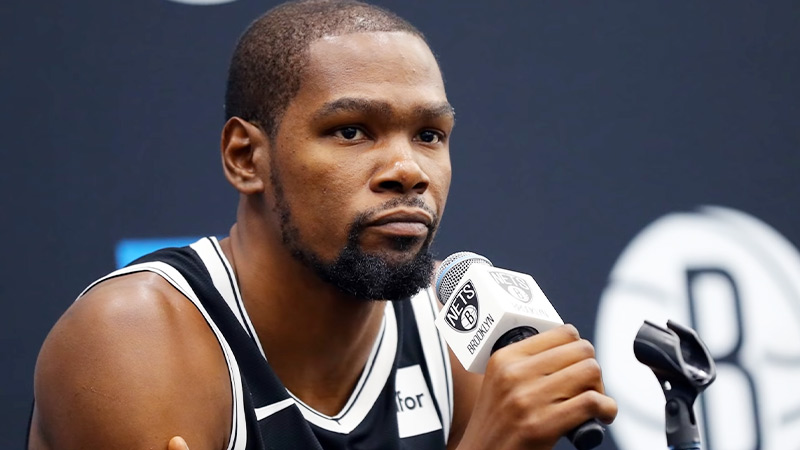
Kevin Durant made exactly 1 three-pointer on 4 attempts (25.0% 3P%) during his last game on April 21, 2026.
Playing for the Houston Rockets in a high-stakes playoff environment against the Los Angeles Lakers, Durant contributed 23 total points despite the limited perimeter output.
While his efficiency from deep was uncharacteristically low, his overall presence on the court spanned 41 minutes of intense postseason action.
This performance was his final appearance before an injury sidelined him for the following matchup on April 25, marking a pivotal moment in the Rockets’ first-round series trajectory.
Kevin Durant’s 3-Point Shooting Performance Breakdown
Analyzing these specific shooting numbers provides a clearer picture of how the Lakers’ defensive scheme neutralized one of the greatest perimeter threats in basketball history during a critical postseason opening matchup.
The Numerical Reality of the Perimeter Game
Durant’s single make from beyond the arc represents a significant departure from his usual scoring gravity. On 4 attempts, his 25.0% conversion rate highlights a night where the defense prioritized closing out on his catch-and-shoot opportunities.
By limiting him to just 4 looks from deep over 41 minutes, the opposition successfully funneled his scoring attempts toward the mid-range and the rim, forcing him to work significantly harder for every point recorded during the contest.
Evaluating Efficiency Inside the Arc
While the long-range numbers were lower than expected, Durant’s overall field goal percentage remained impressive at 58.3%.
He successfully converted 6 of his 8 two-point attempts, demonstrating his elite ability to navigate into the mid-post and rise over defenders.
This tactical shift showed that even when the three-point shot isn’t falling, Durant remains a dangerous offensive engine capable of maintaining high-volume scoring through sheer technical skill and physical advantages in the intermediate areas of the floor.
Comprehensive Game Stats: Rockets vs. Lakers April 21, 2026
The following table provides a granular look at every major statistical category from the game, illustrating the dual nature of an efficient scoring night hampered by uncharacteristic mistakes.
| Statistic | Value | Analysis |
|---|---|---|
| Points Scored | 23 | Led the Rockets’ primary offensive efforts. |
| 3-Pointers Made | 1 | A quiet night from beyond the arc (25%). |
| Field Goals | 7-12 (58.3%) | High efficiency on two-point field goals. |
| Free Throws | 8-9 (88.9%) | Near-perfect execution from the stripe. |
| Rebounds | 6 | Balanced effort with 2 offensive boards. |
| Assists | 4 | Contributed significantly to team ball movement. |
| Turnovers | 9 | A career-high-level concern in a playoff setting. |
| Minutes Played | 41 | Massive workload for the veteran superstar. |
| Plus/Minus | -2 | Reflects the tight nature of the 101-94 loss. |
Analyzing the Impact of High Turnovers and Heavy Minutes
The box score reveals a complex narrative where offensive brilliance was offset by ball security issues and the immense physical toll of playing nearly the entire game.
The Ball Security Challenge in Game 1
Perhaps the most jarring statistic from the April 21 game was Durant’s 9 turnovers. In a seven-point loss, losing the ball nearly ten times dramatically curtailed the Rockets’ chances of maintaining momentum.
These errors often stem from aggressive double-teams or late-game fatigue, both of which seemed present as the Lakers ramped up their defensive intensity in the fourth quarter.
Each giveaway essentially acted as a transition opportunity for the Lakers, swinging the game’s emotional and statistical tide.
Physical Toll: The 41-Minute Workload
Logging 41 minutes in a modern playoff game is a Herculean task for any player, let alone a veteran of Durant’s tenure. This heavy usage rate explains both his scoring consistency and his eventual decline in ball security.
When a player is on the floor for such an extended period, mental fatigue often leads to the high turnover volume seen in this matchup. This exhaustion likely played a role in the subsequent injury news that shocked the Rockets’ fanbase later that week.
Playmaking and Defensive Presence
Despite the errors, Durant managed to contribute 4 assists, 1 steal, and 1 block. This all-around activity shows that his value extends far beyond just “how many 3s” he makes.
By facilitating for others and protecting the rim, he kept Houston within striking distance until the final whistles.
His 6 rebounds, including 2 on the offensive glass, provided extra possessions that the Rockets desperately needed to offset their poor shooting from the perimeter as a collective unit.
Tactical Analysis of the Defensive Coverage
Success for any opponent against a player of this caliber requires a disciplined approach that forces him into his least favorite spots on the hardwood.
Doubling the Perimeter Threat
The Lakers’ strategy was clear: do not let Durant get comfortable at the three-point line. By utilizing “soft doubles” and ensuring a hand was always in his face during perimeter catches, they limited him to just 4 attempts.
This disciplined close-out strategy is a primary reason his percentage dropped to 25.0%. Defenses often prefer to give up a mid-range jumper rather than a rhythm three-pointer, and that gamble paid off for Los Angeles in this victory.
Forcing the Drive and Mid-Range Game
By denying the three-point line, the defense funneled Durant into the “teeth” of the paint. While he was successful here—shooting nearly 60% overall—it required more physical contact and more complex decision-making.
This tactical choice by the Lakers likely contributed to the high turnover count, as the congestion in the lane makes passing lanes tighter and strips more common. It was a calculated risk to let him score 23 points if it meant disrupting his team’s overall rhythm.
Injury Status and Series Outlook
The performance on April 21 turned out to be a bittersweet finale for this specific stage of the postseason, as the fallout became clear only days later.
Why Durant Missed the Next Playoff Game
The high-intensity 41-minute performance took a visible toll, as Durant was ruled out for the follow-up game on April 25 due to an injury.
This absence left a massive void in the Rockets’ lineup, stripping them of their most efficient scorer and primary offensive focal point.
The transition from a 23-point performance to an inactive status changed the entire complexion of the first-round series, forcing the coaching staff to look for alternative scoring options.
How the Rockets Adjusted Without Their Star
Losing a player who contributes 23 points and 4 assists is nearly impossible to overcome in the postseason.
Without Durant’s gravity on the court, the Lakers were able to tighten their defense on the remaining Rockets players, no longer needing to worry about the elite mid-range game that Durant displayed on April 21.
The injury emphasized just how much the team’s success relied on his ability to stay on the floor and manage the heavy offensive burden.
Frequently Asked Questions: KD’s Playoff Stats
How many 3-pointers did Kevin Durant make in his last game?
He made exactly 1 three-pointer out of 4 attempts.
What was the final score of the game?
The Houston Rockets lost to the Los Angeles Lakers 101-94 on April 21, 2026.
Did Kevin Durant play in the game following the April 21 loss?
No, he missed the game on April 25, 2026, due to an injury sustained during his 41-minute performance.
What was Durant’s total scoring and efficiency in his last appearance?
He scored 23 points, shooting 7-of-12 (58.3%) from the field and 8-of-9 (88.9%) from the free-throw line.
How many turnovers did Durant have against the Lakers?
He recorded a high of 9 turnovers during the contest.