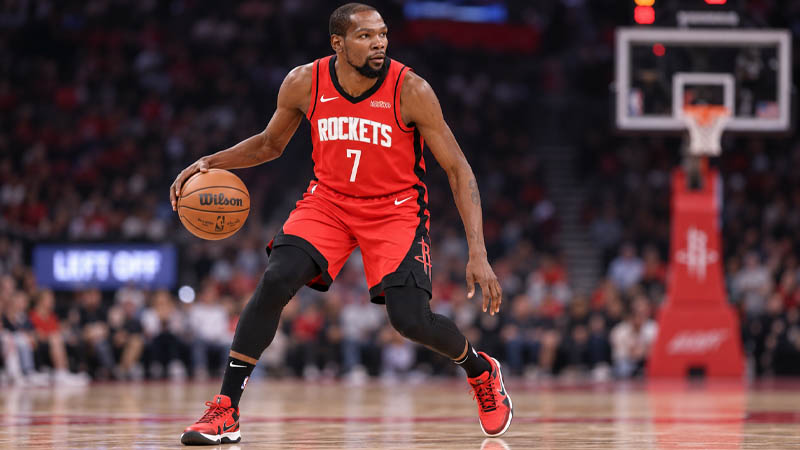
Kevin Durant is officially listed as both a small forward (SF) and a power forward (PF), but in 2026, he primarily functions as a power forward for the Houston Rockets. Throughout his 19-year career, he has played 74% of his total minutes at SF and 21% at PF.
While he dominated as a small forward during his MVP years with the Oklahoma City Thunder, his role has shifted toward the frontcourt in recent seasons to accommodate modern small-ball lineups and maximize his 6’11” frame.
Consequently, he remains functionally both, offering unique positional versatility for teams.
Defining Kevin Durant’s Role in Modern Basketball
Understanding where Durant fits on the floor today requires an analysis of the distinction between his official listing and his tactical utility within modern defensive and offensive schemes utilized by coaching staffs.
Current Listing with the Houston Rockets
As of August 2026, Durant’s role with the Houston Rockets is firmly established within the frontcourt as a primary Power Forward. This designation reflects the current state of the league, where versatility is prioritized over traditional rigid roles.
While he maintains the agility of a perimeter player, his presence at the 4-spot allows the Rockets to utilize faster lineups without sacrificing the height necessary for rebounding and interior shot contests.
Historical Dominance at Small Forward
For the majority of his time with the Oklahoma City Thunder and Golden State Warriors, Durant primarily played as a Small Forward. During this span, he utilized his elite perimeter scoring, handle, and quickness to overwhelm traditional wings.
His speed and scoring prowess at this position were instrumental in winning four scoring titles and the 2014 NBA MVP, proving his absolute dominance as a perimeter-based engine.
The Impact of a 19-Year Career Arc
Over nearly two decades, Durant has experienced a drastic positional inversion, transitioning from a perimeter wing to a frontline anchor. This evolution is not just a result of aging but a reflection of the NBA’s shift toward positionless basketball.
His career minutes breakdown—74% at SF and 21% at PF—highlights a player who spent his prime on the wing before adapting to the interior.
Fantasy Basketball and Official Eligibility
If you are managing a fantasy basketball roster or reviewing official team sheets, Durant is almost universally eligible at both SF and PF positions.
This dual eligibility is a testament to his unique physical profile. He provides the statistical benefits of a big man, such as blocks and rebounds, while contributing the elite shooting and free-throw percentages typically associated with guards.
The Strategic Shift: Why Did KD Move to Power Forward?
The transition to the power forward spot was a calculated move intended to maximize Durant’s efficiency while extending his longevity following major career milestones and physical changes.
Preserving Lateral Energy After Injury
Following his Achilles injury, the Brooklyn Nets permanently shifted Durant to the PF position. This move was designed to conserve his lateral energy on defense, as guarding quicker perimeter wings is often more taxing than defending post players or interior bigs.
By playing the “4,” he could focus his defensive efforts on rim protection and help-side rotations rather than chasing guards through screens.
Modern Small-Ball Lineup Requirements
In the contemporary NBA, small-ball lineups dictate that a 6’11” frame like Durant’s is best utilized anchoring the paint and spacing the floor.
As teams prioritize floor spacing, having a power forward who can shoot from anywhere on the court creates immense gravity. This opens up driving lanes for teammates while forcing opposing big men to leave the basket to contest his shots.
Utilizing the Screen-and-Roll Weapon
By moving to the power forward position, teams have been able to utilize Durant as a frequent screen-and-roll weapon. His ability to “pop” to the three-point line or “roll” to the rim makes him a nightmare for opposing defenses to track.
This shift has allowed him to become a mid-post engine, facilitating the offense from the heart of the court.
Breaking Down the Career Eras by Position
Each chapter of Durant’s storied career has featured a different positional focus, adapting to the needs of his teammates and the philosophy of his head coaches.
Seattle SuperSonics: The Shooting Guard Anomaly
In his rookie season (2007–2008), head coach P.J. Carlesimo famously played the 6’9″ rookie almost entirely at Shooting Guard. This was the only year of his career where he was not classified as a forward.
It served as a developmental “blueprint,” forcing the young star to hone his ball-handling and perimeter defense against much smaller, faster opponents.
Oklahoma City Thunder: The Premier Perimeter Threat
During his tenure in Oklahoma City, Durant played over 95% of his minutes at the Small Forward position. Playing alongside traditional interior forces like Serge Ibaka and Kendrick Perkins, he was freed to operate as a pure perimeter scorer.
This era defined his legacy as one of the greatest wing players to ever step onto a basketball court.
Golden State Warriors: The Defensive Hybrid
While officially starting at SF in Golden State, Durant frequently operated as a hybrid in the legendary “Death Lineup”. In these scenarios, he would slide to the PF spot, allowing the Warriors to switch every screen defensively.
His size allowed him to function as a weak-side rim protector while maintaining the speed required to slash on offense.
Brooklyn Nets to Houston Rockets: The Frontline Pivot
From 2020 through 2026, Durant’s career has been defined by his role as a Power Forward. In Brooklyn, he played roughly 85% of his minutes at the “4,” a trend that solidified during his stretches with the Phoenix Suns and the Houston Rockets.
Today, he is primarily viewed as a half-court closer and interior help defender.
Summary of Kevin Durant’s Positional Assignments
The following data provides a comprehensive overview of how Durant’s role has transformed across different team eras and tactical requirements throughout his career.
| Team Era | Primary Position Listed | Defensive Assignment | Offensive Role |
|---|---|---|---|
| Sonics (2007–08) | Shooting Guard (SG) | Perimeter Guards | Isolation / Wing Scorer |
| Thunder (2008–16) | Small Forward (SF) | Wings / SFs | Primary Scorer / Shot Creator |
| Warriors (2016–19) | Small Forward (SF) | Wings & Bigs | Weak-side Rim Protector / Slasher |
| Nets (2020–23) | Power Forward (PF) | Post Bigs / Low-man | Pick-and-Pop / Mid-post Engine |
| Suns / Rockets (2023–26) | Power Forward (PF) | Interior Help / PFs | Floor Spacer / Half-court Closer |
Why Durant Blurs Traditional Position Lines
Durant is often referred to as a “unicorn” because his physical attributes and skill set do not align with any single traditional basketball position or archetype.
- Elite Handle and Perimeter Playmaking: Despite his height, Durant possesses the ball-handling skills of a point guard. This allows him to initiate the break and create his own shot from the perimeter, a trait rarely seen in players who spend 21% of their career at power forward.
- Rim Protection and Post Defense: With a massive wingspan and a 6’11” frame, he can defend bigger players and protect the rim like a traditional power forward or center. This defensive versatility is a primary reason why modern coaches prefer him in the frontcourt.
- Shooting Range and Gravity: His ability to shoot with high efficiency from beyond the arc forces opposing power forwards to guard him on the perimeter. This “gravity” disrupts traditional defensive structures, making him a perpetual threat regardless of his listed position.
- Physical Profile vs. Skill Set: Functionally, he is a hybrid. He combines the physical profile of a big man with the shooting range and elite scoring of a shooting guard.
Frequently Asked Questions About Durant’s Position
Is KD better at small forward or power forward?
Statistically, Durant’s most productive scoring years came at Small Forward, where he won his MVP and scoring titles. However, his transition to Power Forward has arguably made him a more impactful all-around player in the modern era.
Playing the “4” has allowed him to showcase his elite rim protection and interior passing, which were less emphasized earlier in his career.
What is Durant’s official height and how does it affect his position?
Durant is officially listed at 6’11”, though he has often been described as nearly seven feet tall. His height is the primary factor in his positional shift.
While he has guard skills, his size makes him a natural fit for the Power Forward spot in small-ball lineups, where he can anchor the paint without being outmatched physically.
Can Kevin Durant play center in small-ball lineups?
While the sources do not explicitly list him as a Center, his role in Golden State’s “Death Lineup” and his current duties as an interior help defender suggest he can function as a small-ball big.
His 6’11” frame and weak-side rim protection allow him to occupy the space typically reserved for centers in high-speed, versatile lineups.
How does his position affect fantasy basketball eligibility?
In most fantasy basketball platforms, Durant is eligible at both SF and PF. This is a massive advantage for managers, as it provides flexibility when building a daily lineup.
He provides “out-of-position” stats, giving you the blocks of a forward and the three-pointers and percentages of an elite wing.
The Future of Positionless Greatness
Kevin Durant’s journey from a rookie shooting guard in Seattle to a frontline anchor in Houston is one of the most unique trajectories in NBA history. He has proven that elite talent is not confined by traditional labels.
Whether he is facilitating from the wing as an SF or protecting the rim as a PF, his impact remains consistent.
As the game continues to evolve toward a more fluid, positionless style, Durant stands as the ultimate blueprint for the modern professional basketball player.
For fans and coaches alike, the answer to whether he is a SF or PF is simple: he is whatever the team needs him to be to win.