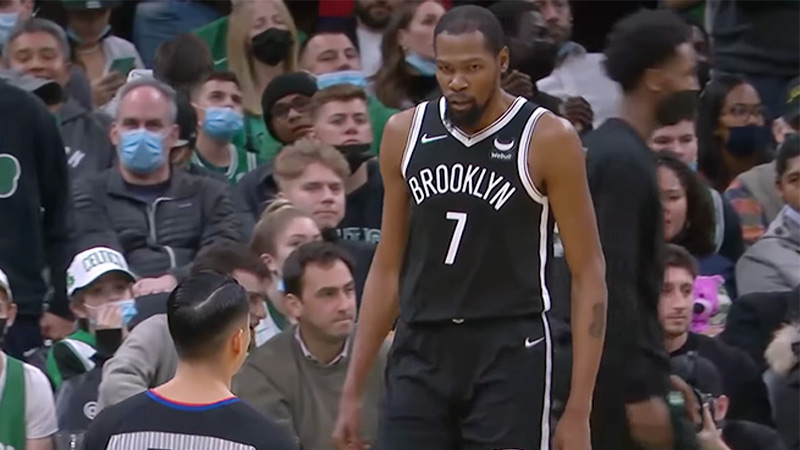
Yes, Kevin Durant remains a premier fantasy basketball asset, holding a firm second-round valuation for the 2025–26 season.
Despite approaching age 38, he remains a “fantasy cheat code” due to his elite scoring, unmatched efficiency, and multi-categorical contributions. Across his 18-year career, Durant has never finished below the top 12 in per-game value when healthy.
Currently with the Houston Rockets, he provides a rare anchor for both field-goal and free-throw percentages while delivering 26.0 points per game.
For managers seeking a high-floor superstar who stabilizes a roster without major statistical weaknesses, Durant is an essential draft target.
The Statistical Blueprint of a Fantasy Icon
To understand why Kevin Durant is consistently ranked at the top of every draft board, one must examine the sheer volume and efficiency he provides. Across 1,201 regular-season games, he has built a resume that is virtually unmatched in the history of the game.
| Category | Career Average (18 Seasons) | 2025-26 Performance (Rockets) |
|---|---|---|
| Points (PPG) | 27.1 | 26.0 |
| Field Goal % | 50.3% | 52.0% |
| Free Throw % | 88.2% | 87.4% |
| Three-Pointers | 2.0 | 2.4 |
| Rebounds (RPG) | 6.9 | 5.5 |
| Assists (APG) | 4.4 | 4.8 |
| Steals (SPG) | 1.1 | 0.8 |
| Blocks (BPG) | 1.1 | 0.9 |
| Turnovers (TOPG) | 3.2 | 3.1 |
Durant’s greatest strength is his ability to contribute at an elite level without a significant “punt” category, other than turnovers, which are common for high-usage stars.
His 2025-26 season with Houston shows a slight decline in rebounds and defensive statistics, but his scoring and playmaking remain remarkably steady.
How the Percentage Anchor Dominates Category Leagues
Understanding the mathematical advantage of drafting Durant is crucial for any high-stakes fantasy manager. Most high-volume scorers in the NBA rely on a large number of perimeter shots, which often leads to a lower field-goal percentage that can drag down a team’s efficiency.
The Mathematical Advantage of High-Volume Efficiency
Durant is a rare outlier who boosts both efficiency metrics while maintaining a high scoring output. His career 50.3% field-goal percentage is incredible for a player who takes a significant number of jump shots and three-pointers.
When you pair this with his 88.2% free-throw average on 7.4 attempts per game, you have a player who essentially wins you two categories while providing the backbone for a third (points).
Balancing Roster Flaws with 50/40/90 Production
Managers who draft Durant gain the flexibility to take risks on high-upside players who may have shooting struggles. For instance, if you draft a guard with poor field-goal percentages, Durant’s hyper-efficiency serves as a corrective force.
His entry into the 50/40/90 club—shooting 50% from the field, 40% from deep, and 90% from the line—is a feat that mathematically optimizes category-based team builds by providing zero negative drag on your percentages.
Analyzing the Four Core Eras of Durant’s Career
Durant’s longevity is not just about staying on the court; it is about how his role has shifted to provide different types of fantasy value over two decades. Each era offered a unique “cheat code” for managers.
The Oklahoma City Dominance and Scoring Titles
During his tenure with the Thunder, Durant was a raw scoring machine. He led the NBA in total points scored four separate times between 2010 and 2014. This era was defined by his 2013-14 MVP season, where he averaged a massive 32.0 points per game.
During this period, he was a perennial top-3 asset, often challenging for the number one overall spot due to his heavy minutes and massive free-throw volume.
The Golden State Unicorn and Rim Protection
When Durant moved to the Warriors, his raw scoring volume dipped slightly, but his fantasy utility actually increased in specific areas. He transformed into a “Unicorn” defensive asset, peaking at 1.8 blocks per game in 2017-18.
This allowed managers to win the blocks category from the small forward position, an “out-of-position” stat that provided an unmatched structural advantage over opponents who were forced to draft clunky, non-shooting centers to get that same rim protection.
The Brooklyn and Phoenix Efficiency Masterclass
Following his Achilles injury in 2019, Durant refined his game into a model of pure efficiency. During the 2022-23 season, he put up nearly 30 points per game on historic 56% field-goal and 93.4% free-throw splits.
While he missed chunks of time during these years, his per-game value remained top-5 in the league, even if his total value occasionally fell to the second round because of missed games.
The Houston Veteran Durability Era
The most recent stage of his career in Houston has been defined by a surprising “durability bounceback”. In the 2025-26 season, Durant played 78 games, silencing critics who suggested his age would lead to constant rest schedules.
He finished the season as a top-10 total value asset, demonstrating that he can still carry a heavy load in a professional environment while anchoring efficiency metrics for a young Rockets squad.
Is the Houston Rockets Volume Logjam a Real Concern?
While Durant remains elite, the current context of the Houston Rockets roster introduces new variables that managers must consider. The team features several young, high-usage players who impact Durant’s ceiling.
Sharing the Floor with Sengun and Thompson
The Rockets are a deep team with primary offensive options like Alperen Sengun and Amen Thompson.
Because Houston plays at a somewhat slower pace and distributes the ball among multiple playmakers, Durant’s field-goal attempts have capped out at around 17–18 per game.
This is a step down from his peak years when he would routinely take 20+ shots, meaning a return to a top-5 overall fantasy finish is unlikely.
The Defensive Erosion and Age Factors
As Durant enters his age-38 season, certain statistical “stocks” (steals plus blocks) are beginning to trickle downward.
In the most recent season, he averaged 0.9 blocks and 0.8 steals, which is a noticeable decline from the 1.2+ blocks he swatted earlier in his career.
While he is still a net positive in these categories for a wing, he no longer provides the elite rim protection that was his trademark during the Golden State era.
Expert Draft Strategy: Who to Pair with Durant?
To maximize a draft pick spent on Kevin Durant, you must build around his specific strengths. He is widely considered the ultimate “structural anchor” for a fantasy roster.
- The Guard Balance Strategy: Durant is the ideal target if you selected a high-turnover or poor-shooting guard in the first round, such as Trae Young or LaMelo Ball. His flawless percentages and low mistake rate perfectly balance out the high-risk metrics of those players.
- The “Out-of-Position” Build: Because Durant provides steady blocks (0.9 BPG) and rebounds (5.5 RPG) for a small forward, you can afford to draft “stretch” big men who hit threes but might be weak in traditional interior categories.
- Target Draft Range: In standard redraft leagues, you should confidently target Durant in the mid-to-late second round. His current Estimated Average Draft Position (ADP) sits between 15 and 22.
- Format Considerations: In Head-to-Head (H2H) leagues, his per-game dominance is a massive advantage in the playoffs. In Rotisserie (Roto) formats, his recent 78-game durability makes him much safer than in previous years.
Frequently Asked Questions
Is Kevin Durant still a first-round pick in fantasy?
While Durant has spent 15+ years as a first-round per-game value asset, his current ADP has shifted toward the mid-to-late second round (15–22).
This shift is primarily due to his age and the “volume logjam” in Houston, which limits his raw scoring ceiling compared to younger stars. However, in terms of per-game production, he often still performs like a top-10 player.
How does Durant’s age affect his fantasy durability?
There was a period between 2020 and 2024 where Durant struggled to play more than 55 games a season due to various injuries. However, he alleviated many of these concerns by playing 78 games in the 2025–26 season.
While the risk of injury is naturally higher for a player nearing 40, his recent track record suggests he has found a sustainable rhythm.
What are Kevin Durant’s biggest statistical weaknesses?
The only significant negative in Durant’s fantasy profile is his turnover rate, which has averaged 3.2 per game over his career.
Aside from turnovers, he is a neutral or positive contributor in every single 9-category metric, which is why he is considered one of the most well-rounded players in history.
Should I draft Durant in a points league or a category league?
Durant is elite in both, but he truly shines in category leagues where his 50/40/90 efficiency can be weaponized to win the percentage categories.
In points leagues, his value is tied more to his 26.0 PPG scoring and 78-game availability, which still makes him a top-tier second-round selection.
Conclusion: The Legacy of the Most Reliable Wing in History
Kevin Durant’s 18-year journey through the NBA has provided fantasy managers with a masterclass in consistency. From a scoring champion in Oklahoma City to a veteran anchor in Houston, he has remained a top-12 per-game producer for nearly two decades.
Durant has never averaged below 25.0 points per game, providing the highest-floor baseline of any active player. Even as defensive statistics dip with age, his ability to facilitate the offense and maintain elite 52% field-goal splits ensures he remains a “cheat code”.
For 2026, target this living legend in the second round to stabilize your team’s percentages. He is the ultimate structural wing for victory.