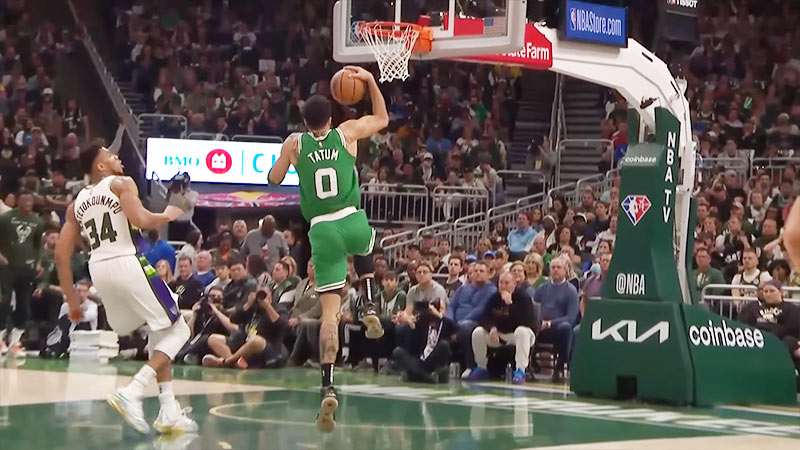
During the 2025–26 NBA season, Jayson Tatum averaged 21.8 points, 10.0 rebounds, and 5.3 assists per game. This campaign was uniquely challenging for the Boston Celtics star, as a significant Achilles injury limited him to just 16 regular-season appearances.
Despite the reduced volume, Tatum achieved a career-high in rebounding and demonstrated advanced playmaking skills. His shooting efficiency dipped to 41.1% from the field, but he remained a pivotal force when available.
This analysis explores how Tatum balanced recovery with elite production, maintaining his role as the cornerstone of the franchise during his ninth professional season.
Analyzing the 2025–26 Regular Season Statistics
The 2025–26 season stands as a statistical anomaly in Jayson Tatum’s illustrious career, primarily due to the limited sample size resulting from his health struggles.
While the scoring numbers saw a decline from previous peaks, other facets of his game reached new heights of maturity.
Why Did Jayson Tatum Average 21.8 Points?
The drop to 21.8 points per game represents Tatum’s lowest scoring output since the 2018–19 season. To understand this, one must look at his shooting efficiency and the context of his return from injury.
He converted only 41.1% of his field goal attempts and 32.9% of his shots from beyond the arc. These figures are notably below his career field goal average of 45.8% and his career three-point average of 36.8%.
The physical toll of his Achilles injury likely hampered his lift and rhythm, making it difficult to maintain the 30-PPG pace he set just a few years prior.
Breaking Down the Career-High 10.0 Rebounds
One of the most impressive developments this year was Tatum’s dominance on the glass. For the first time in his career, he averaged a double-double, pulling down exactly 10.0 rebounds per game. This surpassed his previous season high of 8.8 rebounds per game set in 2022–23.
By utilizing his size and positioning, Tatum became a more effective defensive rebounder, allowing the Celtics to initiate fast breaks more quickly. This shift suggests that even when his scoring touch was inconsistent, he found ways to provide elite value to the roster.
The Evolution of Tatum as a Playmaker
Tatum’s playmaking continued its steady upward trajectory during the 16 games he appeared in. He averaged 5.3 assists per game, a mark that significantly exceeds his career average of 3.9.
Over the last three seasons, his assist numbers have climbed from 4.9 to 6.0 and settled at 5.3 this year, indicating a permanent shift in his role from a pure scorer to a primary offensive engine.
This evolution allowed the Celtics to maintain a sophisticated offensive flow even when the defense focused on neutralizing Tatum’s individual scoring threats.
How the Achilles Injury Affected Tatum’s Year
The defining narrative of the 2025–26 campaign was the significant Achilles injury that sidelined Tatum for the vast majority of the regular season. This setback interrupted the rhythm of a player who had previously been remarkably durable.
Resilience Following a Significant Setback
An Achilles injury is one of the most taxing physical hurdles an elite athlete can face, requiring meticulous rehabilitation and a cautious return to action. For Tatum, this meant appearing in only 16 games, a stark contrast to his usual availability.
Despite the injury, his ability to return for both the tail end of the regular season and the playoffs demonstrates a high level of professional dedication and physical resilience.
His presence on the court, even in a limited capacity, provided a necessary psychological boost to his teammates and the coaching staff.
Comparing Game Volume to Previous Campaigns
Prior to this season, Tatum was a model of consistency and availability for the Boston Celtics. In his first eight years, he never played fewer than 64 games in a single season, and he appeared in 80 games as a rookie.
Reaching a total of 601 career regular-season games by his ninth year highlights his status as a reliable centerpiece.
The 16-game season of 2025–26 serves as a rare outlier in a career defined by high-volume participation and sustained excellence at the highest level of professional basketball.
Postseason Resilience: Playoff Averages and Impact
When the stakes were highest, Tatum showed flashes of his peak form during the 2026 playoffs. Although the Celtics’ run was shorter than anticipated, his individual statistics during the postseason provided a more optimistic view of his recovery.
Statistical Resurgence in the First Round
In the 6 playoff games Tatum played, his efficiency and scoring both saw a marked improvement over his regular-season averages. He raised his scoring to 23.3 points per game and his rebounding to 10.7 per contest.
More importantly, his shooting percentages stabilized; he shot 47.5% from the field and 36.5% from three-point range during the postseason.
These numbers were much closer to his career norms, suggesting that as he gained more distance from his initial injury, his elite offensive mechanics began to return.
Assessing the First-Round Exit Against Philadelphia
Despite Tatum’s improved play, the Boston Celtics were unable to advance past the first round of the 2026 playoffs. The team fell in six games to the Philadelphia 76ers.
During this series, Tatum played 36.3 minutes per game and contributed 6.8 assists, showcasing his role as a floor general under intense playoff pressure.
The loss marked a disappointing end to a difficult year, but it also established a baseline for Tatum’s return to full strength in the subsequent seasons.
A Historical View of Tatum’s Career Progression
To appreciate where Tatum stands today, it is essential to review his development from a high-upside rookie to a perennial MVP candidate. His statistical growth over nine years illustrates a player who has constantly refined his craft.
| Season | Games Played | Points (PPG) | Rebounds (RPG) | Assists (APG) | FG% | 3P% |
|---|---|---|---|---|---|---|
| 2017–18 | 80 | 13.9 | 5.0 | 1.6 | 47.5% | 43.4% |
| 2018–19 | 79 | 15.7 | 6.0 | 2.1 | 45.0% | 37.3% |
| 2019–20 | 66 | 23.4 | 7.0 | 3.0 | 45.0% | 40.3% |
| 2020–21 | 64 | 26.4 | 7.4 | 4.3 | 45.9% | 38.6% |
| 2021–22 | 76 | 26.9 | 8.0 | 4.4 | 45.3% | 35.3% |
| 2022–23 | 74 | 30.1 | 8.8 | 4.6 | 46.6% | 35.0% |
| 2023–24 | 74 | 26.9 | 8.1 | 4.9 | 47.1% | 37.6% |
| 2024–25 | 72 | 26.8 | 8.7 | 6.0 | 45.2% | 34.3% |
| 2025–26 | 16 | 21.8 | 10.0 | 5.3 | 41.1% | 32.9% |
| Career | 601 | 23.5 | 7.4 | 3.9 | 45.8% | 36.8% |
Tatum has consistently improved his rebounding and assists nearly every year since entering the league. His 2025–26 rebounding average of 10.0 is double what he produced as a rookie, and his 5.3 assists per game are more than triple his first-year output.
This data confirms that while scoring fluctuates, his overall impact on the game has widened significantly over his nine-year tenure in Boston.
Frequently Asked Questions Regarding Jayson Tatum
How many games did Jayson Tatum miss this season?
Tatum appeared in only 16 regular-season games during the 2025–26 campaign. Given that a full NBA season consists of 82 games, he was absent for 66 contests.
This high number of missed games was due to a severe Achilles injury that required extensive time for recovery and rehabilitation before he could safely return to high-intensity competition.
Did Jayson Tatum’s injury affect his playoff performance?
While the injury limited his regular-season availability, Tatum’s performance in the playoffs showed signs of a strong recovery. He averaged 23.3 points and 10.7 rebounds per game in the postseason, both of which were higher than his regular-season marks.
His field goal percentage also jumped from 41.1% in the regular season to 47.5% in the playoffs, indicating that he was regaining his rhythm just as the season concluded.
What are Jayson Tatum’s career-high averages?
Tatum’s career-high in scoring occurred during the 2022–23 season, where he averaged 30.1 points per game. His career-high in rebounding was achieved this season (2025–26) at 10.0 rebounds per game.
His highest assist average came in the 2024–25 season, when he recorded 6.0 assists per game.
How has Tatum’s defensive impact changed over time?
Tatum has developed into a consistent two-way player throughout his nine-year career. He maintains a career average of 1.1 steals and 0.6 blocks per game.
During the 2025–26 regular season, he actually exceeded his career steals average by recording 1.4 per game, though his block rate dropped to 0.2 during that specific 16-game stretch. His true shooting percentage over his career stands at a solid 58.2%.
Conclusion: The Future of the Celtics Cornerstone
The 2025–26 season was a test of character and physical endurance for Jayson Tatum. While the raw scoring data and shooting percentages might suggest a decline, a deeper look at the context reveals a player who is still evolving.
Reaching double-digit rebounding for the first time and maintaining high-level playmaking while recovering from an Achilles injury is no small feat.
As he prepares for his tenth season, the statistics from his brief 2025–26 appearances—and his subsequent playoff resurgence—suggest that he remains one of the premier talents in the league.
For the Boston Celtics, a healthy and fully recovered Tatum is the most critical factor in their pursuit of future championships.