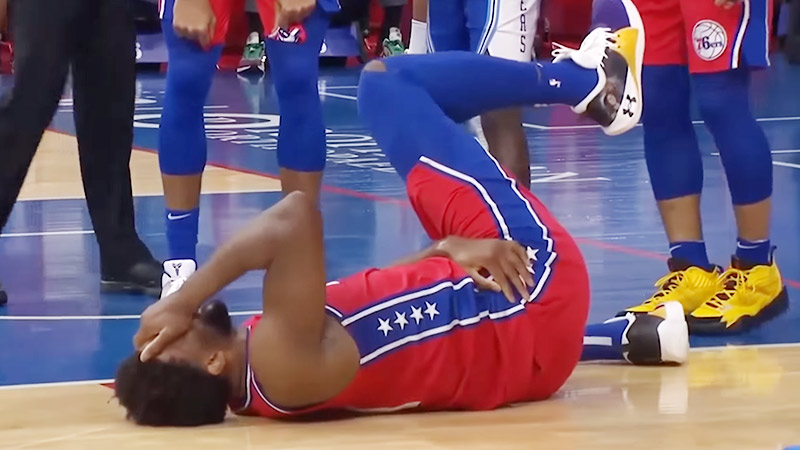
Joel Embiid is currently fully healthy and formally designated as day-to-day on the Philadelphia 76ers roster for the 2026 offseason.
He is not carrying any active structural damage and is coming off a recovery period following an emergency appendectomy performed in April 2026.
For the first time in his professional career, Embiid is entering the summer without the need for post-season surgery or intensive rehabilitation.
He is expected to be a full participant when training camp opens in late September 2026, marking a significant milestone in his medical journey.
Understanding the Joel Embiid Injury Status Today
While his current status is positive, understanding the specific hurdles he cleared during the most recent campaign is vital for fans and analysts tracking his long-term availability and performance metrics.
Recovering from the 2026 Emergency Appendectomy
On April 9, 2026, Embiid was rushed to a hospital in Houston for an emergency appendectomy. This sudden internal surgery forced him to miss the Play-In tournament and several early playoff matchups, disrupting the team’s momentum at a critical juncture.
Although he made an accelerated return mid-postseason, the abdominal operation required significant core rebuilding during the early summer months.
This was a rare non-orthopedic setback for the star center, highlighting the unpredictable medical challenges he has faced throughout his eleven-year career.
Addressing the 2026 Right Oblique Strain
During March 2026, a severe muscle tear in his side, diagnosed as a right oblique strain, sidelined Embiid for 13 consecutive regular-season contests.
This injury significantly impacted his lateral mobility and breathing while playing, which are critical for a player of his 280-pound stature.
The oblique strain contributed to him being limited to just 38 total regular-season games during the 2025–26 campaign. Such muscle strains are often viewed as compensatory issues resulting from his history of lower-body instability.
Managing Late-Season Ankle and Hip Soreness
Upon his return for the 2026 Eastern Conference Semifinals against the New York Knicks, Embiid sustained a right ankle sprain and significant hip soreness.
These ailments were categorized as compensatory joint issues, likely resulting from the uneven weight distribution following his abdominal surgery. He was forced to miss Game 2 of that series to manage the inflammation.
Fortunately, clinical evaluations following the postseason confirmed that no structural damage occurred, allowing these issues to heal completely through rest and standard physical therapy this summer.
Why Is Joel Embiid Injured So Much?
Analyzing the underlying causes of his frequent absences reveals a complex interplay between his massive physical profile, his early career surgeries, and the long-term changes to his joint health.
The Impact of Extreme Size and Weight
Standing 7-foot-0 and weighing approximately 280 pounds, the sheer force and torque placed on Embiid’s joints during high-intensity jumping and cutting are immense.
The physical burden of his frame makes his lower body particularly susceptible to stress-related injuries and inflammatory conditions.
Over his career, this has led to a staggering 109 documented incidents involving his lower body, as his joints struggle to absorb the impact of his elite-level athleticism. This physical reality remains the primary factor in his frequent “day-to-day” injury designations.
Mechanical Shifts from Early Foot Surgeries
The foundation of Embiid’s professional career was marred by two years of inactivity due to navicular bone stress fractures in his right foot.
These surgeries, which included the insertion of screws and bone grafts, permanently altered his baseline lower-body mechanics.
When a player’s foundation is structurally modified, it often leads to a “kinetic chain” of issues where the knees and hips overcompensate for the altered gait.
This historical wear-and-tear is a major reason why he has missed more than 350 regular-season games.
Degenerative Changes in Knee Joint Cushioning
A significant contributing factor to his recurring knee inflammation is the loss of protective cartilage padding.
Having undergone multiple meniscectomies, which involve the trimming or removal of the meniscus in his left knee, Embiid has reduced natural cushioning within the joint.
This lack of “padding” often results in bone bruises and chronic soreness after heavy workloads. Without the full meniscus to act as a shock absorber, the joint is constantly at risk for secondary strains and inflammatory flare-ups during the season.
Comprehensive History of Joel Embiid Career Injuries
Tracking the evolution of his medical history provides essential context for his current physical state and the resilience he has demonstrated throughout 166 separate medical incidents.
The 2014-2016 Foot Surgery Era
Embiid’s professional journey began with back-to-back season-ending surgeries before he even played a single NBA minute. A stress fracture in his back at the University of Kansas was followed by a navicular bone stress fracture discovered just before the 2014 draft.
Healing stalled in 2015, requiring a second major foot operation using bone grafts. These initial crises set a precedent for his career, highlighting a fragile physical foundation that required years of patient rehabilitation before he could finally debut in late 2016.
The 2017-2020 Facial and Knee Trauma
Following his debut, Embiid faced a series of traumatic injuries, including a torn left meniscus in 2017 that ended his rookie season after 31 games.
In 2018, a collision with a teammate resulted in a left orbital fracture and concussion, necessitating facial surgery and the use of a protective mask during the playoffs.
These years also saw a gruesome ligament tear in his left ring finger that required surgical repair in 2020. Despite these setbacks, he continued to refine his game, even as his medical folder grew exponentially.
The 2021-2024 MVP and Postseason Hurdles
During his peak years, Embiid frequently played through severe pain during the playoffs, including a lateral meniscus tear in 2021 and a second orbital fracture in 2022.
In 2023, an LCL sprain in his right knee sidelined him during crucial matchups against Brooklyn and Boston.
The 2024 season was particularly grueling, as he underwent a meniscus procedure in February and was later diagnosed with Bell’s Palsy during the postseason.
His ability to maintain MVP-level production while dealing with such structural limitations is nearly unprecedented.
The Diagnosis of Bell’s Palsy
In April 2024, Embiid was diagnosed with a mild case of Bell’s Palsy, a form of facial paralysis that affected the left side of his face. This condition caused blurred vision and dry eyes, forcing him to play through significant discomfort during the playoffs.
While not a traditional basketball injury, it represented the “general medical” category of his history, which includes 29 separate instances of respiratory illnesses and other non-orthopedic conditions.
The paralysis eventually cleared, but it remains a notable example of the unique hurdles he has faced.
Breakdown of Career Ailments by Body Region
The distribution of Embiid’s 166 separate medical incidents shows a clear concentration of issues in his lower extremities, though his entire frame has been impacted over the last decade.
- Knees (73 instances): This is his most vulnerable area, dominated by left meniscus tears, LCL strains, recurring tendinitis, and bone bruises.
- Feet & Ankle (22 instances): Includes the foundational navicular stress fractures, numerous rolling ankles, and midfoot sprains.
- Torso & Back (19 instances): Comprised of his college back fracture, the 2026 oblique muscle strain, and chronic lumbar tightness.
- Hands & Arms (11 instances): Primarily driven by torn thumb collateral ligaments and dislocated or broken fingers.
- Head & Face (4 instances): Specifically two separate orbital bone fractures, concussions, and the 2024 diagnosis of Bell’s Palsy.
- General Medical (29 instances): Encompasses respiratory illnesses, the 2026 emergency appendectomy, and various safety protocols.
Frequently Asked Questions Regarding His Health
How long will Embiid be out for?
Embiid is expected to miss zero games moving forward and currently has no recovery timeline heading into the fall.
Because he finished the 2026 playoffs without structural damage and successfully avoided the need for summer surgeries, the 76ers anticipate he will be ready for the season opener.
His recovery from the April appendectomy is complete, and he has spent the summer rebuilding his conditioning to ensure he is at peak fitness for training camp.
What was Embiid’s injury in 2026?
During the turbulent 2025-26 season, Embiid dealt with a sequence of four primary ailments: lingering knee soreness in the winter, a severe right oblique strain in March, an emergency appendectomy in April, and a right ankle sprain in May.
These rolling issues limited him to just 38 regular-season appearances, the lowest total of his recent career. However, the 76ers medically ruled him out for the remainder of the previous 2025 season to ensure he could enter 2026 with a stronger baseline.
Does he have an active knee injury?
Currently, Embiid has no active knee injuries or structural damage. While he experienced chronic left knee soreness earlier in 2026, he reported that the joint felt solid by the conclusion of the postseason.
He is presently undergoing routine knee management and maintenance programs, which are standard for a player with his history of meniscus procedures. The goal of this offseason has been preservation rather than rehabilitation, a rare luxury for the star center.
What is his status for training camp?
Embiid is expected to be a full participant when the Philadelphia 76ers launch their training camp in late September 2026. Both his agency and head coach Nick Nurse have confirmed that he is experiencing his first completely surgery-free summer in several years.
This health status allows him to focus on team chemistry and on-court conditioning rather than rehabilitating from a procedure, which has often hindered his start to previous seasons.
Strategic Outlook for the 2026-27 Season
The 76ers’ organization is shifting its approach to Embiid’s health, prioritizing availability during the most critical months of the calendar year.
The First Surgery-Free Summer
The 2026 offseason marks the first time in Embiid’s professional career that he has not required a post-season operation. This “clean bill of health” is a significant psychological and physical boost for the player, as it allows for a normal training cycle.
According to his agent, Rich Paul, entering the summer fully healthy provides a rare opportunity to build a physical cushion before the rigors of the 82-game schedule begin in October.
Implementing Strict Load Management Protocols
The Philadelphia front office has indicated a shift in strategy, planning to manage Embiid’s load strictly next season.
Rather than pushing him to chase individual accolades or a full 82-game schedule, the team will prioritize keeping him healthy for the 2027 playoffs.
This may include scheduled rest days and minutes restrictions during the regular season to prevent the type of cascading soreness that limited his availability during the 2026 campaign.
Conclusion: A Path to Long-Term Availability
Joel Embiid’s medical journey is a testament to resilience, as he has navigated 166 documented injuries to remain one of the most dominant forces in basketball.
While his history is extensive, his current status as a “fully healthy” participant for the 2026 training camp offers a rare moment of optimism for the Philadelphia 76ers.
By balancing his elite competitive drive with modern load management and the lessons learned from a decade of setbacks, the team hopes to finally see a healthy Embiid lead them through a deep postseason run in 2027.