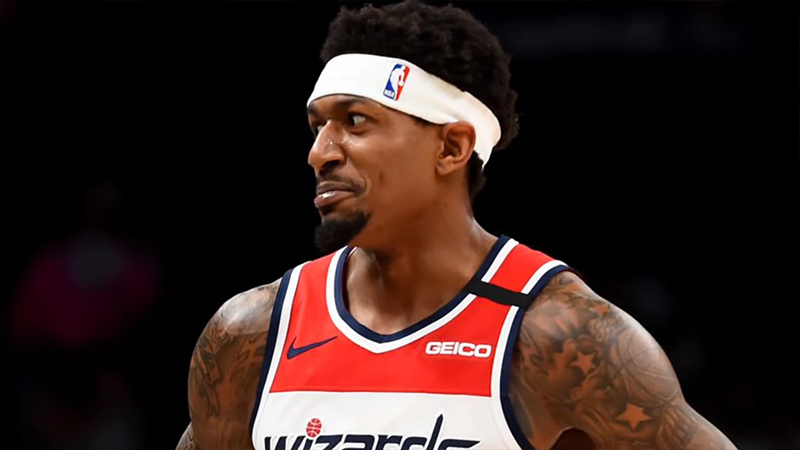
Bradley Beal can play small forward for short stretches in specialized “small-ball” lineups, but he cannot effectively occupy the position full-time due to significant size and defensive limitations.
Standing at 6’4″, Beal is a natural shooting guard who has spent over 95% of his 14-year career in the backcourt.
While his elite floor spacing and secondary playmaking provide offensive advantages at the “three,” his height deficit against average 6’6″ to 6’8″ forwards creates unsustainable defensive mismatches.
Consequently, utilizing Beal at small forward remains an emergency tactical maneuver rather than a viable long-term positional strategy.
The Physical Mismatch of Bradley Beal at Small Forward
Understanding the tactical constraints of Beal at the wing requires a deep dive into the physical metrics that define the position. The following sections evaluate how his frame stacks up against elite NBA forwards.
Analyzing the Height and Length Deficit
The most immediate hurdle is a sheer lack of verticality compared to standard league wings. While Beal is officially listed at 6’4″, the average NBA small forward stands between 6’6″ and 6’8″, giving opponents a consistent two-to-four-inch advantage.
On the perimeter, this deficit allows taller forwards to shoot cleanly over his contest, effectively neutralizing his defensive pressure during high-point shooting windows.
Weight, Frame, and Post-Up Resistance
Though Beal possesses a strong 207-pound frame for a backcourt guard, he lacks the lower-body mass and functional length required to withstand physical, paint-oriented play.
When matched against traditional forwards, he is often overpowered in the mid-post. Larger wings can easily back him down, using their superior size to create high-percentage looks or force help rotations that compromise the overall defensive structure.
Vertical Contest and Wingspan Constraints
Verticality in the NBA is as much about wingspan as it is about standing height. Beal has functional length to challenge other guards, but his total reach is insufficient to disrupt the league’s elite wings.
This limitation is most apparent during perimeter closeouts, where he struggles to impact the vision of taller shooters, leading to a higher defensive rating whenever he slides into the small forward slot.
Defensive Vulnerabilities in Small-Ball Lineups
Deploying a three-guard lineup often prioritizes offensive speed, but it introduces severe defensive liabilities. This section explores how Beal’s presence at the small forward position affects a team’s ability to get stops.
Becoming a Mid-Post Isolation Target
Opposing coaches frequently identify Beal as a mismatch when he operates as a small forward. By running isolation plays or mid-post sets, teams can exploit his size disadvantage consistently.
This tactical targeting forces his team to choose between allowing a high-percentage look or sending a double-team, the latter of which often leads to open three-point opportunities for the opposition.
Rebounding Deficits and Inside Position
Small forwards are traditionally expected to provide secondary rebounding and baseline help-side defense. Beal’s career average of roughly 4.0 rebounds per game highlights his natural perimeter orientation.
When forced to contend for inside position against true forwards, he struggles to secure contested boards, often resulting in second-chance points for the opposing offense and a lack of transition opportunities for his own.
Rim Protection and Rotational Integrity
Slotting a 6’4″ guard at the “three” significantly weakens a team’s help-defense backline. Beal does not possess the shot-blocking instincts or reach of a traditional wing, meaning he provides little resistance against physical slashers attacking the rim.
This lack of rim protection forces the center to over-commit, leaving the weak side open and fracturing the team’s defensive rotations.
The Strategic Trade-offs of 3-Guard Lineups
Coaches must weigh the benefits of increased scoring against the inevitable defensive decline. Below is a breakdown of the tactical impact observed when Beal operates as a situational small forward.
| Strategic Advantage (Pros) | Tactical Liability (Cons) |
|---|---|
| Elite Floor Spacing: Drags slower forwards away from the paint to create driving lanes. | Defensive Breakdown: Forces a natural guard into rotations meant for lengthier athletes. |
| Offensive Speed: Creates hyper-athletic units that excel in fast-break transitions. | Rim Protection Loss: Weakens the backline defense against aggressive, physical slashers. |
| Secondary Playmaking: Functions as a tertiary ball-handler to initiate weakside sets. | Foul Trouble: Increased physical contact in the post leads to accelerated personal fouls. |
| Shooting Gravity: Forces opposing teams to stay home on the perimeter, opening up the dunker spot. | Rebounding Margin: Surrenders critical second-chance points to taller, stronger wing units. |
Statistical Positional Breakdown and History
Analyzing Beal’s career through an analytical lens reveals a clear preference for backcourt roles. His brief experiments on the wing have almost always been born out of roster necessity rather than tactical preference.
The Guard Baseline and Perimeter Dominance
Across his tenures with the Washington Wizards, Phoenix Suns, and LA Clippers, advanced metrics show that over 95% of Beal’s total career minutes have been spent at shooting guard or point guard.
He is fundamentally an off-screen scoring threat who excels with the ball in his hands or coming off curls. His game is built on agility and shot creation, which are most effective when matched against other guards.
Situational Small Forward Utilization
In the rare instances Beal has logged minutes at small forward, it has typically occurred within “ultra-small” configurations.
These lineups often feature two other shorter guards, such as his time in Phoenix with Devin Booker and Tyus Jones, or in Los Angeles with James Harden.
In these cases, the goal is to maximize spacing and shooting, accepting the defensive trade-offs as a necessary gamble for high-octane offense.
What Position Does Bradley Beal Play in 2026?
As an unrestricted free agent in the 2026–27 season, Beal’s positional identity is a major talking point for front offices. His role moving forward will likely be defined by team needs and championship aspirations.
Assessing His Free Agency Market Value
Following his decision to decline his player option with the LA Clippers, Beal is being scouted primarily for his secondary shot-creation and backcourt depth.
Elite contenders view him as a high-level scoring option who can stabilize a second unit or start alongside a traditional floor general. His value remains high as a combo guard, but few teams see him as a starter at small forward.
Projected Roles for Elite NBA Contenders
Rumored suitors like the Miami Heat or Boston Celtics are looking at Beal to bolster their perimeter rotation. In these systems, he would likely serve as a sixth man or a starting shooting guard, depending on the roster construction.
His ability to handle primary playmaking duties when a traditional point guard is off the floor remains his most valuable secondary skill, far outweighing his utility as a situational wing.
Tactical Considerations for Future Coaches
Managing a veteran star like Beal requires an understanding of his evolving physical profile. Coaches must be strategic about his minutes to maintain his efficiency and defensive energy.
Managing Bench Depth vs Starters
At this stage of his career, Beal is most effective when he can focus his energy on elite scoring and playmaking. By utilizing him in his natural backcourt role, teams can protect him from the physical toll of guarding larger forwards.
This preservation is essential for long-term health and maintaining his shooting percentages throughout a grueling 82-game season.
Navigating the Risk of Attrition
Constant physical mismatches at the small forward position often lead to increased foul trouble and physical fatigue. By limiting his time at the “three,” coaches can reduce the number of high-impact collisions he faces in the post.
This tactical adjustment ensures that Beal remains available for critical late-game situations where his shot-making ability is most needed.
Frequently Asked Questions About Beal’s Versatility
Can Bradley Beal play point guard?
Yes, he has frequently operated as a primary playmaker when his team lacks a traditional floor general, leveraging his ball-handling and vision.
What is Beal’s primary position?
He is fundamentally a shooting guard, a role he has occupied for the vast majority of his 14-year NBA career.
Why is he considered a liability at small forward?
His 6’4″ frame is roughly 2 to 4 inches shorter than the average small forward, making him a target for post-ups and rebounding mismatches.
Is Beal an unrestricted free agent?
Yes, after declining his player option for the 2026–27 season, he is currently a free agent available for any team to sign.
Which teams are interested in Beal for 2026?
Organizations like the Miami Heat and Boston Celtics have been linked to him as potential suitors for backcourt depth and scoring.
Conclusion: A Situational Weapon, Not a Wing
While the modern NBA embraces positionless basketball, the physical realities of the game still dictate effective lineup construction. Bradley Beal remains one of the league’s premier scoring guards, but his utility at small forward is strictly situational.
For a team to maximize his impact, he must be deployed in roles that highlight his elite shooting and playmaking rather than exposing his lack of size on the wing.
As he enters the next phase of his career in 2026, the teams that utilize him in the backcourt will likely see the highest return on their investment.