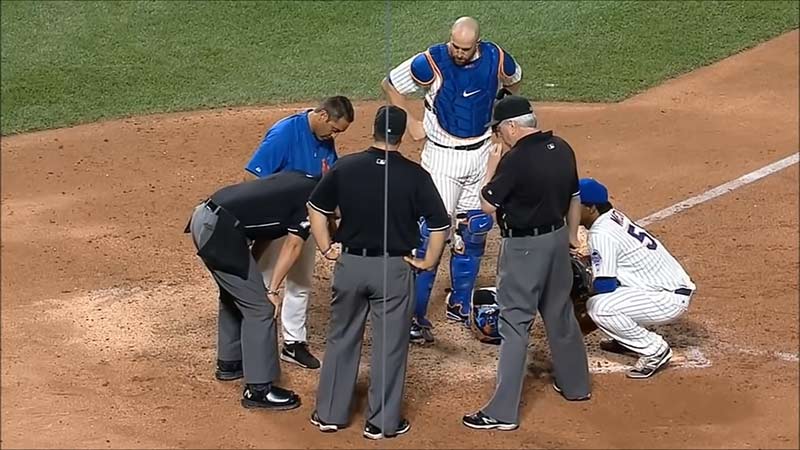
In the fast-paced world of baseball, we often treat the umpires as invisible fixtures of the landscape. They are there to call balls and strikes, safe or out, and ensure the game flows according to the rulebook.
However, because umpires must stand in proximity to the action to make accurate calls, they occasionally find themselves physically involved in a play.
Whether it is a screaming line drive off the bat or a hurried throw from the outfield, the question inevitably arises: What happens if the ball hits the umpire?
While common sense might suggest the ball is always “dead” the moment it touches an official, the actual rules of baseball are more nuanced.
The outcome depends entirely on the type of ball—batted or thrown—and the position of the umpire relative to the fielders.
Understanding these distinctions is crucial for players, coaches, and fans to understand why a play continues or why a runner is sent back to their original base.
The Batted Ball: The “Before or After” Rule
The most common and impactful form of umpire contact involves a batted ball. When a batter hits a fair ball that strikes an umpire, the game’s status is determined by whether the ball had already “cleared” the infield defense.
When the Ball is Ruled Dead
if a fair batted ball strikes an umpire who is stationed in front of the infielders, the play is immediately halted. In this specific scenario, the contact is ruled as umpire interference, and the ball is considered dead.
The immediate consequences of this ruling are:
- The Batter is Awarded First Base: Because the interference prevented the defense from making a play and the batter from potentially reaching base naturally, the batter is automatically awarded first base.
- The Status of Runners: One of the most critical aspects of this rule involves the runners already on base. Runners only advance if they are forced to move by the batter taking first base. For example, if there is a runner on first, they would move to second. However, if there is only a runner on third, that runner cannot score and must stay at third because they were not forced to vacate their base.
The Live Ball Exception
The rules change significantly if the ball has already passed the primary infield defense. If a batted ball strikes an umpire after it has already passed an infielder (other than the pitcher) or after it has deflected off an infielder, the ball remains live and in play.
In this situation, the umpire is treated as part of the field, similar to a base or a fence. The defense must retrieve the ball and attempt to make a play, and runners may advance at their own risk.
This prevents the defense from being “saved” by a dead-ball ruling on a ball that had already beaten the infielders.
Thrown Balls and Deflections: Keeping the Game Moving
Not every instance of a ball hitting an umpire involves a batted ball. Thrown balls are a frequent occurrence, especially during high-pressure plays at the plate or during double-play attempts.
The Umpire as a “Live” Obstacle
The protocol for thrown balls is much simpler than for batted balls. If an umpire is struck by a thrown ball—such as a catcher attempting to pick off a runner or an outfielder throwing to a cutoff man—the ball remains live and in play.
There is no interference called in this scenario. Players must continue the play as if the ball had hit the ground or a base.
The Pitcher Deflection Exception
A unique interaction occurs when the pitcher is involved. If a batted ball hits the pitcher first and then ricochets off an umpire, the ball is ruled a live ball.
When determining umpire interference on a batted ball, the pitcher is often excluded from the “passing an infielder” criterion.
This means that even if the umpire is standing in a position that would normally trigger a dead ball, the fact that the ball touched the pitcher first keeps the play active and live.
Navigating the Bases: What Happens to the Runners?
The most confusing part of an umpire interference call often involves where the runners end up. The “dead ball” status triggers specific requirements for runner placement to ensure neither team is unfairly advantaged or disadvantaged.
Forced Advances vs. Returning to Base
As established, if the ball is ruled dead due to hitting an umpire before passing an infielder, the batter takes first base. This creates a “force” situation for certain runners.
- Forced Runners: If every base behind a runner is occupied (e.g., runners on 1st and 2nd, or bases loaded), those runners advance to the next base.
- Non-Forced Runners: In any situation where a runner is not forced to advance, they are required to return to their original base.
This rule is strictly enforced. If a runner on second base sees a ball hit an umpire and runs to third, but the batter was only awarded first (and didn’t force the runner at second), that runner will be ordered by the officials to return to second base once the ball is ruled dead.
Conclusion: Knowing the Protocol
Understanding what happens when a ball hits an umpire requires a quick assessment of the play’s geography and the ball’s trajectory.
If the ball is batted and hits an umpire before passing an infielder, the play stops, the ball is dead, and the batter gets first base.
In almost every other scenario—including thrown balls, balls that have passed an infielder, or balls deflected off the pitcher—the ball remains live and in play.
For players and coaches, the best advice is to always play until the umpire explicitly calls the ball dead. Because many contacts with the “man in blue” do not actually stop the play, assuming the ball is dead can lead to costly defensive lapses or runners being caught off guard.
By mastering these nuances of umpire interference, teams can ensure they are always prepared for the unpredictable moments when the umpire becomes a physical part of the game.