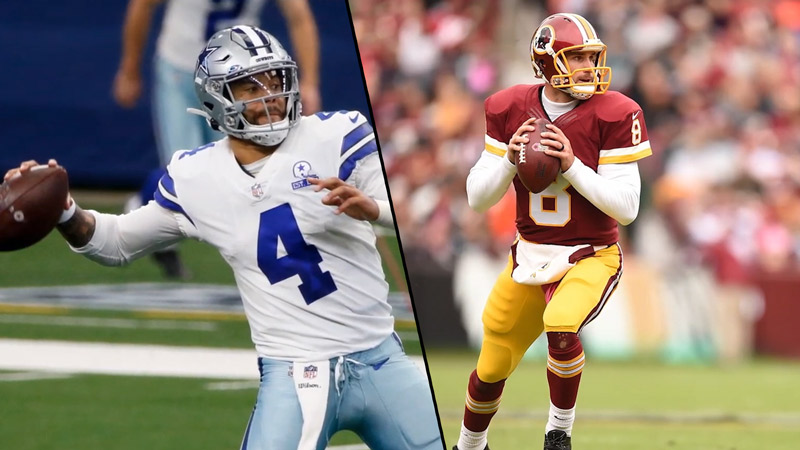
The modern NFL landscape is defined by its architectural tiers. At the summit, you find the generational talents—the “aliens” whose physical tools redefine the boundaries of the game.
At the base, you find the developmental prospects and bridge starters. However, the most strategically complex debate in professional football resides in the “upper-middle-class” tier of signal-callers. This is the domain of Dak Prescott and Kirk Cousins.
For years, analysts, front offices, and fantasy managers have wrestled with a high-stakes question: When the numbers are nearly identical, how do you differentiate between two of the most efficient, yet frequently scrutinized, passers in the league?
While the public narrative often treats this as a lopsided comparison, a granular look at the data—spanning passing efficiency, rushing floors, and environmental variables—reveals a race that is much tighter than the average fan perceives.
To settle the debate, we must look beyond the box score and analyze the context of their production.
The Statistical Foundation: Efficiency vs. Narrative
The primary friction point in the Prescott-Cousins debate is the gap between statistical efficiency and public perception.
Kirk Cousins is frequently relegated to the status of a “league-average” starter, yet his efficiency metrics often rival or exceed those of quarterbacks considered to be in a higher tier.
Conversely, Dak Prescott is generally viewed as the superior asset, largely due to a higher career winning percentage and a more dynamic athletic profile. When we look at their career averages, the margin is razor-thin:
Career Statistical Averages
| Metric | Dak Prescott | Kirk Cousins |
|---|---|---|
| Career Passer Rating | ~98.3 | ~96.8 |
| Completion Percentage | ~66.6% | ~66.7% |
| Yards Per Attempt | ~7.82 | ~7.90 |
| Primary Value Add | Rushing/Volume | Pure Passing Efficiency |
As the data illustrates, their pure passing mechanics result in nearly identical accuracy and per-pass efficiency. Both players are technicians who excel at operating within the rhythm of an offense and delivering the ball to their primary playmakers with high-level consistency.
The Rushing Gap: The Strategic Edge of Mobility
If the passing efficiency is a wash, the differentiation begins with the athletic floor. This is where Dak Prescott pulls away in most professional evaluations. In the contemporary NFL, a quarterback who acts as a stationary target—a “statue,” as some critics label Cousins—places an immense burden on the offensive line.
Prescott provides a dynamic element outside the pocket that forces defensive coordinators to account for an eleventh man in the run game. This mobility does more than just move the chains; it fundamentally changes the scoring potential of the offense.
The 40-Start Scoring Impact
| Category | Dak Prescott (Last 40 Starts) | Kirk Cousins (Last 40 Starts) |
|---|---|---|
| Passing Touchdowns | 62 | 77 |
| Interceptions | 27 | 26 |
| Rushing Touchdowns | 13 | 2 |
| Total Yardage | 11,215 | 10,004 |
The “rushing gap” is significant. Prescott’s ability to generate 13 rushing touchdowns over a 40-start span compared to Cousins’ two represents an 11-touchdown swing.
In the world of high-stakes performance, this rushing floor equates to roughly 86 additional points per season, or approximately five points per game. For a team-building perspective, Prescott’s legs provide a “margin for error” that a pure pocket passer lacks.
Environmental Variables: The Protection Disparity
To evaluate these quarterbacks without considering their environment is to ignore the most critical data point in their career arcs: pass protection.
Data from PFF highlights a staggering disparity in the quality of the offensive lines protecting these two players. Kirk Cousins has spent much of his career playing behind some of the league’s most inconsistent blocking units.
Between 2014 and 2020, his protection was frequently ranked in the bottom third of the league.
Vikings Pass Block Grade & Rank (PFF)
| Year | PFF Grade | League Rank |
|---|---|---|
| 2015 | 67.9 | 28th |
| 2016 | 64.7 | 30th |
| 2018 | 63.6 | 27th |
| 2020 | 55.5 | 29th |
Conversely, Dak Prescott has historically operated behind a Cowboys front that is viewed as one of the premier units in professional football.
While Prescott has had stretches of difficulty—most notably in 2018 when his primary target was Allen Hurns—he has largely enjoyed a clean pocket and an elite offensive infrastructure.
The fact that Cousins maintained a 104.1 passer rating over a 40-start stretch while playing behind bottom-five offensive lines suggests that his pure passing talent may actually be undervalued.
Analysts argue that Cousins’ ability to remain efficient while being one of the most pressured quarterbacks in the league is a testament to his technical mastery.
The “Upper-Middle-Class” Tier: The Playoff Purgatory
Both Prescott and Cousins share a common criticism: the inability to consistently translate regular-season efficiency into deep postseason runs. They are often grouped together in the “very good, not transcendent” tier of starters.
This shared scrutiny stems from their high salaries and the strong supporting casts they have often led.
While Prescott is credited with a higher win-loss percentage, both players have faced the same “empty calorie” accusations—the idea that their stats are driven more by volume and game script than by the ability to carry a team when everything breaks down.
However, the “tape” often reveals different paths to this ceiling. Critics of Cousins point to his lack of play-making ability when the structure of the offense fails.
Supporters of Prescott point to his mechanical evolution; before the 2019 season, Prescott underwent a significant overhaul of his throwing mechanics, which led to a higher ceiling of production that Cousins has rarely touched.
The Value Proposition: High Floor vs. Peak Ceiling
When choosing between these two signal-callers, the decision depends entirely on the organization’s risk tolerance and offensive philosophy.
- The Case for Dak Prescott: He is the “point-producing machine.” His ability to combine high passing volume with a significant rushing floor makes him a more versatile threat. While his numbers were arguably inflated by an “unsustainable pace” at the start of 2020, his peak ceiling remains higher than Cousins’.
- The Case for Kirk Cousins: He is the “unfashionable” efficiency king. He is a reliable starter who won’t “lose you the league” and can maximize elite wide receivers like Justin Jefferson. For a team with a dominant defense and a specific need for timing-based passing, Cousins is one of the most undervalued assets in the game.
Strategic Comparison Matrix
| Feature | Dak Prescott | Kirk Cousins |
|---|---|---|
| Playmaking Style | Dynamic/Dual-Threat | Technical/Pocket-Oriented |
| Risk Profile | High Ceiling/Volume-Driven | High Floor/Efficiency-Driven |
| Best Asset | Rushing & Versatility | Passer Rating Under Pressure |
| Major Criticism | unsustainable Volume | Lacks “Elite” Playmaking |
Final Synthesis: Who Should You Choose?
The Prescott-Cousins paradigm is a study in versatility versus stability.
If your team building strategy requires a quarterback who can create offense when the play breaks down and provide a high-scoring rushing floor, Dak Prescott is the clear choice. He is a more dynamic athlete who has shown the ability to adapt and grow his technical game to match his physical tools.
However, if you are looking for a technical expert who can maintain elite efficiency despite poor protection, Kirk Cousins is the most underrated option in the league. He is a player who provides a stable floor and will never lose a game due to a lack of preparation or fundamental mechanics.
Ultimately, while the margin is slimmer than many believe, Dak Prescott’s ability to add significant value as a runner and his history of high-volume production give him the definitive edge in the modern, playmaker-driven NFL.