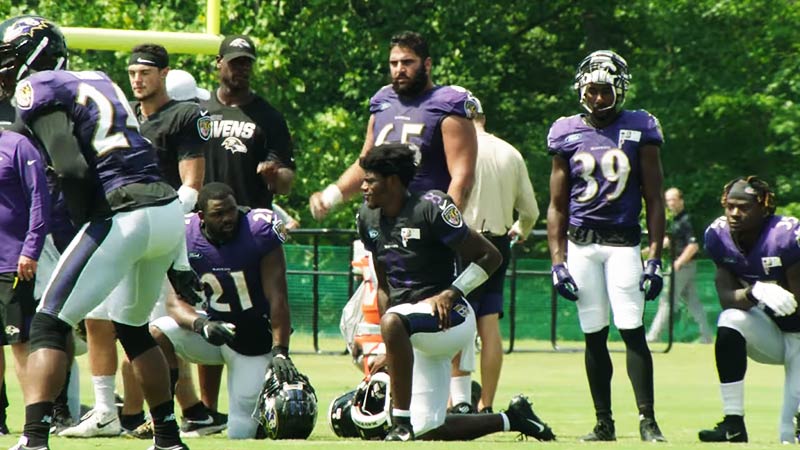
In the modern landscape of professional football, the traditional image of a solitary team grinding through the heat of summer in isolation is rapidly becoming a relic of the past.
Today, the most successful franchises in the league are opting for a more collaborative, high-stakes approach to preparation: the joint practice.
Once a novelty, these sessions have evolved into a cornerstone of training camp, serving as a critical bridge between the repetitive drills of July and the high-speed collisions of September.
This shift represents more than just a change in scheduling; it is a calculated response to the changing economics of player health, the reduction of the preseason calendar, and the sophisticated nature of modern coaching.
To understand why NFL teams are increasingly inviting their “enemies” to their backyards, one must look at the intersection of risk management and competitive evolution.
The Preseason Void: Adapting to a New Calendar
The primary driver behind the explosion of joint practices is the recent restructuring of the NFL season.
With the league’s move to a 17-game regular season and a subsequent reduction of the preseason to just three games, coaches found themselves facing a preparation deficit.
In the old four-game preseason format, teams had a set rhythm for evaluating talent. Today, that window has narrowed significantly.
Joint practices have stepped in to fill this prep-time gap, offering a controlled environment where starters can engage in high-intensity reps that they would otherwise miss.
Because starters rarely see significant action in actual preseason games anymore due to the risk of injury, these sessions are often the only time a first-string unit faces an unfamiliar opponent before the regular season begins.
The Architecture of Safety: Controlled Intensity
For an NFL head coach, the greatest fear during the summer is the “meaningless” injury—a season-ending blow delivered in a preseason game that doesn’t count in the standings.
Joint practices provide a strategic solution to this problem by allowing coaches to dictate the tempo and specific rules of engagement.
In a live preseason game, the environment is unpredictable. In a joint practice, however, coaches manage the matchups.
They can run specific red-zone drills, third-down conversions, or two-minute drills without the “live” tackling to the ground that often leads to lower-extremity injuries.
This is particularly vital for the protection of franchise quarterbacks. During these sessions, starters can simulate game speed and pocket pressure while remaining “off-limits” for reckless hits, ensuring the team’s most valuable assets are ready for Week 1.
Demystifying the “Secret” Playbook
A common question among fans and international observers is whether practicing with an opponent allows them to “steal” the playbook.
To the uninitiated, a playbook is a guarded treasure of unique secrets. However, NFL insiders view playbooks more like “owner’s manuals” to a car—functional, standardized, and updated annually.
The reality of the modern NFL is that there are very few true secrets in terms of individual plays.
The coaching community is a small, interconnected circle where terminology and concepts are frequently shared as players and coaches move between franchises.
Most NFL offenses are built around a core of 8 to 12 primary concepts—such as the “Stick” or “Y-Stick” route—that every defensive coordinator in the league already recognizes.
The true competitive advantage in the NFL does not lie in the “plays” themselves, but in the weekly game plans and the “tags” or motions used to dress up those base concepts.
During joint practices, teams intentionally keep their schemes “vanilla,” focusing on the fundamental execution of their base system rather than revealing the specific strategic wrinkles they will use to exploit an opponent during the season.
The “Stick” Concept: A Study in Consistency
To illustrate why “stealing plays” isn’t a major concern, consider the “Stick” concept, a staple for nearly every team in the league.
In this concept, the outside receiver typically runs a fade to clear space, an inside receiver runs a quick out, and a third receiver runs a “stick” route.
While a team might call it “Y-Stick” or “H-Stick” depending on which player is the primary target, the underlying rules and quarterback progressions remain the same.
The goal of these practices is to allow players to “play fast,” relying on muscle memory and instinct rather than overthinking complex new schemes.
By running these universal concepts against a new defense, coaches can evaluate how well a player understands the core system when the “tells” of their own teammates are removed.
The Psychology of Competition: Breaking the Monotony
After three weeks of training camp, players often suffer from what is known as “teammate fatigue.”
When a wide receiver faces the same cornerback every morning, he begins to subconsciously pick up on that defender’s specific signals and habits. This can lead to a false sense of security or success.
Joint practices break this monotony by introducing fresh competition. Players are suddenly forced to react to different body types, varying skill sets, and unfamiliar defensive alignments.
This “fresh blood” naturally raises the intensity of the practice. It forces players to sharpen their techniques because they can no longer rely on knowing exactly what the man across from them is going to do.
Furthermore, these sessions provide coaches with a more accurate evaluation tool. Seeing how a rookie offensive lineman handles a Pro Bowl defensive end from another team provides far more valuable film than seeing him battle the same teammate he has seen since OTA sessions in May.
A Business-First Culture: The Professionalism of the Modern Athlete
The nature of NFL rivalries has also shifted in a way that facilitates these collaborative sessions. While fans might expect animosity, the modern generation of players often views the league through a professional and business-oriented lens.
There is a growing sense of mutual respect among players who recognize that they are all part of the same elite labor pool.
This “business first” mentality allows players to mingle cordially and work together to improve their respective crafts, a dynamic that was much rarer 20 or 30 years ago.
To maintain this professional atmosphere and protect strategic interests, teams generally avoid scheduling joint practices with divisional rivals.
Instead, they typically partner with cross-conference opponents (e.g., an AFC team practicing with an NFC team) that they are unlikely to face in a high-stakes game later that year.
Strategic Benchmarking: The Fortune 500 Standard of Football
From a management perspective, joint practices are essentially a form of competitive benchmarking.
Just as a top-tier corporation might study the best practices of an industry peer to refine its own internal processes, NFL teams use these sessions to see where they stand relative to the rest of the league.
By inviting another organization into their space, a team can evaluate:
- Operational Efficiency: How quickly can the unit get in and out of the huddle against a different tempo?
- Talent Depth: How do the second and third-string players perform when the scheme is no longer familiar?
- System Integrity: Does the base “vanilla” offense hold up against a defensive scheme they haven’t spent all summer studying?
Conclusion: The Future of NFL Preparation
The evolution of the NFL joint practice is a testament to the league’s move toward a more analytical, risk-averse, and professionalized model of preparation.
By choosing controlled scrimmages over the unpredictability of the preseason, franchises are maximizing their evaluation windows while minimizing the threat to their most expensive assets.
As the game continues to prioritize speed, health, and conceptual mastery, the joint practice will likely remain the gold standard for summer preparation.
It is the ultimate “win-win” in a high-stakes industry: a way to get better, faster, and safer—all while the rest of the world is still waiting for the kickoff of Week 1.