In the high-stakes environment of professional football, the difference between a season-defining performance and a season-ending injury often comes down to inches and milliseconds. For a starting quarterback, the pocket is both a sanctuary and a danger zone.
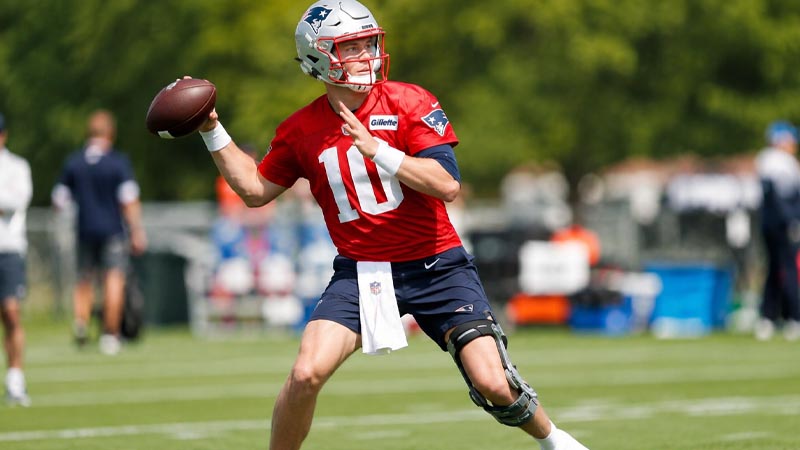
This reality was highlighted during the 2021 preseason when images began to circulate of then-rookie Mac Jones sporting a noticeable, rigid brace on his left knee.
The sight of a high-profile athlete in new orthopedic gear often sparks immediate speculation regarding hidden injuries or setbacks. However, the story behind Mac Jones’ knee brace is not one of recovery, but of meticulous, proactive strategy.
By examining the specific hardware he utilizes and the biomechanical reasoning behind it, we gain a clearer understanding of how modern elite athletes manage risk in an increasingly physical game.
Identifying the Hardware: The DonJoy Advantage
When analyzing the specific equipment used by elite passers, the brand that consistently emerges is DonJoy. Mac Jones utilizes a DonJoy protective knee brace, specifically a lightweight, functional model designed for high-performance athletes.
DonJoy has long been established as a leader in the orthopedic industry, providing bracing solutions that offer a critical balance between structural rigidity and athletic mobility.
For a player like Jones, the selection of the brace was not a random choice or a standard team-issue requirement.
It was a calculated decision based on extensive personal testing. During the initial phases of integrating this gear, Jones tested several different versions to find a “smooth, comfortable fit”.
In the world of professional sports, comfort is a prerequisite for performance. A brace that restricts a quarterback’s ability to pivot, drive, or scramble is a liability, regardless of how much protection it offers.
Jones eventually settled on a functional design that provides the necessary “extra protection” without hindering his natural movement in the pocket.
The Biomechanics of the Pocket: Why the Left Knee?
To the casual observer, a knee brace on a healthy player might seem redundant. However, for a right-handed quarterback, the left leg is the most vulnerable point in their entire physical architecture while passing.
When a quarterback drops back and prepares to throw, the left leg becomes the “lead” or “plant” leg. As the player steps toward their target, this leg is extended and firmly planted into the turf to provide the leverage needed for a powerful throw.
In this specific moment, the leg is essentially a fixed pillar. If a defensive player is blocked into the quarterback or dives for a low tackle, that planted leg has no “give.” It cannot move easily to dissipate the force of an impact, making it a primary target for ligament tears, specifically the ACL and MCL.
By wearing a functional brace on this specific limb, Jones is adding a layer of “defensive armor” to his lead leg.
These braces are engineered to act as an external skeleton, absorbing the lateral forces of a hit and redirecting them away from the vulnerable ligaments of the knee joint.
Jones himself clarified this strategy, noting that because the left leg is where a quarterback plants, he simply wanted to “make sure I keep it safe”.
The “Brady Lesson”: Historical Context in New England
The decision to wear a preventive brace carries a specific weight in the context of New England football history. Long-time observers of the game cannot help but draw parallels to the 2008 season, a year that changed the trajectory of the league’s approach to quarterback safety.
In the 2008 season opener, legendary quarterback Tom Brady suffered a season-ending tear to his left ACL after a low hit from Kansas City Chiefs safety Bernard Pollard.
At the time, Brady was at the height of his powers, and the loss of the starting quarterback in the very first game was a devastating blow to the organization. Interestingly, that ACL tear stands as the only major, long-term injury of Brady’s storied career.
Mac Jones’ move to wear a brace on that same left leg during his rookie season suggests a keen awareness of this history.
While the league has since implemented various “Brady Rules” to protect quarterbacks from low hits, the reality of the game remains chaotic.
A proactive approach—utilizing technology like the DonJoy brace—serves as a secondary insurance policy against the unpredictable nature of an NFL Sunday.
From Reactive to Proactive: The Evolution of Injury Prevention
For decades, the culture of professional football was largely reactive; players wore braces only after they had already suffered a significant injury. The “bulky brace” was a sign of a “gimp” leg or a player on the mend.
Mac Jones is part of a growing cohort of athletes who view protective equipment as a preventive necessity rather than a post-injury crutch.
During his media availabilities, Jones was adamant that he was not injured and had participated in every practice since being drafted. His use of the brace was described as being purely for “protective reasons”.
This shift in mindset is reflective of a broader “Fortune 500” level of professionalism within the NFL.
Just as a major corporation invests in cybersecurity to prevent a data breach rather than simply reacting to one, elite athletes are now investing in “body armor” to prevent a physical breach.
Jones highlighted this philosophy when he remarked that he thinks it is simply a “good idea as a quarterback” to have that protection on the front knee.
Technical Specifications: What Makes the DonJoy Functional?
While the specific model number of Jones’ brace can vary based on the requirements of a specific game or practice surface, the DonJoy functional line typically focuses on four points of leverage.
This design is intended to reduce the strain on the ACL by providing a constant, corrective force to the tibia.
- Materials: Modern models utilize aircraft-grade aluminum or high-strength carbon fiber frames. This allows the brace to be incredibly rigid against impact while remaining light enough that the player doesn’t feel weighed down.
- Low Profile: To ensure the brace fits under standard football pants without snagging or causing friction, the hinges are designed to be extremely low-profile.
- Customization: For players of Jones’ caliber, these braces are often custom-fitted to the exact measurements of their leg, ensuring the hinges align perfectly with the natural axis of the knee joint.
Jones’ emphasis on testing different models confirms the importance of this technical precision. He wasn’t looking for a “one size fits all” solution; he was looking for a piece of equipment that integrated seamlessly into his mechanics.
Conclusion: The Professional Standard of Performance
The mystery surrounding Mac Jones’ knee brace is a testament to the high level of scrutiny placed on NFL stars.
However, the reality is far more practical than the rumors suggested. By utilizing a DonJoy functional brace, Jones is employing a data-driven, strategic approach to his career longevity.
Protecting the plant leg is not about a lack of toughness; it is about an abundance of intelligence.
In a sport where a single play can dictate the future of a multi-billion dollar franchise, Mac Jones’ “defensive armor” is a professional standard of care that ensures he remains in the game, play after play.