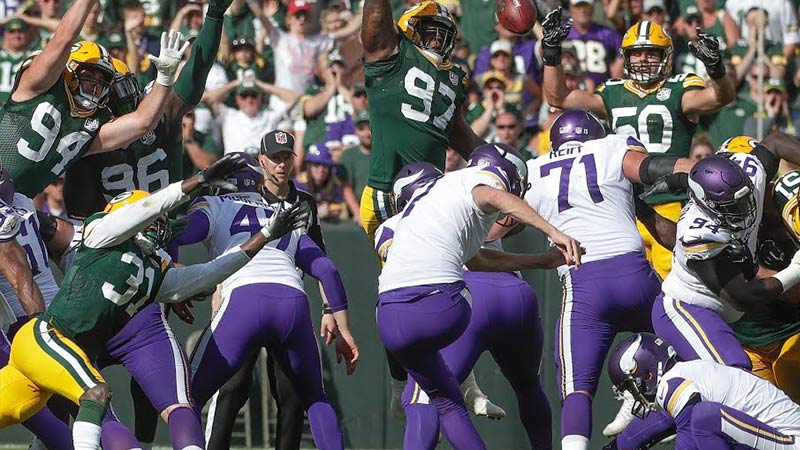
For decades, the “Point After Touchdown” (PAT) was considered the most predictable sequence in professional sports.
It was a brief interlude—a moment for fans to grab a beverage or for broadcasters to pivot to a commercial break.
The kicker would trot onto the field, the ball would be snapped from the two-yard line, and with the mechanical precision of a metronome, the scoreboard would tick upward by one.
However, the modern NFL has fundamentally dismantled this predictability. What was once a formality has transformed into a strategic inflection point that can define a franchise’s season.
To understand the current landscape of NFL kicking, one must examine the intersection of regulatory changes, statistical volatility, and the psychological pressure that accompanies a thirty-three-yard attempt.
The 2015 Paradigm Shift: From 20 to 33 Yards
The primary catalyst for the current state of kicking uncertainty was a radical rule change implemented in 2015. Before this pivot, extra points were snapped from the 2-yard line, resulting in a 20-yard kick.
At this distance, NFL kickers were nearly infallible, operating at a conversion rate exceeding 99%. The play lacked competitive tension, prompting the league to seek a solution that would reintroduce “difficulty and strategy” into the scoring process.
By moving the snap back to the 15-yard line, the NFL effectively turned the extra point into a 33-yard field goal. While a 13-yard difference might seem negligible to the casual observer, the statistical impact was immediate and profound.
The margin for error narrowed, the angles changed, and the influence of environmental factors—such as wind and turf conditions—became significantly more pronounced.
Analyzing the Modern Conversion Rate
The data following the 2015 rule change reveals a permanent shift in efficiency. In the contemporary league, the conversion rate has settled into a range of 94% to 96%. While this still indicates a high level of proficiency, it represents a departure from the “automatic” era.
Consider the 2022 regular season as a primary case study: professional kickers missed a total of 64 extra points out of 1,197 attempts.
This resulted in a success rate of 94.65%. In practical terms, this means that an extra point miss occurs approximately once a week across the league.
These are no longer “rare” events; they are recurring variables that head coaches must account for in their weekly game planning.
The sheer volume of misses has escalated dramatically. Before the 15-yard line became the standard, the entire league would combine for fewer than 10 missed extra points in a single season.
Today, the league consistently sees 50 to 60 misses per year. This five-fold increase in failure rate has forced a re-evaluation of the “value” of a kicker and the risk-reward profile of the two-point conversion.
The Psychological Weight: Case Studies in High-Stakes Volatility
Kicking is as much a psychological discipline as it is a physical one. The 33-yard distance sits in a “no-man’s land” where success is expected, but failure is no longer impossible. This creates a unique form of pressure.
Perhaps the most stark example of this volatility occurred in January 2023 during a high-stakes playoff matchup.
Dallas Cowboys kicker Brett Maher experienced what many sports psychologists refer to as “the yips” on a national stage, missing four extra points in a single game against the Tampa Bay Buccaneers.
Maher’s performance was a statistical anomaly, yet it served as a reminder that the increased distance of the PAT has stripped away the safety net for professional kickers.
Furthermore, some franchises have historically struggled more than others to maintain consistency in this department. The Washington Commanders franchise holds the record for the most missed extra points in league history, with 159 total misses.
This historical data suggests that while the league-wide average sits around 95%, individual team stability can fluctuate wildly based on personnel decisions and specialized coaching.
The Ripple Effect: Strategic and Economic Implications
The decline in “automatic” points has fundamentally altered how games are managed in the fourth quarter. When a team can no longer guarantee seven points after a touchdown (6 for the score, 1 for the kick), the “chase for points” begins earlier in the game.
- The Two-Point Conversion Surge: As the PAT success rate dipped toward 94%, the mathematical appeal of the two-point conversion (which generally succeeds at a 48-50% rate) became more competitive. Coaches are now more likely to “go for two” if they have an elite short-yardage offense, knowing that the “safe” one-point option is no longer a certainty.
- Specialist Compensation: The increased difficulty of the extra point has raised the market value of elite kickers. A kicker who can maintain a 98% PAT rate in the modern era is a massive competitive advantage over a league-average kicker at 94%. This 4% delta represents several points over a season—often the difference between a playoff berth and an early off-season.
- Roster Management: NFL teams are now less patient with struggling kickers. In the pre-2015 era, a missed extra point was viewed as a fluke. Today, it is often seen as a symptom of a mechanical or mental breakdown, leading to more frequent “mid-season tryouts” and roster turnover.
Technical Breakdown: Why the 13-Yard Move Matters
To the uninitiated, a 33-yard kick still feels like a “short” field goal. However, moving the ball from the 2-yard line to the 15-yard line changes several technical aspects of the operation:
- Snap Depth and Timing: The rhythm between the long snapper, the holder, and the kicker must be perfect. At the 15-yard line, the defense has more room to generate a “burst” off the edge to block the kick.
- Trajectory: A 20-yard kick can be driven with a lower trajectory because it clears the line of scrimmage almost instantly. A 33-yard kick requires a slightly different approach to ensure it has the height to clear the reaching arms of interior linemen while maintaining the distance to reach the uprights.
- The “Mental Reset”: For many kickers, the extra point was once a “warm-up.” Now, it is a legitimate scoring attempt that requires the same level of focus as a game-winning 50-yarder.
The Future of Kicking Accuracy
As we look toward future seasons, the question remains: will kickers adapt and push the 94% rate back toward 99%? It is unlikely.
The 33-yard distance introduces just enough variables—wind gusts, slight snap inaccuracies, and psychological fatigue—to ensure that the “automatic” point remains a relic of the past.
The NFL’s decision to move the snap was a masterclass in game design. It took a dead period in the broadcast and turned it into a moment of tension.
For fans, it means every touchdown comes with a footnote of uncertainty. For kickers, it means their job security is tied to a 13-yard difference that changed the geometry of the game.
Conclusion: The New Standard of Excellence
The evolution of the extra point is a microcosm of the NFL’s broader trend toward optimization and entertainment.
By removing the “gimme,” the league has ensured that every point must be earned. As conversion rates hold steady at 94-96%, the value of a reliable leg has never been higher.
In a league of parity, where games are frequently decided by a single score, those “once-a-week” misses are more than just statistics—they are the moments that define champions.