The National Football League is an institution built on controlled aggression, high-stakes competition, and a relentless pursuit of physical dominance.
Every Sunday, athletes push the boundaries of human endurance and strength. However, there are moments in the history of the sport where the framework of the game collapses, and the “controlled” aspect of that aggression vanishes.
When discussing the most significant physical altercations in league history, there is no single official metric for “the biggest.”
The league itself does not maintain a formal ranking of these incidents, but the consensus among historians, fans, and media outlets points to a select few moments that redefined the limits of professional conduct.
These are the moments where rivalries transcended the scoreboard and became part of a darker chapter of gridiron lore.
The Modern Benchmark: The 2019 Cleveland-Pittsburgh Conflict
In the modern era of the sport, characterized by heavy oversight and immediate social media scrutiny, one incident stands alone for its sheer visceral impact: the 2019 altercation between the Cleveland Browns and the Pittsburgh Steelers.
At the center of this firestorm were Browns defensive end Myles Garrett and Steelers quarterback Mason Rudolph.
As the game neared its conclusion, a standard tackle evolved into a chaotic struggle on the ground. The situation escalated rapidly when Garrett forcibly removed Rudolph’s helmet.
In a moment that shocked the sporting world, Garrett swung the heavy equipment, striking Rudolph in the head with his own helmet.
The fallout was instantaneous and severe. A “massive multi-player brawl” erupted as teammates from both sides rushed into the fray, resulting in a scene of total chaos that lasted several minutes.
The league’s response reflected the gravity of the incident; Garrett received an indefinite suspension, one of the most significant disciplinary actions in the history of the sport for an on-field act.
This event remains a primary talking point in any discussion regarding the “biggest” or most infamous fights because of the weaponization of equipment and the high-profile nature of the players involved.
The Receiver-Cornerback Paradox: Andre Johnson vs. Cortland Finnegan
While the 2019 incident was defined by its explosive finish, the 2010 clash between the Houston Texans and the Tennessee Titans is often cited as the most “technically” significant fight in league history.
This altercation featured Texans star receiver Andre Johnson and Titans cornerback Cortland Finnegan.
Unlike many fights that stem from a single play, the Johnson-Finnegan brawl was the culmination of what historians describe as “years of jabs”.
Finnegan had cultivated a reputation as a relentless physical and psychological agitator, often pushing the limits of the rules to get under a receiver’s skin. Johnson, conversely, was known for a stoic and professional demeanor.
In November 2010, the pressure reached its breaking point. Johnson snapped, removing Finnegan’s helmet and “raining punches” on the cornerback in front of a stunned crowd.
This fight holds a unique place in history; it is frequently ranked as the #1 most infamous fight on historical lists, such as those compiled by WatchMojo.
It serves as a case study in how consistent psychological pressure can eventually cause even the most composed athletes to abandon professional decorum.
Psychological Warfare and the Breaking Point: A.J. Green vs. Jalen Ramsey
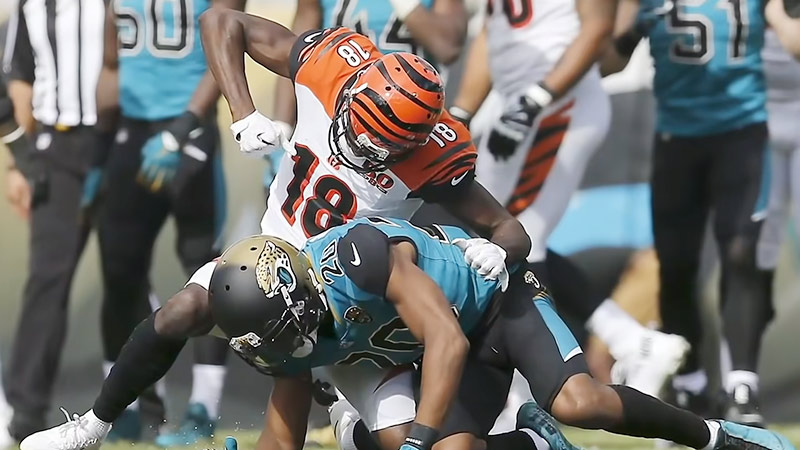
In 2017, the Jacksonville Jaguars and Cincinnati Bengals provided another entry into the history of legendary altercations.
This fight followed a similar blueprint to the Johnson-Finnegan incident, highlighting the intense one-on-one battles that occur on the perimeter of the field.
Jalen Ramsey, then a rising star for the Jaguars, was known for “jawing” at opponents throughout the duration of a game, utilizing verbal harassment to disrupt a receiver’s focus. His target that day was Bengals receiver A.J. Green.
The constant verbal and physical pestering eventually triggered a violent response. Green, typically a quiet leader, placed Ramsey in a chokehold and punched him to the ground.
This incident is significant because it illustrates the efficacy—and the danger—of psychological warfare in professional sports.
When a defender successfully disrupts a star’s mental state to the point of physical retaliation, it changes the trajectory of the game, often resulting in the ejection of both key players and shifting the competitive balance.
The Institutional Grudge: The 1989 Bounty Bowl
Not all infamous fights are limited to player-on-player violence. Some are the result of deep-seated institutional animosity between entire organizations.
The 1989 “Bounty Bowl” between the Philadelphia Eagles and the Dallas Cowboys remains the gold standard for coaching-driven conflict.
Taking place on Thanksgiving Day, a stage traditionally reserved for family and sportsmanship, the game was anything but festive.
The atmosphere was described as “chaotic,” featuring multiple skirmishes throughout the afternoon. However, the true “fight” happened behind the scenes and through the media.
Eagles coach Buddy Ryan and Cowboys coach Jimmy Johnson engaged in “bitter accusations,” with allegations that Ryan had placed “bounties” on Cowboys players, specifically the kicker and the quarterback.
The intensity of the coaching feud trickled down to the players, creating a hostile environment where every play felt like the start of a new brawl. The Bounty Bowl is a reminder that the biggest fights often have roots that extend far beyond the white lines of the field, reaching deep into the leadership of the franchises themselves.
Analyzing the Impact: Why These Fights Resonate
The fascination with these altercations goes beyond a mere interest in violence. From an analytical perspective, these fights represent moments of extreme human vulnerability.
These athletes are trained to operate within a very specific set of rules and social expectations.
When those rules are discarded, it offers a glimpse into the raw intensity that fuels the sport at its highest level.
Furthermore, these incidents have a direct impact on the evolution of the league’s governance. Every major brawl in the history of the league has resulted in:
- Rule Modifications: The league often clarifies or tightens rules regarding “unsportsmanlike conduct” following high-profile incidents.
- Safety Protocols: The Myles Garrett incident led to renewed discussions about helmet safety and the penalties for removing an opponent’s equipment.
- Disciplinary Standards: The severity of modern suspensions is a direct result of the league’s desire to protect its brand and ensure that “gridiron grudges” do not overshadow the game itself.
The Legacy of the Grudge
The history of the NFL is incomplete without an acknowledgment of its most heated moments. Whether it is the spontaneous explosion of a helmet swing in 2019 or the deep-seated coaching animosity of the late 1980s, these fights are a testament to the emotional weight of the sport.
While the league continues to move toward a safer, more regulated version of the game, the “gridiron grudge” remains an ever-present element of the rivalry.
These moments of infamy serve as a reminder that underneath the strategy and the statistics, the game is driven by an intensity that, on rare occasions, simply cannot be contained.
As we look back at the most significant fights in history, we see more than just athletes losing their cool. We see the breaking points of some of the most competitive individuals on the planet.
These altercations, while often regrettable, are permanently etched into the story of the NFL, defining the legacies of the players and the teams who participated in them.