In the high-stakes environment of professional football, the margin for error is razor-thin. While spectacular catches and thunderous tackles often command the highlights, the game’s outcome is frequently decided by the technical precision of the offensive line.
Among the most critical yet misunderstood elements of this precision is the initiation of the play itself: the snap.
When this fundamental action deviates from the established rulebook, it results in an illegal snap, a dead-ball foul that can stall momentum and force an offense backward before a play even begins.
For coaches, players, and serious students of the game, understanding the nuances of the snap is not merely about avoiding penalties; it is about mastering the discipline required to execute at an elite level.
This guide provides an in-depth analysis of the illegal snap, the mechanics of a legal exchange, and the strategic implications of these infractions on the field.
The Technical Anatomy of a Legal Snap
Every offensive play in American football begins with the snap, but the transition from a stationary ball to a live play is governed by strict procedural requirements.
To the untrained eye, the snap may look like a simple hike, but for the officiating crew and the center, it is a highly regulated movement.
1. The Stationary Start
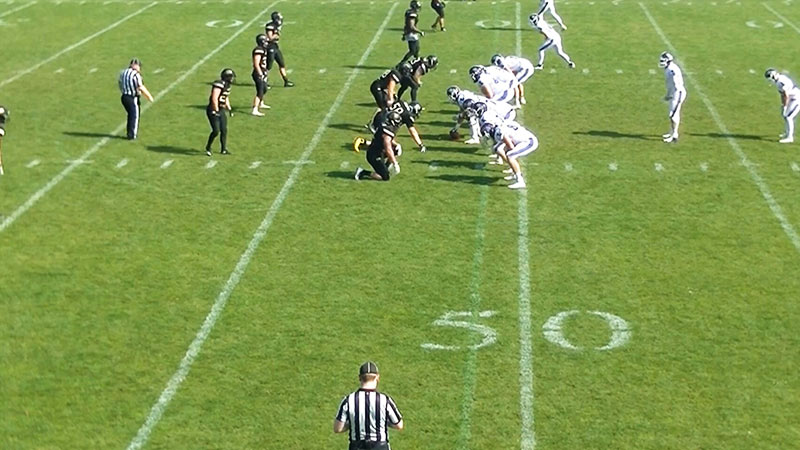
Before any movement can occur, the ball must be placed on the ground and remain completely still.
Once the offensive team has broken their huddle and aligned at the line of scrimmage, the center typically places one or both hands on the ball to establish their stance.
According to the regulations, the ball must be entirely stationary on the ground before the snapping action begins.
This ensures that the defense has a fair starting point and that the offense does not gain an unfair advantage by shifting the ball’s position to improve the angle of the hike.
2. Single Continuous Motion
The most defining characteristic of a legal snap is its fluidity. Once the center begins the motion of moving the ball toward the backfield, that motion must be a single, continuous backward movement.
The ball must leave the center’s hands in one fast, smooth action. This rule prevents the center from “pulsing” the ball or using multiple jerky movements to confuse the defensive line. Any break in this continuity is immediately flagged.
3. The Prohibition of Hesitation
Precision requires commitment. Once the snapping motion has been initiated, there is no room for second-guessing. The center cannot lift, rotate, or pause the movement once it has started. T
his “point of no return” is vital for the integrity of the line of scrimmage. If a center begins to lift the ball but then stops—perhaps because they realized the quarterback was not ready or the cadence was misheard—they have committed an infraction.
Defining the Illegal Snap: Why the Whistle Blows
An illegal snap is classified as a dead-ball foul. This distinction is critical because it means the foul occurs either before or at the moment the ball is put into play, causing the officials to whistle the play dead immediately.
Unlike a live-ball foul, where a play might be allowed to continue to see the result, a dead-ball foul stops the clock and prevents any yardage from being gained or lost through play execution.
The primary reasons for this foul are centered on fairness and the prevention of deception. The rules are designed to ensure that the defense is not “tricked” into a neutral zone infraction or offsides penalty by an illegal move by the center.
Simulating the Snap (The Fake)
One of the most common causes of an illegal snap is the attempt to draw the defense offsides through a simulated snap. This occurs when the center twitches or moves the ball incorrectly to mimic the start of a play.
This “pump-fake” of the ball is strictly prohibited. While a quarterback is permitted to use a “hard count”—a vocal inflection designed to test the defense’s discipline—the center must remain a pillar of stability. Any sudden movement of the ball that does not result in an immediate and continuous hike is a foul.
Illegal Adjustments After the Set
Communication on the offensive line often involves the center pointing out defensive alignments or “miking” a linebacker. However, once the offensive team is officially set, the center’s relationship with the ball changes.
Shifting or lifting the ball forward or sideways after the team is set is a common cause of infractions. While minor adjustments are sometimes allowed early in the alignment phase, any movement once the quarterback has begun the cadence is scrutinized heavily.
Losing Contact and Fumbled Snaps
A legal snap requires a controlled transfer of the ball. A foul is called if the center removes both hands from the ball or drops it before a legitimate backward pass occurs.
This rule ensures that the snap is a deliberate act of passing the ball to a teammate in the backfield rather than an accidental or deceptive “loss” of the ball that could confuse the defense.
The Strategic Impact: Consequences and Penalties
When an official observes an illegal snap, the result is a 5-yard penalty enforced from the previous spot.
While five yards may seem minor in the context of a 100-yard field, the true cost of an illegal snap is often measured in lost momentum and “down and distance” management.
Killing Offensive Rhythm
Modern offenses often rely on tempo. By moving quickly and using “no-huddle” systems, they hope to tire the defense and prevent substitutions.
An illegal snap is a self-inflicted wound that completely halts this tempo. Because the ball is whistled dead immediately, the offense loses the opportunity to capitalize on a potentially successful play-call, and they are forced to reset, often on a longer-yardage down.
The Psychological Toll
For an offensive lineman, especially the center, the snap is the most basic part of the job. Failing to execute it properly can lead to a lapse in confidence.
Furthermore, if an illegal snap occurs on a critical third-down-and-short situation, the 5-yard penalty can transform a manageable “go-for-it” distance into a mandatory punting situation.
The Role of the Center: Discipline Under Pressure
The center is often referred to as the “quarterback of the offensive line.” They are responsible for identifying defensive fronts, calling out blocking assignments, and, most importantly, initiating the play. In professional environments, the center must balance these mental responsibilities with the physical requirement of perfect snapping mechanics.
Training for Consistency
Elite centers spend hundreds of hours perfecting the “one fast, smooth movement” required by the rules. This training involves:
- Grip Consistency: Ensuring that the hand placement allows for a clean release without the need for mid-motion rotation or adjustment.
- Stance Stability: Maintaining a balanced base so that the snapping motion does not cause the center to tip forward or backward, which could be interpreted as a “twitch.”
- Cadence Synchronization: Developing a pre-snap rhythm with the quarterback to ensure the ball is snapped at the exact moment of the “go” signal, eliminating the urge to hesitate or second-guess.
Official Mechanics: How the Foul is Identified
Officials, particularly the Umpire and the Referee, are trained to watch the ball and the center’s hands during the pre-snap phase. They look for specific “triggers” that indicate an illegal snap:
- The Upward Twitch: If the center’s shoulders or the ball move upward before the backward motion begins.
- The Slide: If the center attempts to slide the ball an inch or two forward to give the offensive line more room to operate against a nose tackle.
- The Pause: A momentary hitch in the movement that suggests the center is waiting for the quarterback to get into position.
By maintaining a stationary start and a single continuous motion, the center ensures that the officiating crew sees a clean, legal start to the play.
Conclusion: The Foundation of Execution
In the complex world of professional football, success is built on the mastery of fundamentals. The snap is the most fundamental act of the offense, yet its technical requirements are demanding.
An illegal snap, characterized by a lack of continuous motion or a stationary start, serves as a reminder that even the smallest mechanical error can have significant consequences.
By ensuring that every play begins with a legal, smooth, and decisive snap, an offense sets the stage for the explosive plays that win championships. Precision at the point of attack is not just a rule—it is a competitive advantage.