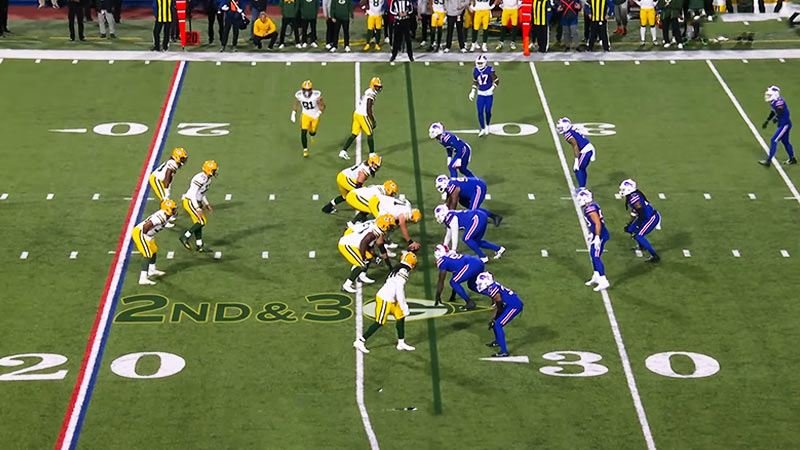
The tension in an American football stadium reaches a fever pitch when the offense marches deep into opponent territory.
As the players line up, the stadium scoreboard flashes a phrase that instantly shifts the psychological energy of the game: 2nd and Goal.
For seasoned enthusiasts, this terminology signals an immediate spike in drama. But for newer viewers, casual fans, or international spectators, the sudden shift from numbers to the word “Goal” can raise immediate questions.
Why does the standard down-and-distance tracking disappear? Why is the yardage no longer stated in the primary notation?
This comprehensive guide breaks down the structural mechanics, official rules, historical context, and tactical strategies behind 2nd and Goal.
By understanding this crucial football scenario, you will gain a deeper appreciation for the chess match played on the field.
The Fundamental Mechanics of “Goal-to-Go”
To understand what “2nd and Goal” means, we must first review how downs and distance work under standard conditions.
Normally, an offensive team is given a series of four plays, known as downs, to advance the football at least 10 yards.
When a team successfully gains those 10 yards, they are awarded a new first down, resetting the count. This is why you typically hear announcers say phrases like “1st and 10” (first down, 10 yards to go) or “2nd and 5” (second down, 5 yards to go).
However, everything changes when the offense advances the ball inside the opponent’s 10-yard line.
Inside this threshold, the distance between the line of scrimmage (where the play starts) and the end zone is less than the 10 yards required for a standard first down.
Because the boundary of the end zone is closer than a fresh first-down marker, reaching a standard first-down line becomes physically impossible.
Therefore, the rules of the sport adapt:
- The Target Shifts: The traditional first-down line is eliminated. The only target left on the field is the opponent’s goal line.
- The “Goal” Designation: Because the goal line is now the line to gain, the distance indicator is replaced by the word “Goal”.
- The Play Count: “2nd and Goal” indicates that the offensive team has already used their first down of this close-range series and did not score. They now have three downs remaining to cross the goal line for a touchdown.
In essence, “2nd and Goal” means the offense is starting its second attempt of the series, and the play must result in a touchdown or lead to a subsequent down, because there is no intermediate checkpoint left to achieve.
Why It Is Called “Goal” Instead of a Number: The Practical Reasons
A common question among those learning the nuances of the sport is: Wouldn’t it make more sense to use the exact yardage instead of being vague? For instance, if the offense is three yards away from the end zone, why not call it “2nd and 3”?
There are vital structural and communicative reasons why the sport utilizes “Goal” rather than a number:
Preventing On-Field and Spectator Confusion
If an announcer or scoreboard displayed “2nd and 3” while the ball was resting on the opponent’s 3-yard line, it could lead to significant confusion.
In a standard scenario, “2nd and 3” means that if the offense gains three yards, they will be awarded a fresh set of downs and can keep driving.
However, at the 3-yard line, gaining three yards means scoring a touchdown. By labeling the situation 2nd and Goal, the game clarifies that no first down can be achieved short of the end zone. It immediately communicates that the team has entered a “touchdown or bust” sequence.
Establishing the Stakes
When a drive enters “Goal-to-Go” status, the offense is operating on its final set of downs of that possession.
Barring defensive penalties, they have a maximum of four plays to put the ball in the end zone, or they must turn the ball over to the opponent. Using “Goal” acts as a stark reminder of these high stakes.
Distinguishing Field Positioning
Consider the massive difference between these two scenarios:
- Scenario A: The offense is at their own 20-yard line facing a “2nd and 3.”
- Scenario B: The offense is at the opponent’s 3-yard line facing a “2nd and 3.”
If a broadcaster or statistician simply wrote “2nd and 3” without the “Goal” modifier, the immense difference in leverage, strategy, and field positioning would be obscured. Appending “and Goal” preserves this context instantly.
Broadcast History: From Radio Heritage to TV Scoreboard Evolution
The terminology we hear on modern broadcasts is a product of decades of technological evolution, stemming from a time when fans could not see the field at all.
The Radio Era: Painting a Mental Picture
Before the dominance of television, millions of sports fans followed football exclusively through radio broadcasts. Radio play-by-play commentators had to paint a precise picture of the field using only their voices.
Phrases like “2nd and Goal from the 3-yard line” became crucial shorthand. It immediately conveyed to the listener exactly how close the offense was to scoring, the desperation of the defense, and the physical location of the ball without requiring any visual aid.
The Scoreboard Limitation
Historically, older physical stadium scoreboards had character limits. Many were built with simple incandescent bulbs and rotary dials that could only display numbers, not letters.
On those legacy displays, stadiums would often show the exact yardage to go. As technology progressed to digital screens, scoreboards easily adopted the standardized “Goal” lettering.
The Modern Television Age
Today’s television broadcasts utilize advanced graphical overlays, often called “score bugs,” which feature a virtual blue line to represent the line of scrimmage, alongside a yellow line representing the first-down marker.
Because modern viewers can easily look at the screen and see exactly how many yards separate the ball from the end zone, television broadcasts sometimes drop the “from the [X] yard line” verbal explanation, relying on the visual to carry the information.
However, announcers still use the spoken terminology to maintain the dramatic rhythm of the game.
The Unbelievable Edge Cases: Sacks, Penalties, and Punting
While “2nd and Goal” typically occurs within the opponent’s 10-yard line, the fluid nature of football rules means that extreme, almost paradoxical edge cases can occur.
Under rare circumstances, a team can find itself in a “Goal” situation from dozens of yards away, or even find itself resetting the downs entirely.
The Rulebook Deep-Dive
To understand how these anomalies happen, we must look at the official rulebook. Specifically, Rule 3, Section 8, Article 3 states:
“The line to gain is the spot 10 yards in advance of the spot of the snap that starts a series, except when a goal line is less than 10 yards from this spot. In that case, the line to gain is the goal line.”
Once a series is officially designated as a “Goal-to-Go” series because the goal line was less than 10 yards away at the initial snap, that designation remains in place for the entirety of the possession series, regardless of how far backward the offense is pushed by sacks or penalties.
1: How to Reset from “Goal” to a Standard First Down
Is it possible to go from an “and Goal” situation back to a standard “1st and 10”? The answer is yes, though it requires a very specific sequence of events.
Imagine the following scenario:
- The offense has a 1st and Goal from the 8-yard line.
- On the snap, the quarterback is sacked for a massive 15-yard loss, backing the offense up to the 23-yard line.
- On the next play (2nd and Goal from the 23), the quarterback throws an incomplete pass, but a defensive player commits a defensive holding penalty.
By rule, defensive holding carries a penalty of 5 yards and an automatic first down. Because the ball is now spotted at the 18-yard line—which is more than 10 yards away from the end zone—the “Goal” status is lost.
The line to gain is no longer the goal line; it is a new spot 10 yards downfield. The offense is awarded a standard 1st and 10 from the 18-yard line.
2: Facing “Goal” from Deep Territory
If the offense is pushed backward but the defense does not commit a penalty to reset the downs, the offense must continue their “Goal” series from extreme distances.
For example, if a team starts at the 5-yard line on 1st and Goal, suffers a 15-yard sack, and then commits a 10-yard holding penalty, they will face a 2nd and Goal from the 30-yard line. They still have to reach the end zone to secure a first down, because no intermediate line to gain exists.
3: The Ultimate Paradox—Punting on Fourth and Goal
Perhaps the most bizarre scenario in football is when an offense is forced to punt the ball away on a goal-to-go series.
While extremely rare, this has actually happened in high-level college football games. If an offense suffers catastrophic backward plays—such as consecutive 20-yard sacks, fumbles recovered far downfield, and multiple unsportsmanlike conduct penalties—they can find themselves facing a 4th and Goal from their own side of the fifty-yard line.
Because attempting a 65-yard field goal is highly risky and attempting to gain 60 yards on a single play is highly unlikely to succeed, the coaching staff will make the painful decision to execute a standard punt to pin the opponent deep, completing a highly unusual “fourth-and-goal punt”.
Strategic Playbook: Coaching the 2nd and Goal
Inside the 10-yard line, the physical geometry of the football field undergoes a radical transformation. The field is compressed, which completely alters the strategic approach for both the offensive play-caller and the defensive coordinator.
+-------------------------------------------------------------+
|                          END ZONE                           |
|=================== GOAL LINE ===============================|
|  .  .  .  .  .  .  .  .  .  .  .  .  .  .  .  .  .  .  .  .  | <-- Compressed Space
|  .  .  .  .  .  .  .  .  .  .  .  .  .  .  .  .  .  .  .  .  | (No deep passing threats)
|  .  .  .  .  .  .  .  .  .  .  .  .  .  .  .  .  .  .  .  .  |
|------------------- 10-YARD LINE ----------------------------|
|                                                             |
|                      LINE OF SCRIMAGE                       |
The Offensive Playbook on 2nd and Goal
On second down, the offensive play-caller holds a distinct tactical advantage because they have multiple downs left to work with. The strategy typically focuses on maximizing high-probability gains while maintaining play-action flexibility.
- Managing the Compressed Field: Because the back of the end zone acts as an extra defender, the defense does not have to worry about deep vertical passes. The defense will crowd the line of scrimmage, making throwing windows incredibly tight.
- The Running Game: A strong run on second down serves two purposes: it can push the ball across the line for a score, or it can reduce a 2nd and Goal from the 6 to a highly manageable 3rd and Goal from the 2-yard line.
- The Fade and the Pick Route: To combat the lack of vertical space, offenses will utilize the width of the field. Standard goal-line passing plays include back-corner fades (utilizing the height of tall receivers) or “slant-flat” combinations designed to rub defenders off their coverage targets.
The Defensive Playbook on 2nd and Goal
For the defense, the goal is to hold the offense to a minimal gain, forcing a difficult third down and hopefully limiting them to a field goal attempt on fourth down.
- Heavy Personnel: Defenses will swap out smaller, faster defensive backs (who specialize in deep coverage) for larger, stronger defensive linemen and linebackers. This is often referred to as “goal-line defense” or “heavy package.”
- Clogging the “A” Gaps: The defensive line will crowd the center and guards to prevent a direct fullback dive or quarterback sneak.
- Boundary Leverage: Defensive backs will play aggressive, physical, “man-to-man” coverage, using the sidelines and the back end-line to squeeze the space available to receivers.
Summary: The Essence of the Game
“2nd and Goal” is more than just a mechanical description of down and distance—it is a shorthand that represents the ultimate test of execution in American football.
It strips away the comfort of intermediate first-down lines, leaving both teams with a clear, uncompromising boundary: the goal line.
Whether an offense is attempting to punch the ball in from the 1-yard line or fighting to recover yardage after a disastrous sack, “2nd and Goal” reminds players and fans alike that the safety net is gone. It is simply a matter of who can win the physical battle in the trenches.