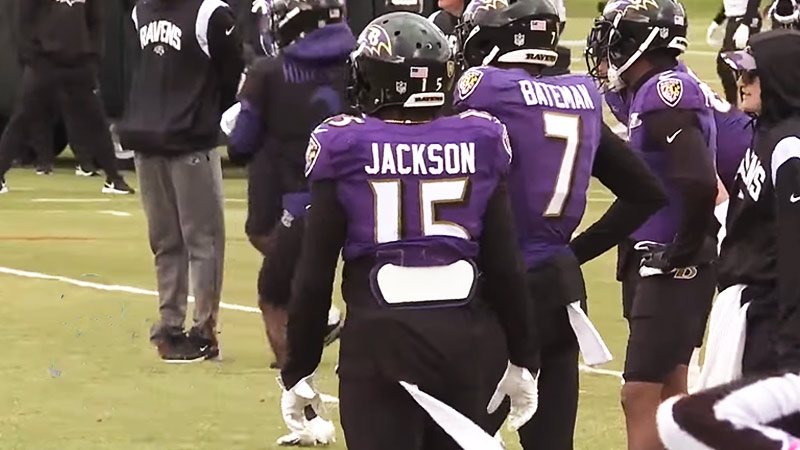
The Pro Football Hall of Fame is an institution built on the pillars of consistency, dominance, and the ability to change the way the game is played.
Every year, the selection committee faces the daunting task of separating the “Great” from the “Immortal.” As the modern era of the NFL produces ballooning passing statistics, the criteria for wide receivers have become increasingly scrutinized.
In this landscape, the candidacy of DeSean Jackson presents one of the most fascinating debates in recent history.
Jackson is not currently a member of the Pro Football Hall of Fame, and many analysts view him as a long-shot or a borderline candidate.
The primary tension lies in his identity as a specialist. In a league that often prioritizes high-volume reception totals, Jackson was a hunter of the home run.
To understand his candidacy, one must look beyond the standard box score and examine the specific, terrifying impact he had on defensive coordinators for over a decade.
The Statistical Blueprint: Redefining Efficiency
When evaluating a receiver for a bronze bust, the first stop is usually the career yardage and reception totals. Jackson finished his 15-year career with 11,263 receiving yards and 641 receptions.
At first glance, 641 catches may seem low for a Hall of Fame hopeful, especially when compared to the 1,000-catch milestones reached by many of his contemporaries. However, the true story of Jackson’s career is found in the space between those catches.
Jackson averaged over 17 yards per reception throughout his career, a statistical rarity for any player who surpassed the 11,000-yard threshold. This efficiency highlights a player who did not rely on “cheap” yards or short-screen passes to bolster his resume.
Every time Jackson touched the ball, the field shrank. He was the primary engine of vertical gravity in the NFL, forcing safeties to play ten yards deeper than they would for almost any other player.
Perhaps his most compelling argument for Canton is his mastery of the “long score.” Jackson is tied for the most career touchdowns of 60 yards or more in the history of the league. This isn’t just a fun fact; it is a testament to a specific type of dominance.
If the Hall of Fame is meant to house the players who were the absolute best at what they did, then the man who shares the throne for the most 60-plus yard strikes must be given serious consideration.
The Multi-Dimensional Threat: Beyond the Wideout Position
One of the most significant shifts in Hall of Fame voting in recent years has been the increased appreciation for special teams contributions.
Players like Devin Hester have paved the way for specialists to be recognized as elite athletes who influenced the outcome of games in non-traditional ways.
DeSean Jackson was not merely a wide receiver; he was a devastating return specialist. Over the course of his career, his impact as both a pass-catcher and a punt returner earned him three Pro Bowl selections.
His ability to flip the field in a matter of seconds made him a “dual-threat” in the truest sense of the word.
For the Philadelphia Eagles, in particular, Jackson’s punt return prowess provided some of the most iconic moments in the franchise’s history.
These “signature moments” are often what tip the scales for Hall of Fame voters. When a player’s highlights are inextricably linked to the history of the league itself, their “fame” often outweighs their “stats.”
Jackson’s presence on the field dictated team strategy in two different phases of the game, a rare feat that few receivers on the current ballot can claim.
Navigating the Hurdles: The “Logjam” and the Lack of Hardware
Despite the explosive highlights, Jackson faces a steep climb to induction. The modern NFL ballot is currently experiencing a “receiver logjam,” where a long list of heavily decorated players are waiting for their turn.
This list includes players with multiple First-Team All-Pro selections and reception totals that dwarf Jackson’s.
The lack of major individual accolades is perhaps the largest obstacle in his path. Jackson was never named a First-Team All-Pro and finished his career with only three Pro Bowl nods.
In the eyes of some voters, a Hall of Famer should be a player who was undeniably one of the top two or three players at their position for a sustained period.
While Jackson was always the fastest and most dangerous deep threat, he was rarely the “best” overall receiver in a league that featured the likes of Calvin Johnson, Larry Fitzgerald, or Andre Johnson.
Furthermore, his career totals sit noticeably below the modern benchmarks for induction. In an era where 13,000 yards and 800+ receptions have become the unofficial entry fee for wide receivers, Jackson’s numbers—while impressive—reflect his role as a specialist rather than a volume-based centerpiece.
The “Eye Test” vs. The Spreadsheet
The debate over DeSean Jackson eventually boils down to a fundamental question: What is the Hall of Fame for?
If the Hall is a “Hall of Stats,” Jackson may fall short. There are players with more catches, more touchdowns, and more All-Pro plaques who are still waiting for the call.
However, if the Hall is a “Hall of Fame”—a place for the most famous, most feared, and most impactful players of an era—Jackson’s case becomes much stronger.
Very few players in the history of the sport could change a game with a single play quite like Jackson. His career was a masterclass in vertical pressure.
He was the player coaches had to account for in every Tuesday morning meeting. He was the reason defensive coordinators stayed awake at night.
That level of psychological dominance over the league’s defenses is a form of greatness that isn’t always captured in a reception count.
Enhanced FAQ: Understanding the DeSean Jackson Debate
Q: Why is DeSean Jackson considered a “specialist” in the Hall of Fame debate?
A: Jackson is categorized this way because his primary impact was as a serious threat and a returner rather than an all-around, high-volume receiver. While he reached 11,263 yards, his 641 receptions are significantly lower than most modern Hall of Famers.
Q: How does his yards-per-reception average compare to other greats?
A: Jackson averaged over 17 yards per reception. To put this in perspective, most elite receivers with high career yardage see their averages dip as they take more short-to-intermediate targets. Maintaining that high an average over 11,000+ yards is an extremely rare accomplishment in the modern era.
Q: Does his record for 60-yard touchdowns actually matter for the Hall of Fame?
A: It is a critical “black ink” stat. Being tied for the most touchdowns of 60+ yards in NFL history provides a concrete “best” metric that voters can use to justify his induction despite lower volume totals.
Q: Who are the players he is competing against on the ballot?
A: He is competing against a “logjam” of receivers with massive career totals and more First-Team All-Pro selections. Players like Torry Holt, Reggie Wayne, and Steve Smith Sr. often represent the traditional statistical hurdles Jackson must overcome.
Final Verdict: A Legacy of Lightning
DeSean Jackson’s career was defined by the long ball and the breathless moments that followed a deep arc from a quarterback’s hand. He was a player of singular talent, a human highlight reel who redefined what it meant to be a vertical threat in the 21st century.
Whether the selection committee eventually welcomes him to Canton remains to be seen. The lack of traditional accolades and the sheer volume of elite receivers on the ballot make him a difficult sell for some.
Yet, for those who watched him play, the argument is simple: You cannot tell the story of the NFL in the 2010s without mentioning the man who could score from anywhere on the field at any moment.
Jackson was the gold standard for speed and big-play tracking. In the final analysis, his case for the Hall of Fame rests on whether we value the steady climb of the mountain or the brilliance of the lightning strike.