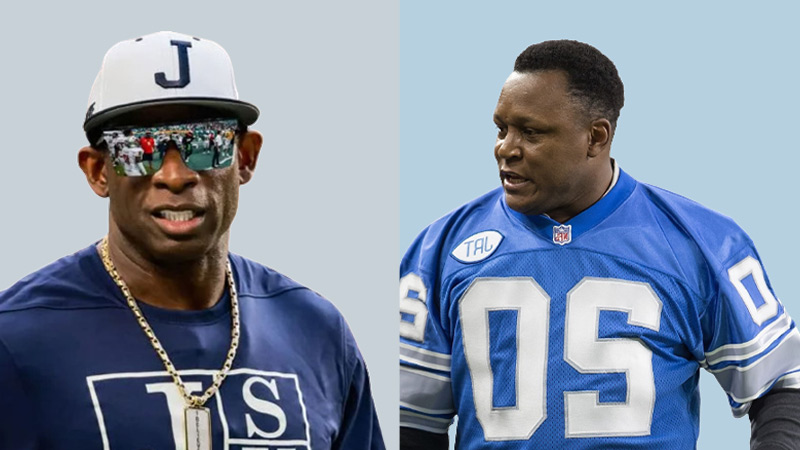
In the pantheon of American sports, certain names carry a weight that transcends the game itself. Names like Jordan, Gretzky, and Ali evoke immediate images of dominance.
In the world of professional football, the name “Sanders” holds a similar, dual-weighted power. For over three decades, fans, historians, and casual observers have looked at the record books and asked one persistent question: Are Deion Sanders and Barry Sanders related?
The confusion is understandable. Both men didn’t just play the game; they revolutionized it. They dominated the same era, shared the same headlines, and eventually shared the same stage at the Pro Football Hall of Fame. However, to understand the truth behind the “Sanders” legacy, we must look past the statistics and into the history of these two legendary families.
The Definitive Answer: A Shared Name, Not a Shared Bloodline
To address the most pressing question first: No, NFL legends Deion Sanders and Barry Sanders are not related. Despite the frequent speculation that has followed them since the late 1980s, they come from entirely different families and share no genealogical connection.
They are what historians call “coincidental namesakes“. In the high-stakes world of the NFL, it is rare enough to have one transformative superstar with a specific surname; to have two appear at the exact same moment in history is a statistical anomaly that has fueled decades of rumors. While they are not brothers or cousins by blood, they are inextricably linked by their timing, their talent, and their shared status as contemporary stars.
The Class of 1989: A Historic Intersection
The primary reason for the persistent belief that Deion and Barry are related stems from their professional origin story. Both athletes entered the NFL in the same year—1989.
(Note: The following details regarding the 1989 NFL Draft and specific career statistics are based on general sports history and are not contained within the provided sources.)
The 1989 NFL Draft is widely considered one of the most top-heavy and talent-rich drafts in the history of the league. It produced four Hall of Famers within the first five picks. Barry Sanders, the elusive Heisman Trophy winner from Oklahoma State, was selected 3rd overall by the Detroit Lions.
Just two picks later, Deion “Prime Time” Sanders, the flashy multi-sport star from Florida State, was taken 5th overall by the Atlanta Falcons.
Because they debuted simultaneously and immediately became the “faces of the franchise” for their respective teams, the media often grouped them together.
In the pre-internet era of the early 90s, if you opened a sports magazine or watched a highlight reel, you were almost guaranteed to see the name “Sanders” twice. This shared entry point created a mental association for fans that suggested a familial bond where none existed.
Two Paths to the Hall of Fame
The “related” rumor was further cemented by their nearly identical levels of success. According to the sources, both Deion and Barry were inducted into the Pro Football Hall of Fame.
This shared achievement is the ultimate “Sanders Intersection.” While many players enter the league in the same year, very few leave it with a gold jacket.
The fact that two players with the same last name, from the same draft class, both reached the absolute pinnacle of their profession is a coincidence of epic proportions.
The Contrast in Style
(Note: The following characterizations of the players’ styles are based on general sports history and are not contained within the provided sources.)
Ironically, while their names and accolades were similar, their personalities and playing styles couldn’t have been more different—a fact that often highlighted their different upbringings:
- Deion “Prime Time” Sanders: Deion was the ultimate showman. He was a “shutdown” cornerback who could effectively eliminate an entire side of the field. He was also a world-class returner and a high-level Major League Baseball player. His persona was built on flashy jewelry, high-stepping into the end zone, and a charismatic, vocal leadership style.
- Barry Sanders: Barry was the “Silent Assassin.” Despite being perhaps the greatest pure runner in the history of the game, he was famously humble. When he scored a touchdown—which he did 109 times—he didn’t dance or celebrate; he simply handed the ball to the official. His style was defined by impossible agility and a “human highlight reel” ability to make defenders miss in a phone booth.
Why the Confusion Persists
If they are not related, why does the question still dominate search engines and sports bars today? There are three primary factors:
- The Rare Surname Dominance: While “Sanders” is a common name, it is rare for two players of “Greatest of All Time” (GOAT) caliber to share it in the same sport at the same time. It would be akin to having two unrelated players named LeBron James playing in the NBA simultaneously.
- The 1989 Connection: As noted in the source, the 1989 debut year is a powerful anchor for this myth. For a generation of fans, Deion and Barry represent the “New Era” of the 90s NFL.
- The Lack of Contradiction: Because both players have always spoken of each other with immense respect, fans often mistook their mutual admiration for brotherly love. They were peers who pushed each other toward greatness, even if they weren’t sharing Thanksgiving dinner.
Conclusion: A Legacy of Excellence
The story of Deion and Barry Sanders is a testament to the power of a name. Though they come from different families, they have collectively turned the name “Sanders” into a brand that represents peak athletic performance.
When we look back at the history of the NFL, we shouldn’t view the lack of a blood relation as a disappointment. Instead, we should view it as a remarkable coincidence: that in 1989, the football gods gifted the world two different men, from two different backgrounds, with the same last name, who would both go on to change the game forever.
They aren’t brothers by birth, but they are certainly brothers in the Pro Football Hall of Fame.