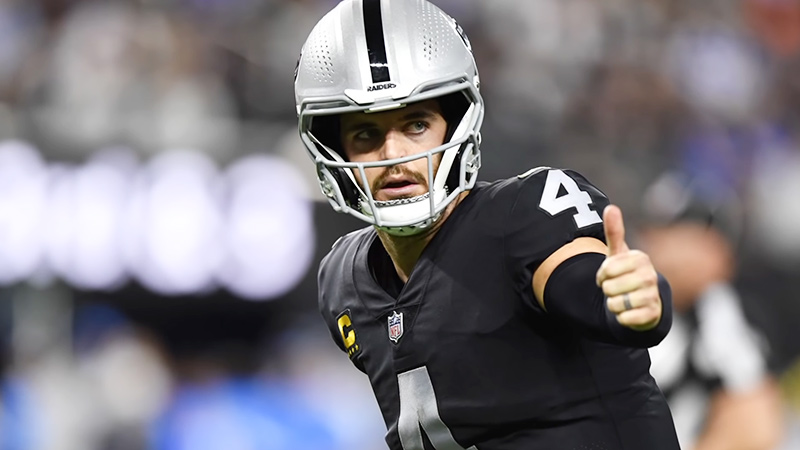
Stability is the bedrock of modern professional football. When a franchise drafts a franchise quarterback in the early rounds, the standard operational blueprint is simple: build the infrastructure around him, maintain continuity in the coaching staff, and let the signal-caller master a single system. For Derek Carr, however, that blueprint was entirely foreign.
Over an impressive 11-year professional career that spanned two distinct franchises—the Oakland/Las Vegas Raiders and the New Orleans Saints—Carr became the ultimate case study in managing extreme organizational instability.
Before ultimately announcing his retirement from the NFL, Carr worked under six different official offensive coordinators.
To put that level of turnover into perspective, consider that some quarterbacks enjoy the luxury of a single play-caller for the majority of their prime years.
Carr, meanwhile, was forced to learn a brand-new playbook, adapt to entirely different terminology, and build chemistry with a fresh leadership tree almost every other season.
Let us break down the chronological timeline of Derek Carr’s offensive coordinators, examine the cascading impact of this constant churn, and look at how his career journey has ultimately brought him full circle into coaching.
The Chronological Breakdown: Derek Carr’s 6 Official Coordinators
Navigating six play-callers in eleven seasons requires an extraordinary amount of mental bandwidth.
Each coordinator brought a distinct philosophy, ranging from West Coast principles to modern vertical spread concepts.
1. Greg Olson (2014; 2018–2021)
The Context: Olson was Carr’s very first NFL offensive coordinator during his rookie campaign with the Oakland Raiders.
The Dynamic: Stepping into a rebuilding franchise as a rookie starter is never easy, but Olson provided a steady foundational hand during Carr’s introduction to the professional level.
After a stint away from the franchise, Olson returned to the Raiders years later to run the offense under head coach Jon Gruden, giving Carr rare pockets of familiarity in an otherwise turbulent career landscape.
2. Bill Musgrave (2015–2016)
The Context: Musgrave took over the offensive reins in Carr’s second season.
The Dynamic: This partnership produced some of the highest-flying football of Carr’s career. Musgrave orchestrated the explosive 2016 Raiders offense that propelled Carr into early MVP conversations and guided the team to a stellar 12-4 record.
Tragically, momentum ground to a halt late in the year when Carr suffered a broken leg, altering the trajectory of the franchise.
3. Todd Downing (2017)
The Context: Following the success of the 2016 campaign, the Raiders front office chose not to renew Musgrave’s contract, opting instead to promote quarterbacks coach Todd Downing to offensive coordinator.
The Dynamic: Downing’s tenure lasted for just one season. The offense struggled to recapture the dynamic rhythm of the previous year, highlighting how disruptive even internal promotions can be when terminology and rhythm shift unexpectedly.
4. Mick Lombardi (2022)
The Context: When Josh McDaniels was hired as the head coach of the Las Vegas Raiders, Mick Lombardi was brought in as the offensive coordinator.
The Dynamic: This partnership marked Carr’s final turbulent season with the franchise that drafted him. Playing in a complex system derived from New England Patriots principles, Carr experienced mounting friction, leading to a mid-season benching and his eventual departure from Las Vegas.
5. Pete Carmichael Jr. (2023)
The Context: Looking for a fresh start in free agency, Carr signed with the New Orleans Saints, spending his first season in Louisiana running Pete Carmichael Jr.’s system.
The Dynamic: Transitioning to the NFC, Carr had to learn a historic Saints offense deeply rooted in the Sean Payton coaching tree, working to stabilize a roster looking for a dependable veteran anchor under center.
6. Klint Kubiak (2024)
The Context: The Saints retooled their offensive staff heading into the 2024 season, replacing Carmichael with Klint Kubiak.
The Dynamic: Kubiak’s arrival brought a zone-running, play-action heavy scheme borrowed from the Kyle Shanahan tree. This system became Carr’s sixth and final official offensive coordinator assignment before his retirement.
Note: While passionate fans and analysts occasionally debate interim promotions—such as Rich Bisaccia’s tenure or temporary play-callers—these six individuals represent the officially designated coordinators heading into each of Carr’s professional seasons.
The Hidden Cost of Constant System Changes
For an NFL quarterback, changing offensive coordinators is much more than just learning a new playbook. It requires mastering an entirely new language. Every coordinator brings unique preferences for:
- Huddle terminology and cadence: Changing words at the line of scrimmage under a new scheme can lead to costly pre-snap penalties or confusion.
- Footwork and dropbacks: A quarterback’s mechanical timing changes drastically depending on whether a system relies on 3-step, 5-step, or 7-step drop timing.
- Route concepts and progressions: Trusting where a wide receiver will break requires thousands of reps; breaking that muscle memory every two years stunts elite development.
Despite this revolving door of leadership, Carr managed to put together a remarkably productive career.
He earned four Pro Bowl selections, established himself as the Raiders’ all-time franchise leader in passing yards, passing touchdowns, and completions, and finished his career safely inside the top tier of modern passing milestones.
Beyond the NFL: Transitioning to the Sidelines
Following the conclusion of his playing days, Carr’s journey in football has come full circle. Rather than walking away from the gridiron entirely, he has transitioned directly into a teaching role.
Carr accepted a position as a special adviser to head coach Bob Chesney at UCLA. In this capacity, the veteran signal-caller volunteers his extensive football IQ to assist the Bruins’ offensive coaching staff with game-planning, strategy, and direct mentorship of young quarterbacks.
Given the sheer volume of systems, schemes, and coordinators he navigated throughout his professional career, Carr brings a rare wealth of high-level perspective to the collegiate ranks.
Frequently Asked Questions
How many total teams did Derek Carr play for in the NFL?
Derek Carr played for two distinct franchise organizations over his 11-year professional career: the Raiders (playing in both Oakland and Las Vegas) and the New Orleans Saints.
Who was Derek Carr’s longest-tenured offensive coordinator?
Greg Olson held the title across two separate stints (2014 and 2018–2021), giving him the most cumulative seasons working directly with Carr as an official coordinator.
What led to Derek Carr’s retirement from professional football?
Carr announced his retirement from the NFL following a severe right shoulder injury (involving a labral tear and rotator cuff damage) that impacted his throwing capacity ahead of the 2025 season.