In the high-stakes world of professional football, certain moments transcend the box score to become permanent chapters of league history.
For Matthew Stafford, that defining moment arrived on November 22, 2009. As a twenty-one-year-old rookie quarterback drafted first overall by a Detroit Lions franchise desperate for a savior, Stafford was already carrying the weight of massive expectations.
But on a cold afternoon at Ford Field against the Cleveland Browns, he carried something far heavier: a physical, agonizing pain that would establish his reputation as one of the most resilient competitors in modern sports history.
For years, football enthusiasts and sports analysts have asked a fundamental question about that legendary afternoon: Did Matthew Stafford actually dislocate his shoulder?
To understand the truth, we must dissect the medical realities of his injuries, relive the dramatic sequence of the game’s final seconds, and clear up the persistent confusion surrounding his left and right shoulders.
The Genesis of a Legend: November 22, 2009
The Detroit Lions entered their Week 11 matchup against the Cleveland Browns struggling to find traction in a rebuilding year.
Yet, the game transformed into an offensive shootout, keeping fans on the edge of their seats. With only seconds remaining on the clock, the Lions found themselves trailing 37-34, desperate for a final drive to secure a victory.
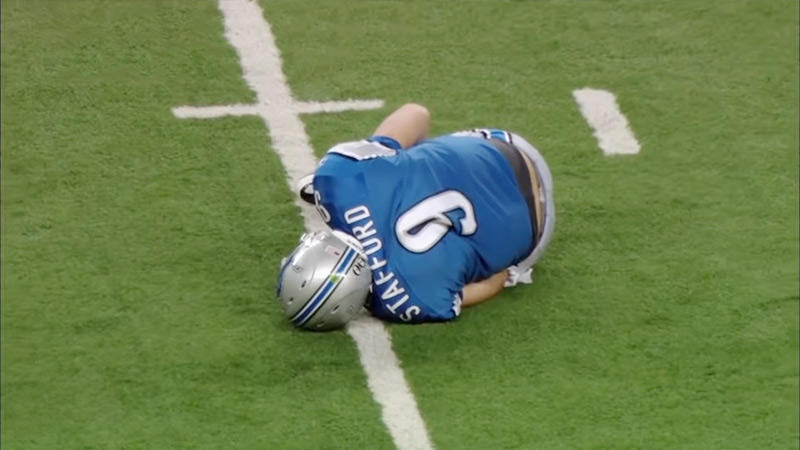
On the final regular play of the game, Stafford dropped back to pass. As he launched a desperate ball toward the end zone, a heavy hit from a Browns defender drove him violently into the turf. The impact was immediate and devastating. Stafford remained on the ground, clutching his left shoulder in obvious agony.
To the millions watching, it appeared the rookie’s afternoon—and potentially his rookie season—was over.
The stadium grew quiet as trainers rushed onto the field to attend to the young quarterback, who was eventually helped to the sideline, holding his left arm completely limp against his body.
Medical Breakdown: Dislocation vs. Separation
To answer whether Stafford dislocated his shoulder, it is crucial to understand the medical terminology often used interchangeably by sports commentators, fans, and even athletes themselves.
During that 2009 rookie game, Stafford suffered a severe left shoulder injury. In the immediate aftermath and the years that followed, the injury was frequently characterized by players, media members, and fans as either a shoulder separation or a shoulder dislocation.
But what is the clinical difference between these two conditions?
- Shoulder Dislocation: A true shoulder dislocation occurs at the glenohumeral joint—the main “ball-and-socket” joint of the shoulder. This happens when the upper arm bone (humerus) is physically forced out of its socket in the shoulder blade (scapula). It is an incredibly painful injury that typically requires a medical professional to manually pop the bone back into place, and it causes significant trauma to the surrounding ligaments and muscles.
- Shoulder Separation: A shoulder separation occurs at a completely different joint—the acromioclavicular (AC) joint. This is the point where the collarbone (clavicle) meets the highest point of the shoulder blade (acromion). A separation involves a sprain or tear of the ligaments that hold these bones together. While the arm bone remains in its socket, the collarbone can shift upward, creating a visible bump on the shoulder.
While official team medical reports can sometimes be guarded for competitive reasons, the collective consensus among those close to the team was that Stafford’s left shoulder had suffered a severe separation or subluxation (a partial dislocation).
Regardless of the exact clinical grading, the physical reality was clear: Stafford’s left shoulder was severely unstable, compromised, and screaming in pain.
The Untimed Down: Grit in Real-Time
What happened next is etched into NFL folklore. As Stafford was being evaluated on the sideline by Detroit’s medical staff, a penalty flag was thrown on his final pass play. The Browns had been called for defensive pass interference in the end zone.
Because an NFL game cannot end on a defensive penalty, the Lions were awarded one final untimed down from the one-yard line.
On the sideline, the Lions’ backup quarterback was warming up, preparing to enter the game for the final, decisive play. But Stafford, seeing the penalty call, realized the game was still alive.
In a display of pure adrenaline and determination, he broke away from the medical staff who were trying to hold him back, grabbed his helmet, and demanded to go back onto the field.
With his left arm hanging awkwardly, Stafford stepped back into the huddle. He took the snap, stood firm in the face of an oncoming rush, and delivered a perfectly placed pass to tight end Brandon Pettigrew in the end zone for the game-winning touchdown. The stadium erupted. The Lions won 38-37, and Stafford’s legend was born.
The Persistent Confusion: Left vs. Right Shoulder
One of the most common gaps in sports discussions regarding Matthew Stafford’s injury history is the confusion between his left and right shoulders.
Because he suffered major shoulder injuries in back-to-back seasons early in his career, many articles and discussions mistakenly blend the details of these two separate events.
To set the record straight, we must separate his rookie campaign from his sophomore year:
1. The 2009 Left Shoulder Injury
As detailed, this was the iconic rookie moment against the Cleveland Browns. Because Stafford is a right-handed quarterback, this injury affected his non-throwing (left) shoulder.
This physical detail is precisely what allowed him to return for that final untimed down; while the pain was excruciating, his right arm was still capable of delivering the football.
2. The 2010 Right Shoulder Injury and Surgery
The following season, in 2010, Stafford faced another physical setback. This time, he dealt with separate right-shoulder AC joint issues.
Because this affected his throwing arm, the consequences were far more restrictive for his playing availability, eventually requiring him to undergo corrective surgery that sidelined him for most of his sophomore season.
While the 2010 right shoulder surgery was medically more significant for his career longevity, it is the 2009 left shoulder comeback that remains the most famous and culturally significant instance of his early-career injuries.
It set a baseline of expectation for how Stafford would handle physical adversity for the next decade and a half.
The Cultural Impact of Stafford’s Rookie Performance
Stafford’s return to the field in 2009 did more than win a single regular-season game; it fundamentally shifted the culture of the Detroit Lions and established a blueprint for his leadership.
For years, Detroit had struggled with a reputation for inconsistency. By risking his physical health for a single victory, Stafford showed his teammates, coaches, and fans that he was fully committed to changing the narrative.
This reputation for unmatched toughness followed him throughout his twelve seasons in Detroit and later to the Los Angeles Rams, where he eventually won a Super Bowl.
Analysts frequently pointed back to that cold November day in 2009 as the moment the NFL truly learned who Matthew Stafford was: a quarterback who would play through almost any level of physical discomfort to give his team a chance to win.
Conclusion: A Legacy Forged in Steel
Ultimately, whether clinically classified as a high-grade separation, a subluxation, or a dislocation, Matthew Stafford’s 2009 rookie injury remains one of the greatest displays of physical resilience in NFL history.
By refusing to let his physical limitations dictate the outcome of the game, Stafford did more than throw a touchdown pass; he earned the lifelong respect of his peers, established a standard of elite leadership, and proved that true grit cannot be sidelined.