A relentless pursuit of mismatches defines the modern professional football landscape. Offensive coordinators no longer view positions through rigid, traditional lenses.
Instead, they seek positionless chess pieces—players who possess the physical profile to play on the boundary and the intellectual precision to operate in congested spaces.
Among the elite tier of wide receivers who embody this modern paradigm, few profiles are as strategically compelling as Stefon Diggs. A central question often arises among analysts, coaches, and fans alike: Does Stefon Diggs play in the slot?
The short answer is yes, but the complete tactical reality is far more complex and intellectually interesting. Diggs is not merely a slot receiver, nor is he strictly an outside burner.
He is a consummate hybrid weapon who splits his deployment between the inside and the outside, forcing opposing defensive coordinators into constant conflict.
This analytical exploration dissects the mechanics of his versatility, the strategic value of his alignment splits, and how his usage has evolved across his career stops with the Minnesota Vikings, Buffalo Bills, Houston Texans, and New England Patriots.
1. The Strategic Architecture of Inside-Outside Deployment
To understand why a coaching staff would choose to move a premier wide receiver away from the traditional outside boundary, one must understand the mathematical and spatial advantages of the modern passing game.
Historically, the premier wide receiver of an offense lined up almost exclusively “out wide” as the X or Y receiver, hugging the sideline.
The slot, conversely, was reserved for smaller, shiftier players who lacked the size or straight-line speed to beat physical press coverage on the perimeter.
That paradigm has shifted entirely. Elite offenses now use their best route-runners throughout the formation.
For Diggs, this hybrid role is not an occasional gimmick; it is a fundamental pillar of his offensive utility.
Throughout his highly productive career, coaches have refused to restrict him to a single spot on the field, choosing instead to move him around dynamically based on the weekly game plan, specific matching scenarios, and the design of the offensive formations.
By shifting an elite receiver inside, an offensive coordinator achieves several immediate advantages:
- Two-Way Go: Unlike an outside receiver who is limited by the boundary of the sideline, a slot receiver has space to break both inside (toward the middle of the field) and outside (toward the sideline). This makes anticipating the route significantly harder for defenders.
- Matchup Manipulation: Placing a premier weapon in the slot frequently forces defenses to make difficult coverage decisions, often leaving him matched up against slower linebackers or safeties who lack the lateral agility to keep pace.
- Coverage Identification: Offenses often use pre-snap motion to shift players like Diggs into the slot, forcing the defense to reveal whether they are playing man-to-man or zone coverage.
2. Mastering the Slot: Exploding the Middle of the Field
When looking closely at the deployment metrics, the tactical division of labor in Diggs’ game becomes clear.
The records indicate that he frequently logs a highly substantial portion of his offensive snaps—often hovering around the 40% to 50% range depending on the specific season and the design of the offensive scheme—directly from the slot.
Operating in the slot between 40% and 50% of the time represents a deliberate tactical choice. It allows an offense to run the passing game through the middle of the field, where passing windows are tighter but the potential yards-after-catch yields are significantly higher.
The Route-Running Calculus
Operating inside requires a completely different cognitive and physical skill set than playing on the outside. In the slot, a receiver must navigate what coaches refer to as “traffic”—the dense middle area of the field populated by linebackers, safeties, and nickel cornerbacks.
Diggs excels in this environment due to his precise route-running. Route-running inside is not just about raw speed; it is about timing, leverage, and the ability to change direction without losing momentum.
- Leverage Dictation: Diggs utilizes subtle head fakes and upper-body deception at the line of scrimmage to manipulate the defender’s leverage. If a nickel cornerback plays with inside leverage to protect the middle of the field, Diggs can fake an inside release, force the defender to shift his weight, and then break outside into open space.
- Stem Manipulation: During the vertical “stem” of the route, Diggs can maintain a consistent speed that masks his final break. This makes it nearly impossible for defenders to anticipate whether he is running a shallow crosser, an in-lap, or a corner route.
- Navigating Zone Voids: In zone coverage, the middle of the field is divided into distinct defensive responsibilities. A slot receiver must find the “dead spaces” between the zones and sit down to offer the quarterback a clean, high-percentage target. Diggs’ football intelligence allows him to read these zone coverage structures in real-time, adjusting his route depth to maximize separation.
By placing Diggs in the slot for nearly half of his snaps, coaching staffs ensure that their quarterback has a reliable, elite separator working the intermediate areas of the field.
This inside utilization acts as an offensive engine, sustaining drives, converting crucial third downs, and keeping the chains moving.
3. The Perimeter Dimension: A Traditional Boundary Threat
While the tactical value of the slot is immense, an offense cannot afford to turn an elite receiver into a one-dimensional inside specialist. To maintain maximum offensive balance, a player must also threaten the defense vertically on the boundary.
This is where Diggs’ true versatility shines. Despite his high slot usage, he remains heavily deployed on the outside as a traditional wide receiver.
On the outside, the spatial dynamics change. The sideline acts as an extra defender, restricting the receiver’s lateral options. To win consistently on the perimeter, a player must possess:
- Press-Release Mastery: Outside receivers must regularly beat physical, press-man coverage at the line of scrimmage. Diggs uses a diverse package of footwork releases—including split releases, foot-fire releases, and hesitation moves—to slip past physical cornerbacks without getting jammed.
- Vertical Speed and Acceleration: To stretch a defense, a receiver must threaten the deep third of the field. Diggs’ ability to accelerate rapidly forces cornerbacks to respect his deep vertical threat, which in turn opens up a cushion for intermediate comeback and curl routes.
- Ball Tracking and Body Control: Deep passes often require a receiver to adjust to the ball in mid-air while running at top speed. Diggs’ body control allows him to shield defenders from the ball, track the ball over his shoulder, and make complex catches along the boundary lines.
By remaining a constant threat on intermediate and deep perimeter routes, Diggs prevents defenses from crowding the middle of the field. If a defensive coordinator decides to roll safety help inside to stop the slot passing game, Diggs can instantly punish them from an outside alignment. This dual-threat capability is what makes him incredibly difficult to game-plan against.
4. The Portability of Versatility: A Career-Long Trend
The ability to play both inside and outside is not a recent development in Diggs’ career. Rather, it has been a defining characteristic of his professional journey.
Throughout his career stops with four different franchises, his coaches have consistently recognized and exploited this hybrid profile:
The Minnesota Era
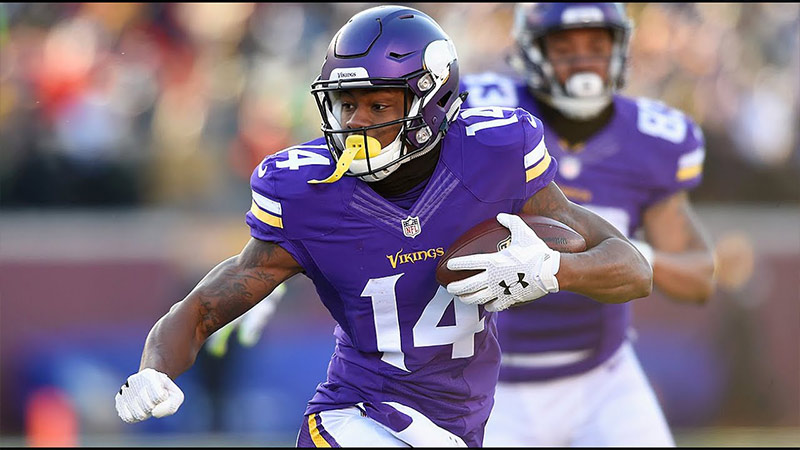
In Minnesota, where Diggs first established himself as an elite NFL talent, his versatile movement across formations allowed the offense to stay balanced.
Even in run-heavy schemes, his ability to align in the slot or out wide gave the passing game necessary flexibility, proving that his route-running was highly adaptable.
The Buffalo Era
During his highly productive years in Buffalo, his inside-outside versatility was weaponized to its fullest extent.
The coaching staff utilized high-tempo, spread formations where Diggs would line up in the slot to dictate matchups, and then shift to the perimeter on subsequent downs to stretch the boundary. This constant movement kept opposing defenses from executing focused bracket coverages.
The Houston Era
In Houston’s dynamic, modern offensive system, Diggs’ inside presence became a vital safety valve for a young quarterback.
By logging significant snaps from the slot, he was able to convert high-percentage throws over the middle while allowing other vertical threats to work the outside boundaries.
The New England Era
In New England, a franchise historically famous for valuing versatile, highly intelligent players who can execute multiple roles within a single game plan, Diggs’ hybrid nature fits perfectly.
The coaching staff can utilize him as a classic perimeter route-runner on first down, and then shift him inside to the slot on third-and-medium to exploit a favorable matchup against a linebacker.
This journey across four different franchises demonstrates the remarkable portability of his skill set. Some wide receivers are highly dependent on a specific coaching scheme or a particular quarterback to find success.
Diggs, however, has proven that his hybrid model—anchored by precise route-running and situational versatility—translates seamlessly into any offensive system.
5. Analytical Matchup Deep Dive: Inside vs. Outside
To fully appreciate why coaches utilize this split deployment, we can analyze how the physical and tactical matchups differ between these two distinct areas of the field.
| Tactical Variable | Slot Alignment (Inside) | Perimeter Alignment (Outside) |
|---|---|---|
| Primary Defenders | Nickel Cornerbacks, Safeties, Linebackers | Boundary Cornerbacks, Deep Safeties |
| Spatial Environment | Congested, high traffic, multi-directional | Open boundary, limited by the sideline |
| Typical Snap Share | Approximately 40% to 50% | Approximately 50% to 60% |
| Core Route Tree | Crossers, Slants, Option routes, Seams | Gos, Comebacks, Posts, Out routes |
| Primary Tactical Goal | Exploit middle-of-the-field mismatches | Stretch defenses vertically, win deep |
| Key Physical Asset | Precise lateral route-running, quickness | Release packages, vertical speed, body control |
This division highlights why a 50/50 or 40/60 split is so effective. If a receiver plays 100% of his snaps in the slot, he becomes easier to bracket with zone defenders.
If he plays 100% of his snaps on the outside, the defense can use the sideline as an extra defender to compress his routes. By balancing his deployment, Diggs remains completely unpredictable.
The Blueprint of the Positionless Wide Receiver
The career and tactical deployment of Stefon Diggs provide a clear blueprint for the future of the wide receiver position in professional football.
The days of the specialist are rapidly drawing to a close. Modern, elite offenses require players who can seamlessly transition between roles within a single possession.
By successfully balancing a heavy slot workload with high-level perimeter play, Diggs has elevated himself from a simple position player to an offensive force multiplier.
Whether he is running a precise option route against a safety in the slot or winning a heavily contested deep ball against a boundary cornerback, his impact remains constant.
For franchises looking to build a modern passing game, the lesson of Diggs is clear: versatility is the ultimate metric of value.
The ability to align a premier weapon anywhere on the field—inside or out—is the ultimate way to stay one step ahead of modern defensive schemes.