The quest to identify the most powerful arm in professional football history is a study of physics, mechanics, and raw human capability.
For decades, fans and evaluators have debated whether greatness is measured by the sheer distance of a vertical launch or the velocity required to fit a ball into a closing window twenty yards downfield.
In the modern era, the definition of a “cannon” has evolved. It is no longer just about the ability to stand tall in a pocket and heave the ball; it is about “arm talent”—the capacity to generate elite power from unstable platforms and awkward angles.
The Evolution of Arm Talent
Historically, a strong arm was a stationary asset. Quarterbacks were expected to drive their back foot into the turf, transfer weight through their hips, and follow through with a high release point.
While this remains the gold standard for mechanics, the modern game demands more. Today’s elite signal-callers must be able to “zip” the ball into tight windows while retreating from a pass rush or sprinting toward the sideline.
This shift has highlighted a new breed of athlete who can generate incredible torque without a set base.
When we analyze the greatest arms to ever play the game, we are looking at a cross-section of pure velocity, distance, and the ability to maintain that power under duress.
The Modern Gold Standard: Josh Allen
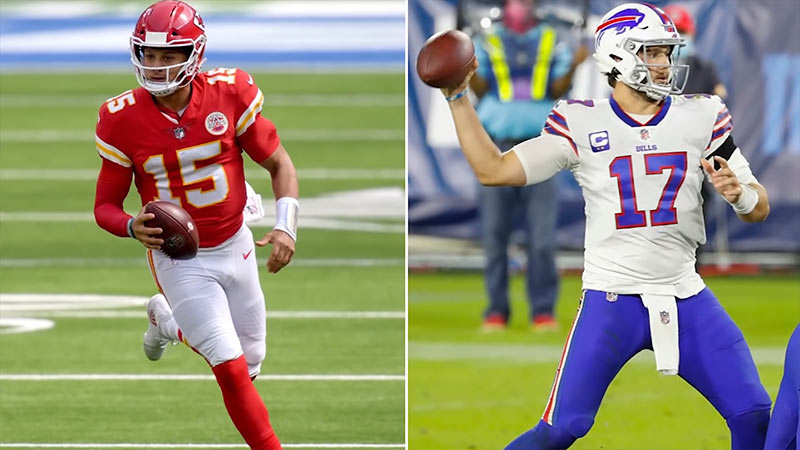
At the pinnacle of the current era stands Josh Allen of the Buffalo Bills. Allen is widely regarded as the quarterback with the strongest arm in the league today.
His physical profile allows him to execute throws that few others would even attempt.
What sets Allen apart is not just the distance he can cover, but his elite velocity. He possesses a unique ability to generate “zip” on the ball, allowing him to fit passes into tight windows even when he is unable to set his feet.
This “off-platform” power is the hallmark of his game, enabling him to remain a threat regardless of how the pocket collapses around him.
Key Characteristics of Josh Allen’s Power:
- Off-Platform Throwing: The ability to launch deep balls while on the move or from awkward, off-balance positions.
- Tight Window Velocity: Driving the ball through narrow defensive lanes without needing a full wind-up.
- Deep-Ball Range: Consistently reaching targets 60+ yards downfield with minimal apparent effort.
The Architecture of the Modern Cannon
While Allen holds the top spot for raw power, he is surrounded by a group of peers who utilize different mechanical advantages to achieve similar results.
Patrick Mahomes has redefined what it means to be an “off-platform” passer. He is renowned for his effortless ability to launch deep, cross-field passes that defy traditional coaching. Mahomes does not always rely on his lower body to generate force; instead, his arm acts as a whip, allowing him to change arm angles—sidearm, three-quarters, or over-the-top—without losing significant velocity.
In contrast, Justin Herbert represents the perfection of modern mechanics. Herbert generates “heavy power” and “pop” by driving through his throws with exceptionally clean form. While Allen and Mahomes thrive in chaos, Herbert is a master of the structured throw, using his frame to deliver a ball that arrives at the receiver with punishing speed.
Matthew Stafford remains a vital part of this conversation as a premier downfield thrower. For years, Stafford has been noted for his ability to lead the league in deep completions, a testament to both his vision and the sustained velocity he keeps on the ball over long distances.
Quantitative Comparison: Modern Elite Arms
| Quarterback | Primary Strength | Defining Metric |
|---|---|---|
| Josh Allen | Raw Velocity & Off-Platform Power | Number one rank for non-base throwing power |
| Patrick Mahomes | Cross-Field Range | Effortless deep launches from any angle |
| Justin Herbert | Mechanical Efficiency | “Heavy power” and ball “pop” through clean drive |
| Matthew Stafford | Vertical Volume | Leader in deep-ball completions and downfield accuracy |
The Historical Titans: Legends of the Launch
To understand the current state of the game, one must look back at the players who set the original benchmarks for arm strength. Before the era of high-speed cameras and advanced analytics, these players relied on raw, intimidating force.
John Elway is perhaps the most famous example of pure velocity in the pre-2000s era. Elway’s arm was so powerful that his receivers famously complained about their hands stinging after catching his passes. He didn’t just throw the ball; he drove it through the air with a level of intensity that made him a constant threat to any secondary.
Michael Vick brought a different flavor of power to the league. Known for an extraordinary “flick-of-the-wrist” motion, Vick could launch the ball like a missile with almost no visible effort. While many quarterbacks required a full-body motion to reach 60 yards, Vick could do it while standing flat-footed, making him one of the most dangerous vertical threats in history.
Brett Favre and Aaron Rodgers represent the legacy of the Green Bay “live arm.”
- Favre was a legendary “hard-thrower” whose gunslinger mentality pushed the limits of what a “live” arm could do.
- Rodgers took that foundation and added a level of precision and touch that few have matched, combining effortless power with an elite release.
Comparative Breakdown: Historical vs. Modern
The debate often centers on whether the legends of the past could match the metrics of today’s stars. While we lack GPS tracking for the 1980s and 90s, the “eye test” and anecdotal evidence suggest that the gap is smaller than one might think.
- Velocity: John Elway and Josh Allen likely share the throne for the “hardest” ball ever thrown, with both players capable of reaching speeds that make catching the ball a physical challenge for receivers.
- Ease of Motion: Michael Vick and Patrick Mahomes share a rare trait where the ball seems to teleport from their hand to a distant target with minimal wind-up.
- Sustained Success: Players like Aaron Rodgers and Matthew Stafford have proven that arm talent is a career-long asset, allowing them to remain elite deep-ball threats well into their veteran years.
Technical Insights: What Makes a Strong Arm?
When scouts evaluate these “cannons,” they look at several biometric and mechanical factors. It is rarely just about bicep strength.
- Kinetic Chaining: The ability to transfer energy from the ground, through the legs, into the torso, and finally out through the arm. Justin Herbert is a master of this.
- Thoracic Mobility: The rotation of the mid-back allows quarterbacks like Mahomes and Allen to create torque even when their lower bodies are trapped or moving in the opposite direction.
- Wrist Snap: The final “flick” that provides the spiral and the “pop.” This was the secret to Michael Vick’s deep-ball success.
- Release Point Consistency: High-velocity throwers must maintain a consistent release point to ensure that the power doesn’t result in an erratic flight path.
The Impact of Arm Strength on Offensive Strategy
A quarterback with a “cannon” changes the geometry of the football field. Defensive coordinators cannot simply “cover the grass”; they must account for the fact that a player like Josh Allen or Patrick Mahomes can hit a target on the opposite sideline from 40 yards away.
This threat forces safeties to play deeper, which in turn opens up the running game and short underneath routes. A strong arm is a gravity-well that pulls a defense out of its preferred shells, creating space for the entire offense. This is why teams will always value “arm talent” over almost any other physical trait during the draft process.
Frequently Asked Questions
Who currently has the strongest arm in the NFL?
Currently, Josh Allen of the Buffalo Bills is widely considered the leader in this category. His ability to combine high velocity with deep-ball distance—especially from off-balance positions—sets him apart from his peers.
Did John Elway really make receivers’ hands bleed?
While “bleeding” might be an exaggeration of lore, it is well-documented that his receivers frequently complained about stinging hands due to the sheer velocity of his throws.
How does Patrick Mahomes’ arm compare to Josh Allen’s?
While Allen is often cited for higher raw velocity and “zip” into tight windows, Mahomes is renowned for his effortless off-platform throws and his ability to launch cross-field passes from any angle.
Is arm strength the same as arm talent?
Not exactly. Arm strength usually refers to the raw power and distance of a throw. Arm talent, as seen in players like Aaron Rodgers, includes the ability to combine that power with precision, different arm angles, and touch.
Summary of the Greats
The lineage of the NFL’s greatest arms is a prestigious club. From the “live” arm of Brett Favre to the “flick-of-the-wrist” missile launches of Michael Vick, the league has always been defined by these vertical threats.
Today, the mantle is carried by Josh Allen, who represents the modern evolution of the position: a player who doesn’t need a perfect pocket to deliver a perfect, high-velocity strike.
Whether it is Justin Herbert’s clean mechanics or Matthew Stafford’s deep-ball volume, the “cannon” remains the most coveted and exciting weapon in professional sports.
As the game continues to move toward more mobile, off-platform play, the definition of the “strongest arm” will likely continue to favor those who can generate elite power in the most difficult circumstances.