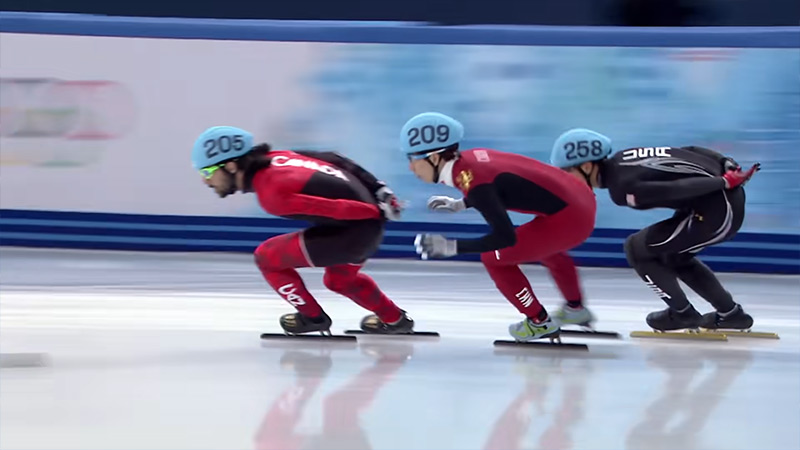
If you’ve ever watched Olympic speed skating and wondered, “Why are there three skaters on the ice at the same time?” — you’re not alone. At first glance, it can look confusing. In some races there are two skaters. In others, three. And sometimes it even seems like more.
The answer depends on the type of speed skating you’re watching. There are actually two main disciplines:
- Speed skating at the Winter Olympics (Long Track)
- Short track speed skating at the Winter Olympics (Short Track)
Each follows different rules — and that’s where the “three skaters” question comes in.
In this detailed guide, we’ll break down:
- The difference between long track and short track
- Why three skaters sometimes race together
- How lanes and qualifying rounds work
- Tactical reasons behind race group sizes
- Why the format makes the sport more exciting
Let’s glide right in.
Understanding the Two Types of Olympic Speed Skating
Before answering the “three skaters” question directly, we need to understand the structure of the sport.
1. Long Track Speed Skating
Long track races are held on a 400-meter oval. Skaters compete in pairs, not in packs.
Two skaters race at a time.
They start in different lanes.
They switch lanes every lap.
Even though you see only two skaters racing together, they are actually competing against the clock, not directly against each other. Final rankings are determined by time.
This format is most commonly seen at the Winter Olympics and World Championships.
2. Short Track Speed Skating
Short track is where things get interesting — and where the “three skaters” usually appear.
Short track is raced on a much smaller 111-meter oval inside a hockey rink. Instead of racing in lanes, skaters race all together in a pack.
In this format:
- Multiple skaters start at the same time.
- They compete directly against one another.
- Only the top finishers move on to the next round.
This is the discipline that most often features three skaters in a heat — especially in later qualifying rounds.
So, Why Exactly Are There 3 Skaters?
The simple answer:
Short track races are organized into heats, and the number of skaters in each heat changes depending on the round and how many competitors remain.
Let’s break it down.
Heat Structure in Short Track Speed Skating
Short track competitions typically follow this format:
- Preliminary Heats
- Quarterfinals
- Semifinals
- Final
In early rounds, there may be 4–6 skaters per heat.
As the competition narrows, fewer athletes remain. That’s when you’ll commonly see:
- 3 skaters in a semifinal
- 3 skaters in a consolation final
- Occasionally 3 skaters in a medal final if disqualifications occur
Three skaters often appear because of:
- The total number of competitors
- Advancement rules
- Penalties or disqualifications
It’s not a fixed rule — it’s a flexible bracket system.
The Strategy Behind Smaller Groups
Why not always have 4 or 5 skaters?
Because smaller groups create:
- Cleaner racing lines
- Fewer collisions
- Fairer advancement when numbers don’t divide evenly
Short track is already chaotic. Skaters travel at speeds exceeding 30 mph on tight turns. The smaller the group, the safer and more tactical the race becomes.
When only three skaters are left in a semifinal, the race becomes highly strategic.
The Physics of Pack Racing
In short track, drafting plays a huge role. When one skater follows closely behind another, they reduce air resistance.
This concept is rooted in basic physics:
While this equation (Newton’s Second Law) explains force and acceleration, drafting affects the amount of force needed to maintain speed. When resistance is lower, skaters can conserve energy and accelerate more efficiently.
With three skaters:
- One leads
- One drafts
- One tries to pass at the perfect moment
It becomes a high-speed chess match.
Tactical Racing With Three Skaters
When only three competitors are on the ice, strategy becomes amplified.
Here’s how:
1. Positioning Matters More
With fewer skaters, each move carries greater weight. If you’re boxed in behind two competitors, passing opportunities shrink.
2. Energy Conservation Is Key
The front skater expends the most energy. The second skater benefits from drafting. The third skater must decide:
- Stay patient?
- Attempt an outside pass?
- Risk an inside cut?
3. Passing Windows Shrink
Short track tracks are tight. With only three skaters, the spacing widens slightly, but so does defensive skating. It becomes harder to surprise an opponent.
Disqualifications and Why You Might See Only Three?
Short track is famous for dramatic disqualifications.
Penalties occur for:
- Impeding another skater
- Causing a crash
- Illegal passing
- Cutting the track
If a heat begins with four skaters and one is disqualified, the next round might feature only three.
This unpredictability is part of what makes short track so thrilling.
Olympic Examples of Three-Skater Races
Throughout Winter Olympic history, there have been numerous races where only three skaters advanced to a final heat.
For example, during certain events at the 2018 Winter Olympics, disqualifications reshaped medal rounds, leaving smaller groups to compete.
Short track has produced some of the most dramatic Olympic moments — often because fewer skaters mean more visible strategy and tension.
Why Not Just Keep It at Four?
You might wonder: Why not just always rebalance the brackets?
The answer lies in fairness and scheduling.
If 9 skaters remain:
- You can’t evenly split them into heats of 4.
- One heat would have 5, the other 4.
- That creates unequal competitive conditions.
Instead, organizers may create:
Three heats of 3 skaters
This keeps competition balanced.
Safety Considerations
Short track is one of the most dangerous Winter Olympic sports.
The tight turns and pack racing increase crash risk. Having only three skaters in later rounds reduces:
- Collision probability
- Multi-skater pileups
- Ice obstruction
Fewer bodies = cleaner ice = safer racing.
The Psychological Element
With three skaters, mental pressure skyrockets.
If only the top two advance:
One skater is guaranteed elimination.
That changes everything.
It creates:
- More aggressive tactics
- Calculated risk-taking
- Late-race surges
When it’s just three, there’s nowhere to hide.
Long Track vs Short Track: Why the Confusion?
Many viewers mix up the formats because both sports are called “speed skating.”
But remember:
- Long track = 2 skaters, time-based
- Short track = multiple skaters, head-to-head
The three-skater scenario happens almost exclusively in short track.
Athletes like Apolo Ohno helped popularize short track in the United States, bringing attention to its dramatic pack racing style.
How Broadcasting Affects Perception
Television angles can also make it seem like there are three skaters when there may actually be more.
Because the track is small:
- Cameras zoom tightly
- Skaters overlap in view
- Officials and lap counters crowd the rink
This can create visual confusion.
When Exactly Will You See Three Skaters?
Most commonly:
- In the semifinals with uneven advancement
- In consolation finals (B finals)
- After disqualifications
- In small-entry international events
It is not a rule — it is a structural outcome.
Why Three Skaters Make the Sport Better
Oddly enough, three-skater heats often produce some of the most exciting races.
Why?
Because every move matters more.
There is:
- Less traffic
- More one-on-one duels
- Clearer strategy
- Higher tension
It becomes less chaotic and more tactical — almost like fencing on ice.
A Simple Breakdown
Here’s the short answer:
You see three skaters in speed skating because short track races use heat-based elimination formats. When brackets narrow or numbers don’t divide evenly, three-skater races naturally occur.
It’s about:
- Competitive fairness
- Tournament structure
- Safety
- Strategy
Final Thoughts
The next time you watch Olympic speed skating and notice three skaters racing together, you’ll know exactly why.
It’s not random.
It’s not a special rule.
It’s not a mistake.
It’s the natural result of how short-track competitions are structured.
And in many cases, those three-skater heats produce the most thrilling moments of the entire event.
Speed skating may look simple — just racing on ice — but behind every lineup is a carefully designed system that balances fairness, safety, and excitement.
Now, when someone asks, “Why are there 3 skaters in speed skating?”
You’ll have the full story.