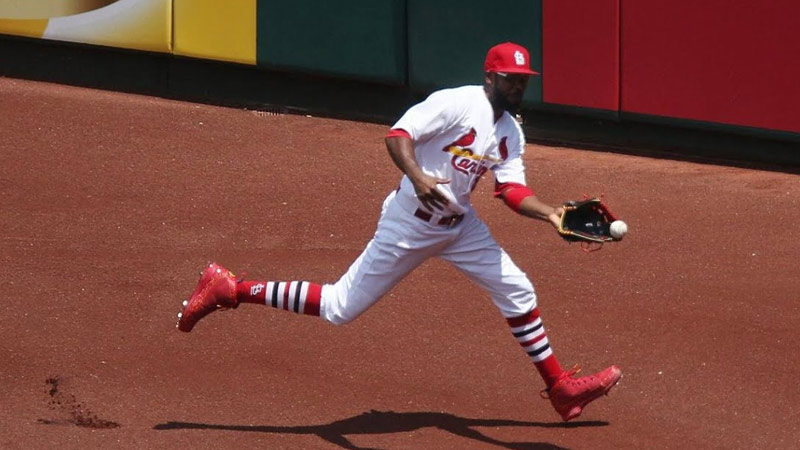
Watch a few innings of any baseball game and you will see it many times: the batter lifts the ball high into the air, an outfielder drifts under it, and the ball drops into a glove. That play is called a fly out, and it is one of the most common ways a hitter is retired.
The play looks simple, but it is tied to several important rules, including tagging up, the sacrifice fly, and the infield fly rule.
This guide explains what a fly out in baseball is, how it is scored, what counts as a legal catch, and why fly outs matter to hitters, pitchers, and fielders.
What Is a Fly Out in Baseball?
A fly out happens when a batter hits the ball into the air and a fielder catches it before it touches the ground. Once the catch is made, the batter is out. No tag is needed, and no base has to be touched to record the out.
The catch can happen in fair territory or foul territory. A foul ball caught in the air is still an out, which is why it is often called a foul out. A foul ball that drops untouched is different. It only counts as a strike, and it cannot be the third strike unless it is a bunt.
In everyday talk, “fly out” usually means a ball hit to the outfield and caught there. In scorekeeping and statistics, every ball caught in the air is often grouped under one label, “air outs.” That group includes fly outs, pop outs, and line outs.
How a Fly Out Happens, Step by Step
Every fly out follows the same basic sequence:
- The pitcher delivers the pitch to the batter.
- The batter makes contact and sends the ball upward instead of on the ground.
- A fielder reads the flight of the ball and moves into position.
- The fielder catches the ball before it touches the ground, a wall, or any object other than a fielder.
- The umpire signals the out, usually with a raised fist.
- Any runners on base must return to and retouch their original base before they can try to advance.
If the fielder fails to make the catch, the ball stays live and the batter becomes a runner. What looked like an easy out can quickly turn into a hit or an error.
Fly Outs vs Other Types of Outs
A fly out is defined by how the ball travels and how the out is made. Here is how it compares with other common outs:
| Type of out | Ball path | How the out is made |
|---|---|---|
| Fly out | High arc, usually to the outfield | Caught in the air |
| Pop out | Very high, short distance, often over the infield | Caught in the air, usually by an infielder or catcher |
| Line out | Hard, low, and flat | Caught in the air |
| Foul out | Any fly ball in foul territory | Caught in the air in foul ground |
| Ground out | Along the ground | Fielder throws to first base before the batter arrives |
| Strikeout | No ball in play needed | Three strikes |
One point often confuses new fans. A foul tip that goes straight back into the catcher’s mitt is not a foul out. It counts as a strike, and the ball stays live. A foul out only happens on a batted ball that rises into the air and is caught.
How Fly Outs Are Scored
Scorekeepers record a fly out with a letter for the type of play and a number for the fielder who made the catch. Each defensive position has a standard number:
| Number | Position |
|---|---|
| 1 | Pitcher |
| 2 | Catcher |
| 3 | First baseman |
| 4 | Second baseman |
| 5 | Third baseman |
| 6 | Shortstop |
| 7 | Left fielder |
| 8 | Center fielder |
| 9 | Right fielder |
A fly out to center field is written as F8, and a fly out to left field is F7. Many scorekeepers also mark pop outs with a P, so a pop-up caught by the shortstop becomes P6. Line outs often get an L, as in L5 for a liner caught by the third baseman.
Foul outs are commonly noted with an extra “f” or as FF, such as F3f for a foul fly caught by the first baseman. Styles vary from one scorekeeper to the next, but the position numbers stay the same everywhere.
The Sacrifice Fly
A sacrifice fly is a fly out that brings home a run. It is credited when there are fewer than two outs, the batter hits a fly ball that is caught, and a runner tags up and scores after the catch.
The batter is still out, but the play is treated kindly in the record book:
- The batter is credited with a run batted in (RBI).
- The batter is not charged with an official at-bat, so the batting average does not drop.
- The play still counts as a plate appearance and is included in the on-base percentage calculation.
A sacrifice fly can also be credited when a fielder drops the ball and the runner scores, as long as the official scorer believes the runner would have scored after a clean catch. Only a run counts, though. If a runner tags up and moves from second to third on a fly ball, the batter does not get a sacrifice fly.
Tagging Up on a Fly Ball
When a fly ball is caught, every runner must go back and touch the base they occupied when the pitch was thrown. This is called tagging up. A runner may leave that base as soon as the fielder first touches the ball, even if the fielder bobbles it before securing the catch.
Tagging up creates some of the most exciting moments in the game. A runner on third base will often stand on the bag, wait for the catch, and then race home while the outfielder tries to throw him out at the plate.
The rule also gives the defense a chance at a double play. If a runner wanders too far off base and the ball is caught, a fielder can throw to that base. If the ball beats the runner back, the runner is out.
If a runner leaves too early, the defense can appeal by touching the base, and the umpire will call the runner out. Because of this, runners often go only halfway on a fly ball that may or may not be caught.
The Infield Fly Rule
The infield fly rule is a special case where the batter is out on a fly ball even if nobody catches it. The umpire can call an infield fly when all of these conditions are met:
- There are fewer than two outs.
- Runners are on first and second, or the bases are loaded.
- The batter hits a fair fly ball that an infielder can catch with ordinary effort.
- The ball is not a line drive or an attempted bunt.
When the umpire declares an infield fly, the batter is out right away. Runners may try to advance at their own risk, but if the ball is caught, they must still tag up. If the ball drifts into foul territory and is not caught, it is treated as a regular foul ball.
The rule exists to protect the offense. Without it, an infielder could let an easy pop-up drop on purpose. The runners, who stayed close to their bases expecting a catch, would suddenly be forced to run, and the defense could turn a cheap double or even triple play.
What Counts as a Legal Catch
Not every ball that lands in a glove becomes a fly out. For the catch to count, the fielder must meet a few basic requirements:
- Secure possession. The ball must be held firmly in the glove or bare hand.
- Clear control. The fielder must hold the ball long enough to show control, and any release must be voluntary, such as reaching in to make a throw.
- No contact with the ground first. If the ball touches the grass, the warning track, or the wall before the fielder secures it, it is not a catch.
- Control through contact. If a fielder grabs the ball but drops it right away after crashing into a wall or a teammate, it is not a catch.
- Proper equipment only. Trapping the ball with a cap, mask, or a glove that has been thrown or taken off does not count.
There are a few cases that surprise people. A ball that bounces off one fielder and is caught by another before it hits the ground is a legal catch. The same is true if a ball pops off a fielder’s glove or body and that fielder grabs it again before it lands.
Fly Outs and Player Statistics
Fly outs show up in the numbers for both hitters and pitchers.
For hitters, a regular fly out counts as an official at-bat without a hit, so it lowers the batting average.
The only exception is the sacrifice fly, which does not count as an at-bat. Coaches also pay attention to how hard and how far a player hits the ball. A deep fly out caught at the wall is often a sign of solid contact, even if the result was an out.
For pitchers, fly outs help describe their style. Pitchers who give up many fly balls are called fly-ball pitchers, while those who get many grounders are called ground-ball pitchers.
A common stat, the ground out to air out ratio (GO/AO), compares the two. Fly-ball pitchers can be effective, but they carry more risk of giving up home runs, especially in ballparks with short fences. Ground-ball pitchers, on the other hand, tend to get more double plays.
Modern hitting has also changed the picture. Many batters now try to lift the ball to hit for more power. This approach leads to more home runs and extra-base hits, but it also produces more fly outs.
Fly Out Strategy for Hitters, Pitchers, and Fielders
A fly out can be a failure or a success depending on the situation, so each side plans for it.
Hitters
With a runner on third and fewer than two outs, a deep fly ball is often all a team needs to score. Many hitters adjust their swing in that spot, looking for a pitch they can drive in the air to the outfield.
With runners on first and second, a fly ball rarely helps, so hitters may focus on line drives or hitting the ball to the right side.
Pitchers
In that same runner-on-third situation, pitchers usually want the opposite result. They try to keep the ball low in the strike zone to get a ground ball or go for a strikeout, since either one can keep the run from scoring.
Fielders
Catching a fly ball takes good reads, quick first steps, and clear communication. Outfielders call for the ball loudly to avoid collisions.
The center fielder usually has priority over the corner outfielders, and outfielders usually have priority over infielders on shallow pop-ups because it is easier to catch a ball while running in than while backpedaling.
Fielders also have to deal with sun, stadium lights, and wind, which can push a routine fly ball far off its expected path.
Final Thoughts
A fly out in baseball is simple at its core: the batter hits the ball in the air, and a fielder catches it before it lands.
Around that basic play sit some of the game’s most important rules, from tagging up and the sacrifice fly to the infield fly rule and the definition of a legal catch.
Once you understand these details, every high fly ball becomes more interesting to watch.
You will know why runners hold at their bases, why a deep out can still be a good result, and why a pitcher works so hard to keep the ball on the ground with a runner on third.