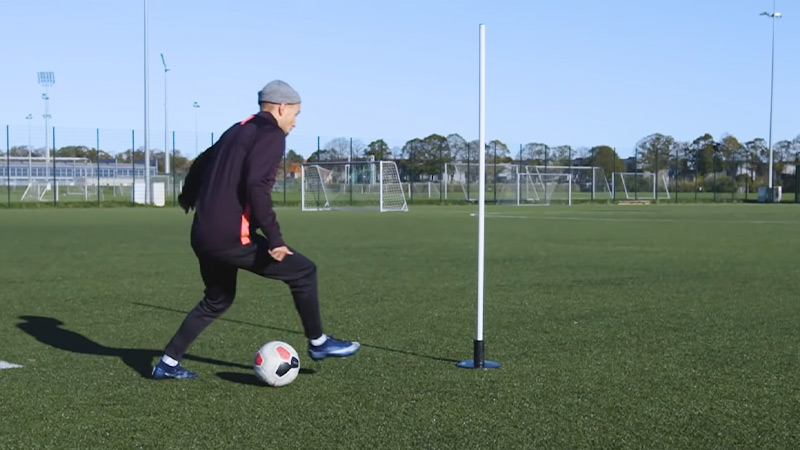
The step-over is far more than a mere flourish of technical ability; it is a fundamental tool of deception that has defined the careers of the world’s most elite attackers.
Known variously as the pedalada, the scissors move, or even the Roeder shuffle, this dribbling feint is designed to manipulate a defender’s momentum and spatial awareness, creating the split-second opening necessary to deliver a cross, a shot, or a penetrative pass.
In the modern era, where defensive structures are increasingly disciplined and compact, the ability to beat an opponent one-on-one is a premium asset.
This comprehensive guide explores the historical origins, the intricate mechanics, and the tactical application of the step-over, providing a roadmap for players looking to elevate their game to a professional standard.
The Historical Evolution: From Buenos Aires to the Global Stage
The lineage of the step-over is as rich as the game itself. While many contemporary fans associate the move with modern icons, its roots trace back to the early 20th century.
Historical records credit the Argentine striker Pedro Calomino with the invention of the move in the early 1900s.
Calomino, a pioneer who is also frequently cited as the creator of the bicycle kick, utilized the step-over to navigate the physical and often erratic defensive styles of his era.
The technique crossed the Atlantic and found a foothold in European football through the Dutch player Law Adam.
During the late 1920s and early 1930s, Adam became so proficient with the move that he was nicknamed “Adam the Scissorman”. His ability to “cut” through defenses using this rhythmic feint set a new standard for technical dribbling on the continent.
As the decades progressed, the step-over was adopted and refined by different footballing cultures. In Italy, Amedeo Biavati became a famed practitioner, while in England during the 1980s, Glenn Roeder’s unique execution led to the move being dubbed the “Roeder shuffle” in domestic circles.
However, it was the Brazilian influence of the 1990s and early 2000s that truly elevated the move into the cultural zeitgeist. The Brazilian Ronaldo utilized the pedalada with explosive power, often using multiple step-overs to “freeze” goalkeepers during one-on-one situations.
This legacy was further cemented by Cristiano Ronaldo, whose relentless use of the skill during his tenure at Manchester United and Real Madrid demonstrated that the step-over remains one of the most effective ways to beat defenders in high-stakes environments.
The Anatomy of the Move: Mechanics and Execution
At its core, the step-over is an exercise in body mechanics and psychological manipulation. It is a non-contact feint where the player swings their foot over the ball without touching it, suggesting a movement that never actually occurs. To master the technique, one must understand the three distinct phases of its execution.
1. The Feint
The process begins as the attacker approaches the defender. The player swings their foot over the ball in a circular motion, moving from the inside of the ball toward the outside.
This motion must be fluid and convincing; the goal is to sell the idea that the foot is about to make contact to push the ball in that direction.
2. The Illusion
The success of the step-over relies entirely on the defender’s reaction. By swinging the foot over the ball, the attacker forces the defender to shift their center of gravity in anticipation of a move.
A well-executed feint “boggles the brain” of the opponent, causing them to lean or plant their weight on the wrong foot.
3. The Escape
The final phase is the “burst.” Once the defender has committed to the fake direction, the attacker uses the outside of their opposite foot to push the ball rapidly in the actual direction of travel.
This sudden change in direction, combined with an explosive acceleration, leaves the defender out of position and unable to recover.
Variations of the Step-Over
While the fundamental principle remains the same, elite players utilize several variations to keep defenders off-balance.
- The Single Step-Over: The most efficient version, involving one quick circle of the ball followed by an immediate acceleration past the defender.
- The Double Step-Over: The player steps over with one foot and then rapidly follows with the other. This is particularly effective against disciplined defenders who may not bite on the first feint but find their balance disrupted by the second.
- Multiple Step-Overs: Popularized by players like Ronaldinho and Cristiano Ronaldo, this involves a series of continuous step-overs. This variation is often used to “paralyze” a defender, waiting for them to commit to a tackle before the attacker chooses their escape route.
- Inside vs. Outside Step-Overs: In an inside step-over, the player approaches as if to pass with the inside of the foot but swings it around the ball toward the center of the body. In the outside step-over, the foot circles away from the midline of the body, creating a wider, more dramatic feint.
Strategic Implementation: Tactical Advantages on the Pitch
The step-over is not merely a “showreel” skill; it serves specific tactical purposes that can alter the course of a match.
Creating Offensive Lanes
The primary benefit of the step-over is its ability to create space in congested areas. By forcing a defender to shift their balance, an attacker opens up lanes for high-value actions, such as a cross into the box or a direct shot on goal.
This is why the move is a staple for wingers and attacking midfielders, who often operate in the “sweet spot” between the midfield and the defensive line, where taking a calculated risk can yield a high reward.
Maintaining Momentum
Unlike some skills that require the ball to be nearly stationary (such as the Cruyff turn or certain drag-backs), the step-over can be executed at high speeds.
This allows a counter-attacking team to maintain their momentum while bypassing individual defenders, making it a lethal weapon in transition phases.
Psychological Dominance
Consistent use of the step-over exerts a psychological toll on the opposition. When a defender knows an attacker has a deceptive repertoire, they become hesitant to commit to tackles.
This hesitation grants the attacker more time and space to scan the field and make better decisions. Furthermore, the move can be used from a standing position to distract defenders or kill time while waiting for teammates to find pockets of space.
A Professional Training Protocol: From Static to Dynamic
Mastering the step-over requires a progression from foundational mechanics to match-speed execution. Even the most “silky” players spent hours refining these steps in isolation before attempting them in a stadium.
Phase 1: Static Mastery
Begin by standing still with the ball. Practice the circular motion of the foot over the ball, focusing on the fluidity of the swing and the balance of the standing leg. The goal here is to build muscle memory so the motion becomes second nature.
Phase 2: Linear Dribbling
Once comfortable, begin dribbling in a straight line at a slow pace. Execute the step-over and focus on the transition between the “feint” and the “escape.” It is crucial to practice with both feet to ensure you do not become a “one-sided” attacker.
Phase 3: The Cone Drill
To simulate a defensive presence, place a cone (representing the defender) approximately 8 meters ahead.
Dribble toward the cone, perform the step-over as you reach it, and then accelerate toward a second marker (the 10-meter mark). This drill emphasizes the change of pace, which is often more important than the feint itself.
Phase 4: Awareness and Vision
A common mistake among developing players is staring at the ball during the move. To reach a professional standard, you must train yourself to look up regularly.
Maintaining a high head position ensures you are aware of the defender’s movements, the positioning of your teammates, and the overall tactical landscape of the pitch.
The Critical Element: The Change of Pace
The most common reason a step-over fails in a match situation is a lack of acceleration after the feint. The move is designed to slow the defender down or stop their feet entirely. If the attacker does not then provide a sudden burst of speed, the defender has time to recover their position.
Professional players often deliberately slow down as they approach a defender, “luring them into a trap”.
The step-over serves as the bait; the explosive push with the outside of the foot is the trap being sprung. Without that final gear, the step-over is merely decorative.
Common Queries and Expert Insights (FAQ)
Is the step-over still effective in the modern game?
Absolutely. While modern football emphasizes systems over individuals, the step-over remains a simple but super-effective way to break down a low-block defense or beat a full-back on the wing. Its continued use by world-class players is a testament to its enduring utility.
How does it compare to other skills?
The step-over is often compared to the rainbow kick or the Elastico. While the rainbow kick is arguably more “impressive” or flashy, the step-over is far more common because it is less risky and can be executed more reliably at high speeds.
It is a foundational skill that every serious attacker should master before moving on to more complex tricks.
What is the “Roeder Shuffle”?
The Roeder shuffle is simply a specific variation of the step-over popularized by Glenn Roeder. It highlights how different players can put their own “signature” on a classic move by altering the rhythm or the angle of the feint.
Conclusion: Integrating Flair with Function
The step-over is the perfect marriage of flair and function. It honors the history of the game—from the early innovators like Calomino to the global superstars of today—while remaining a practical necessity on the modern pitch.
For the player, it offers a way to seize control of a one-on-one situation; for the spectator, it provides a moment of genuine artistry.
To truly master the step-over, one must embrace the discipline of practice. Start with the basics of the inside and outside step-over, focus on your balance, and never underestimate the power of a sudden change in pace.
When executed with confidence and precision, the step-over is not just a trick—it is a statement of intent that can unlock even the most stubborn defenses. Keep training, maintain your vision, and eventually, this classic feint will become a natural extension of your attacking identity.