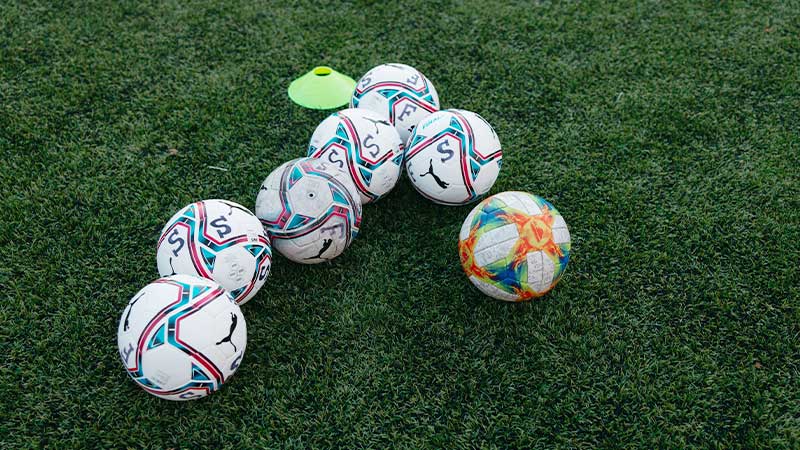
In elite football, every millimeter of equipment is optimized for peak performance. While spectators focus on the skill of the athlete, the engineering of the ball itself is a marvel of material science.
A common question among enthusiasts and curious players alike is: what are professional soccer balls filled with?
This isn’t just about air; it’s about a complex interplay of gases, specialized bladders, and layered protection designed to withstand the world’s most intense matches.
By exploring the internal architecture of these spheres, we uncover the secrets behind their flight, responsiveness, and professional-grade consistency on the pitch.
The Chemistry of Inflation: Atmospheric Composition
When examining what are professional soccer balls filled with, the most common answer is also the most scientific.
Professional match balls are filled with compressed air that closely mirrors the standard atmospheric mixture, consisting of approximately 78% nitrogen and 21% oxygen.
This balance is not accidental; it provides the internal pressure necessary to maintain the ball’s structural integrity while ensuring it reacts predictably to the force of a strike.
The Science of Gas Stability
Using standard atmospheric air allows for a level of consistency across various altitudes and temperatures.
Nitrogen, the primary component, is an inert gas that does not react significantly to the friction heat generated during high-velocity kicks. This ensures that the internal pressure remains stable throughout the ninety minutes of a match.
If the gas were to expand or contract significantly due to temperature changes on the pitch, the ball’s flight path would become erratic, compromising the precision required by professional athletes.
Dispelling the Helium Inflation Myth
A persistent urban legend in the sporting world suggests that professional balls are filled with helium to make them lighter or to give them more “hang time.”
However, the sources confirm this is a complete myth; helium actually leaks out of the ball’s bladder much faster than regular air and offers no competitive advantage.
Helium molecules are much smaller than nitrogen or oxygen molecules, allowing them to permeate through the bladder material at an accelerated rate.
Furthermore, the buoyancy provided by helium is negligible compared to the aerodynamic drag and gravitational forces acting on a soccer ball during play.
The Latex Bladder: The Engine of Performance
The internal “engine” of a professional soccer ball is the bladder, which is the component responsible for holding the air and providing the ball’s rebound characteristics.
In the world of high-stakes sports equipment, the choice of material for this component is the single most important factor in determining how the ball “feels” to the player.
Why Professionals Prefer Natural Latex
High-end match balls typically utilize natural latex bladders instead of the synthetic butyl (rubber) bladders found in cheaper, recreational versions. Latex is prized for its high elasticity and natural “memory.”
When a player kicks the ball, the latex bladder compresses and then snaps back into its original shape with incredible speed.
This creates a “lively” bounce and a softer touch, allowing for more intricate ball control and a more explosive transfer of energy during a shot.
The Maintenance Challenge of High-Performance Latex
While latex offers superior playability, it has one major drawback: it is more porous than synthetic alternatives.
Because of this porosity, professional balls require re-inflation much more frequently than standard ones—sometimes even before every single match.
For a local amateur player, this would be an inconvenience, but for professional clubs, the trade-off is worth it.
The tactile feedback and responsiveness provided by a latex bladder are essential for the high-speed technical maneuvers seen in leagues like the Premier League.
| Feature | Latex Bladder (Pro) | Butyl Bladder (Standard) |
|---|---|---|
| Responsiveness | High / Lively | Moderate / Hard |
| Touch/Feel | Soft and Elastic | Firm and Plastic-like |
| Air Retention | Low (Leaks slowly) | High (Holds for weeks) |
| Primary Use | Match Day / Elite Play | Training / Recreation |
Reinforcing the Sphere: The Lining Layers
Beneath the outer shell but surrounding the bladder is a complex network of reinforcement. This area is critical for ensuring that the ball does not lose its shape after repeated impacts at high speeds.
Professional balls must withstand incredible force, often exceeding 70 miles per hour, without becoming permanently deformed.
Polyester and Cotton Composites
To maintain structural integrity, manufacturers incorporate four or more layers of polyester and cotton between the bladder and the outer shell. These layers act as a buffer and a reinforcement system.
The polyester provides the high tensile strength needed to prevent the ball from “warping” or becoming egg-shaped under pressure.
Meanwhile, the cotton layers provide cushioning, which enhances the ball’s touch and helps the player control the ball more effectively when receiving a high-speed pass.
Achieving Perfect Sphericity
The primary goal of these lining layers is to help the ball retain its spherical shape. In a professional match, even a minor imperfection in the ball’s roundness can lead to a “knuckleball” effect where the ball moves unpredictably in the air.
By using multiple layers of high-quality textiles, engineers ensure that the ball remains a perfect sphere, allowing for the consistent aerodynamics that goalkeepers and strikers rely on for accuracy.
The Outer Shell and Advanced Bonding Techniques
The exterior of a professional soccer ball is the first point of contact and the primary barrier against the elements.
Modern professional balls have moved far beyond the heavy leather of the past, utilizing advanced synthetics that offer consistent performance in all weather conditions.
High-Grade Polyurethane (PU)
The exterior shell of a professional ball is usually constructed from high-grade polyurethane (PU). PU is chosen for its unique combination of softness and durability.
It provides a tactile grip that allows players to “bite” into the ball with their boots to create spin, yet it is tough enough to resist abrasions from the pitch.
Unlike lower-end PVC balls, which can feel slick and hard, PU provides a premium, responsive interface that mimics the feel of natural leather while offering superior water resistance.
The Shift to Thermal Bonding
One of the most significant technological leaps in soccer ball construction is the move from hand-stitching to thermal bonding.
Professional balls are often thermally bonded, meaning the panels are glued together using heat rather than being stitched. This process ensures the ball is seamless, which is vital for maintaining performance in rainy conditions.
Eliminating Water Absorption
Traditional stitched balls have thousands of tiny needle holes that can act as entry points for water. In a wet match, a stitched ball can absorb significant weight, making it heavy and sluggish.
Thermally bonded balls ensure that the ball remains seamless and does not absorb water in rainy conditions, keeping the weight and flight characteristics constant throughout the game.
This ensures that a cross delivered in the 90th minute behaves exactly like one delivered in the 1st minute.
Pressure Standards: The Regulatory Framework
A professional soccer ball is only as good as the pressure inside it. If a ball is under-inflated, it becomes “dead” and unresponsive; if it is over-inflated, it becomes a dangerous projectile that is difficult to control. To ensure fairness and safety, major leagues enforce strict pressure standards.
The Premier League and FIFA Guidelines
Specific pressure ranges are mandated for professional play to ensure consistency. For example, Premier League match balls must be inflated to a range between 8.5 psi and 15.6 psi. Before every match, officials use calibrated pressure gauges to test each ball.
This range allows for slight adjustments based on the atmospheric pressure of the stadium’s location or the specific aerodynamic profile of the ball model being used for that season.
The Impact of Pressure on Flight and Safety
The internal pressure directly influences how much the ball deforms when struck. At the correct pressure, the ball compresses just enough to maximize the “trampoline effect” off the player’s boot, resulting in optimal speed.
Proper inflation also ensures player safety, as a ball that is too hard can increase the risk of head injuries, while a ball that is too soft can lead to unpredictable bounces that cause ankle or knee strain.
Frequently Asked Questions
Why do professional soccer balls feel softer than cheap ones?
The “soft” feel of a professional ball comes from the combination of a natural latex bladder and high-grade polyurethane (PU) shell. These materials are more elastic and cushioned than the hard rubber and plastic-like PVC used in cheaper balls.
Do professional balls use sensors inside?
While the source focuses on the materials like air, latex, and PU, many modern match balls now feature internal suspension systems for electronic sensors.
These sensors help track offside calls and ball speed, but they are surrounded by the same compressed air and lining layers that define the ball’s physical performance.
Can I use a professional ball for daily practice?
While you can, be prepared for maintenance. Because professional balls use porous latex bladders, they lose air faster than recreational balls and will require inflation before almost every session to stay within the recommended 8.5 to 15.6 psi range.
Conclusion: The Precision of the Beautiful Game
Understanding what are professional soccer balls filled with reveals that these objects are far from simple.
They are high-performance tools engineered with natural latex, specialized gas mixtures, and thermally bonded synthetics to ensure the highest levels of playability and durability.
From the nitrogen-rich air inside to the seamless PU shell outside, every component is designed to provide the “lively” bounce and reliable flight that defines professional football.
For the athlete, this engineering provides the confidence to perform; for the fan, it ensures that the game remains a spectacle of speed and precision.
Whether it is a rainy night in Manchester or a humid afternoon in Madrid, the science inside the ball ensures the game stays beautiful.