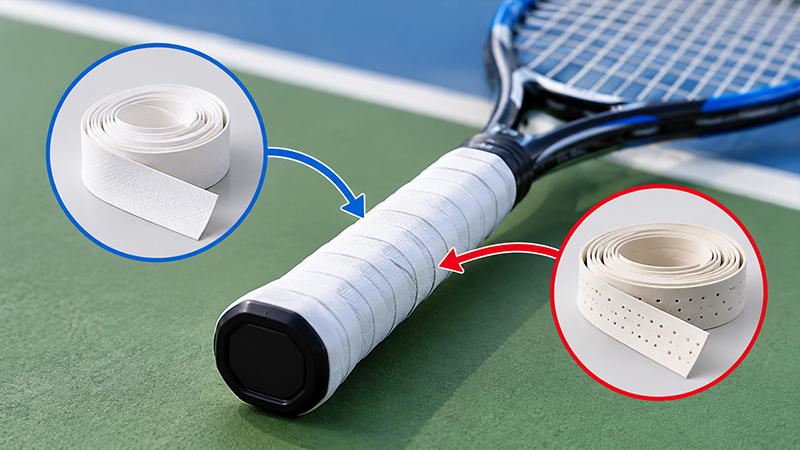
The interaction between a tennis player and their racket is entirely concentrated in a few square inches of the handle.
While enthusiasts often spend weeks researching string tension or frame stiffness, the actual interface—the grip—is frequently treated as an afterthought.
However, the question of whether you need one, two, or even three layers of grip material is central to both injury prevention and on-court performance.
In professional circles, the handle is not a static component; it is a highly customized tool. Understanding the mechanics of base grips and overgrips is essential for any player looking to optimize their game.
The Fundamental Architecture: Base Grips vs. Overgrips
To understand if you need two grips, you must first distinguish between the two layers available to you. Every racket arrives from the manufacturer with a base grip.
This is a thick, cushioned layer wrapped directly around the carbon fiber or graphite frame.
Its primary purpose is to provide a foundational level of shock absorption and to define the initial size of the handle.
The overgrip, by contrast, is a thin, stretchy, and relatively inexpensive tape designed to be wrapped on top of that base layer.
While a base grip is semi-permanent, an overgrip is a consumable item. It is the layer that interacts directly with your skin, managing moisture and providing the specific “tackiness” or “dry feel” you prefer.
The Professional Setup: Why Many Choose Two
You do not strictly “need” two grips to play tennis, but a significant portion of competitive players and nearly all professionals utilize at least one overgrip on top of their base grip.
In fact, it is common for professionals to stack two overgrips over the base foundation to achieve a specific level of “fine-tuning”.
This layering serves three primary strategic purposes:
1. Precision Sizing and Calibration
Tennis rackets are sold in standard grip sizes, typically ranging from size 0 to 5. However, human hands do not always fit perfectly into these increments.
If you find yourself “between” sizes—where a size 3 feels slightly too small but a size 4 feels bulky—layering is your solution.
Adding a single overgrip typically increases the handle diameter by about half a size. By stacking two overgrips, you can bridge the gap between factory standards, ensuring that your hand closes around the handle with the ideal amount of space between your fingertips and palm.
This prevents the “death grip” syndrome, where a player over-squeezes a handle that is too small, leading to forearm tension and tennis elbow.
2. Enhanced Ergonomics and Fatigue Mitigation
The physical toll of a three-set match is often felt first in the hands and wrists. The repetitive impact of the ball against the strings sends vibrations down the shaft of the racket. While the frame technology handles much of this, the grip is your final line of defense.
Multiple layers provide a softer, more pressurized feel. This extra cushioning allows the hand to remain relaxed during the “ready position,” conserving energy and reducing the muscular fatigue that often leads to late-match errors.
3. Advanced Moisture Management
For players in high-humidity environments or those who struggle with heavy perspiration, a single base grip is rarely sufficient. Base grips are often made of synthetic leather or similar materials that can become slick when saturated.
Layering allows for superior sweat control. A fresh overgrip is designed to wick moisture away from the surface. By maintaining a secondary layer, you ensure that even if moisture penetrates the top wrap, the structural integrity of your hold remains secure.
The Technical Trade-offs: The Cost of Excessive Padding
While the benefits of layering are clear, more is not always better. There is a “diminishing returns” point where adding extra wraps begins to degrade the technical feedback of the racket.
The Geometry of the Octagon
A tennis handle is not a cylinder; it is an octagon with eight distinct flat sides known as bevels. These bevels are the sensory map for a tennis player.
They allow you to switch from a Western forehand grip to a Continental service grip by “feel” alone, without needing to look down at your hand.
When you stack too many overgrips, the sharp edges of these bevels begin to round out. The handle starts to feel like a broomstick. This loss of “feel” can be devastating for high-level play, as it makes it difficult to verify your grip position during the split-second transitions of a fast rally.
The Weight and Balance Equation
Every gram added to a racket changes its swing weight and balance point. An overgrip typically adds between 6g and 12g of weight. While this seems negligible, this weight is added specifically to the “butt” or handle end of the racket.
If you stack two or three overgrips, you are adding up to 24g to the handle. This shifts the balance of the racket toward the hand (making it more “head-light”).
For a player who relies on a head-heavy setup for power from the baseline, this subtle shift can alter the timing of their swing and the depth of their shots.
Strategic Recommendations: Finding Your Ideal Setup
To determine your personal requirement, you should evaluate your game based on three criteria: Hand Measurement, Feel Preference, and Environmental Conditions.
Scenario A: The “Direct Feedback” Player
If you pride yourself on “touch” shots, volleys, and precise placement, you likely prefer to feel the bevels of the handle as clearly as possible.
- Recommendation: Use a thin leather base grip with a single, very thin overgrip. This maintains the sharpest possible edges while providing sweat absorption.
Scenario B: The Power Baseliner
If you play with heavy topspin and a high-intensity swing, hand comfort and security are your priorities.
- Recommendation: Use a standard cushioned base grip plus one or two overgrips. This provides the “squish” needed to absorb high-velocity impacts and ensures the racket won’t slip during a maximum-effort forehand.
Scenario C: The Climate-Challenged Player
If you play in extreme heat or indoors where air circulation is poor, your grip strategy is about survival.
- Recommendation: Focus on “dry-feel” overgrips. You may want to stack a fresh overgrip over a slightly worn one to create a more porous, absorbent surface that keeps your palm dry throughout the match.
Maintenance: The Lifecycle of Your Grip Layers
A common mistake is treating the grip as a permanent fixture. To maintain, you must adhere to a strict replacement schedule.
- Overgrips: These should be replaced as soon as they lose their “tack” or show visible signs of fraying. For frequent players, this could be every 2–4 matches.
- Base Grips: These are more durable but will eventually lose their cushioning and become “dead.” A base grip should typically be replaced every 6–12 months, depending on how often you play and how many overgrips you use to protect it.
Frequently Asked Questions
Q: Can I just use two base grips instead of an overgrip?
A: This is generally discouraged. Two base grips would make the handle significantly too large and add excessive weight (up to 40g or more), which would fundamentally ruin the balance of almost any modern racket.
Q: Why do pros use two overgrips specifically?
A: It is often about reaching a “custom” thickness. Many pros prefer a handle size that is precisely halfway between the standard sizes offered by manufacturers. Stacking two thin overgrips allows them to hit that “sweet spot” of thickness without losing too much bevel feel.
Q: Will adding an overgrip help with my tennis elbow?
A: Indirectly, yes. If your handle is too small, you have to squeeze harder to keep the racket from twisting on off-center hits. This constant muscle tension contributes to tendonitis. Adding an overgrip to reach the correct size allows your hand to stay relaxed.
The Final Verdict
The answer to “Do you need two grips?” is nuanced: you do not need them for the racket to function, but you likely require them to perform at your peak.
The standard setup of one base grip and one overgrip is the baseline for a reason—it offers a balance of comfort and feedback.
However, do not be afraid to experiment with the “Pro Stack” of two overgrips if you struggle with hand fatigue, sweat, or a handle that feels just a bit too thin.
In the world of high-performance tennis, the goal is to eliminate distractions. A slipping racket or a blistered palm is a distraction. By mastering the art of grip layering, you ensure that the only thing you have to focus on is the ball.