When you invest in a premium tennis racket, the expectation is a product ready for immediate high-performance play.
However, many players are surprised upon unboxing their equipment to find the handle feels different than what they experience on the professional circuit.
This is because new tennis rackets do not come with an overgrip installed. Instead, manufacturers provide a replacement grip, also known as a base or stock grip, as the foundational layer.
Understanding the distinction between these two layers is critical for maintaining equipment longevity and optimizing on-court performance.
This guide provides a comprehensive analysis of handle maintenance, customization, and the technical reasons why the overgrip is a necessary secondary addition.
The Foundation: Defining the Replacement (Base) Grip
The base grip is the primary layer of material that is permanently wrapped around the racket handle.
Unlike the thin strips players frequently change, the base grip is a thick, cushioned padding designed to provide the initial level of comfort and shock absorption.
From a manufacturing standpoint, this layer is built to last significantly longer than an overgrip. It features a sticky adhesive back that ensures it remains firmly fixed to the wood or graphite handle.
Without this adhesive foundation, the rotational forces of a high-velocity swing would cause the grip to slip, leading to instability and potential injury.
The following information regarding base grip materials is not from the provided text and should be independently verified: Replacement grips are typically made from synthetic polyurethane or, in traditional models, genuine leather.
Leather base grips offer maximum “bevel feel,” allowing players to clearly sense the edges of the handle for precise grip changes, whereas synthetic versions prioritize vibration dampening and softness.
The Performance Layer: What is an Overgrip?
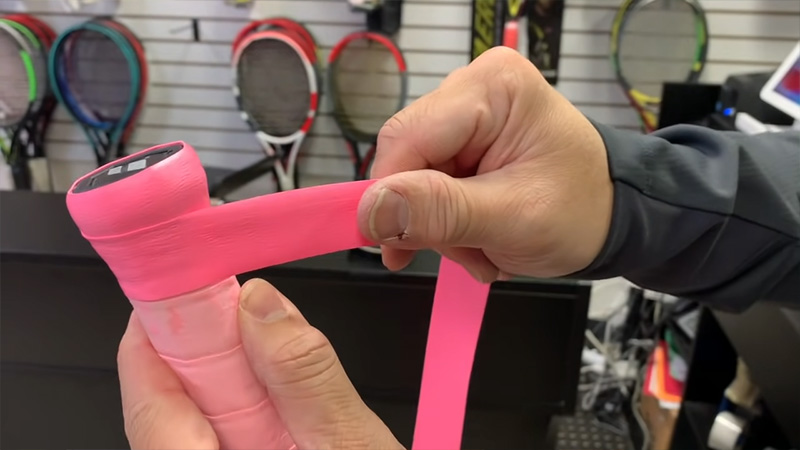
An overgrip is a very thin, disposable strip that is applied on top of the base grip. Unlike the foundational layer, an overgrip is often non-adhesive or only lightly sticky, relying on tension and a finishing tape to stay in place.
Because it is the outermost layer, it is the only part of the racket handle that makes direct contact with the player’s hand. This makes it the most important factor in “feel”—the tactile feedback a player receives during a match.
Because these strips are added separately, players have the freedom to choose textures and moisture-wicking properties that suit their specific physiological needs.
Why the Overgrip is a Requirement for Competitive Play
While a racket is technically “functional” with only a base grip, nearly all competitive players add an overgrip for three primary reasons:
1. Advanced Sweat Control
One of the most immediate challenges during a match is moisture management. Overgrips soak up sweat, preventing the handle from becoming slick.
A slippery handle can cause the racket to rotate in the hand upon impact, leading to “shanking” the ball or, in extreme cases, the racket slipping out of the hand entirely.
2. Preservation of the Equipment
Tennis rackets are significant investments. By using an overgrip, players keep the thick base grip from wearing out quickly. Replacing a base grip is a more expensive and time-consuming process involving adhesive cleanup.
In contrast, an overgrip is designed to be sacrificial; it takes the brunt of the friction and dirt, leaving the expensive foundation pristine.
3. Precision Handle Sizing
Grip size is fundamental to preventing injuries like tennis elbow. Overgrips allow for micro-adjustments because they add a tiny bit of thickness to the handle.
If a player’s hand size falls between standard grip measurements, an overgrip can bridge that gap to create a perfect fit.
Strategic Selection: Choosing Your Surface
The following analysis of overgrip types is not from the provided text and should be independently verified:
Since the provided data establishes that overgrips are a separate purchase, players must understand the two primary categories available in the market:
- Tacky Overgrips: These are designed for players who want a “sticky” feel. They provide a high level of security and are ideal for players who do not sweat excessively or who play in cooler, drier climates.
- Absorbent (Dry) Overgrips: Often featuring a cloth-like or “sanded” texture, these are engineered specifically for high-moisture environments. They become more effective as they get damp, making them the standard choice for players in humid regions.
The Technical Process: How to Apply an Overgrip
The following step-by-step instructions are not from the provided text and should be independently verified:
To ensure the overgrip fulfills its purpose of protection and size adjustment, it must be applied with technical precision.
- Anchor the Start: Most overgrips have a tapered end with a small adhesive tab. Start at the butt cap of the racket.
- Maintain Tension: As you wrap upward, keep the strip taut. This prevents the grip from bunching or sliding during play.
- Manage the Overlap: For a standard feel, overlap the previous layer by approximately 1/8 of an inch. To add more thickness, increase the overlap.
- Secure the Top: Once you reach the top of the handle, cut the excess at an angle and use the provided finishing tape to seal the grip.
Maintenance Cycles: When to Replace
Since overgrips are disposable, they have a limited lifespan. Using a grip past its peak effectiveness can lead to blisters and decreased control.
The following maintenance guidelines are not from the provided text and should be independently verified:
- Professional Standard: Many professional players change their overgrip every set to ensure maximum tackiness.
- Frequent Players: If you play 3–4 times a week, you should expect to change your overgrip every 6–10 hours of play.
- Visual Cues: Replace the grip immediately if you see fraying, discoloration, or if the material feels “slick” rather than grippy.
Addressing the “Grip Size” Dilemma
Selecting the correct grip size is a prerequisite for both comfort and power. As noted, overgrips add a tiny bit of thickness.
The following sizing advice is not from the provided text and should be independently verified: A common rule of thumb is the “index finger test.”
When holding the racket in a standard Eastern forehand grip, there should be just enough space between your fingertips and the palm of your hand to fit the index finger of your other hand.
If the gap is too small, adding one or two overgrips can achieve the correct ergonomic alignment. If the gap is too large, you may need a different racket frame altogether, as removing the base grip to reduce size is generally not recommended.
The Manufacturer’s Perspective: Why Rackets are Sold “Bare”
From a corporate and logistical standpoint, delivering rackets without overgrips is a deliberate choice. Overgrips are highly personal.
A player in a tropical climate requires a different moisture-wicking profile than a player in a dry, indoor facility.
By providing only the replacement grip (base grip), manufacturers offer a neutral starting point, allowing the consumer to customize the final layer to their specific environment and preference.
Furthermore, overgrips have a shelf life. The materials used in “tacky” grips can degrade over time if exposed to air or heat.
By keeping the overgrip as a separate, sealed purchase, players are guaranteed a fresh, high-performance surface every time they step onto the court.
Enhanced FAQ: Mastering the Handle
Q: Can I play with just the base grip that comes on the racket?
A: Yes, but it is not recommended for long-term use. The base grip is thick and cushioned, but it is also more expensive to replace. Using an overgrip protects this foundation from sweat and friction, saving you money over time.
Q: How many overgrips can I put on one racket?
A: While most players use one, you can add multiple layers to increase the handle thickness. However, be aware that each layer rounds out the bevels of the handle, which may make it harder to feel your grip transitions.
Q: Is there a difference between a “replacement grip” and an “overgrip”?
A: Yes. A replacement grip is thick and adhesive-backed, meant to be the permanent foundation. An overgrip is thin and disposable, meant to be wrapped on top of the base layer.
Q: Do overgrips come in different sizes?
A: Generally, overgrips are “one size fits all” in terms of length and width. You customize the size of your handle by how much you overlap the grip during the wrapping process.
Q: Why does my new racket handle feel sticky if there is no overgrip?
A: New rackets are often wrapped in a thin plastic film to protect the replacement grip. Once you remove this plastic, the base grip may have a natural tackiness, but it still lacks the specialized sweat-wicking properties of a dedicated overgrip.
Final Recommendations for Performance Optimization
To ensure your equipment supports your technical growth on the court, consider the handle as a two-part system.
The base grip provides the structural integrity and comfort needed for long sessions, while the overgrip provides the specific tactile response required for match play.
The following final tips are not from the provided text and should be independently verified:
- Always carry extras: Keep a three-pack of overgrips in your bag. A fresh grip can be a psychological and physical “reset” during a tough match.
- Experiment with brands: Each manufacturer uses a slightly different chemical composition for their “tack” and “absorbency.” Finding the one that reacts best with your skin chemistry is a key part of your gear strategy.
- Check the butt cap: Ensure your overgrip completely covers the butt cap of the racket. This prevents the plastic edges from rubbing against your palm, which is a common cause of blisters.
By mastering the application and maintenance of your racket handle, you ensure that the only thing you have to focus on during a match is your next shot. Proper grip management is the hallmark of a prepared player.