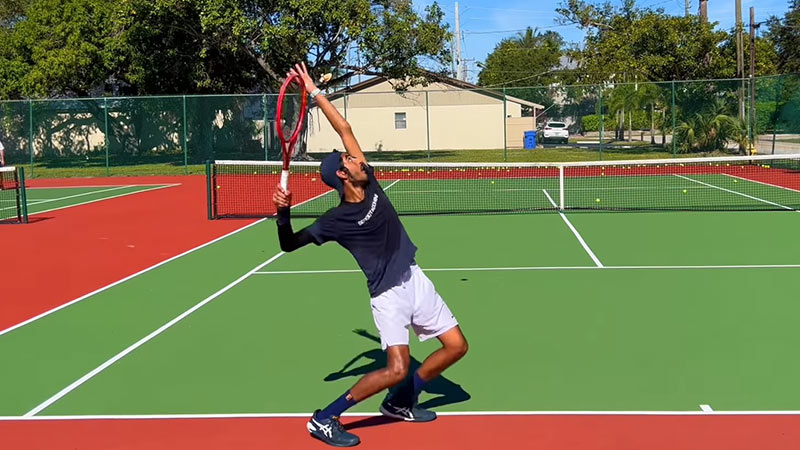
The serve is often described as the most important stroke in tennis. It is the only moment in a match where a player has total control over the ball, the timing, and the placement.
However, for many beginners and even intermediate enthusiasts, one of the most common points of confusion isn’t the toss or the grip—it is where to stand.
A frequent question that arises during weekend matches and club tournaments is: Do you always serve from the same side in tennis?
The short answer is no. To maintain the integrity of the game and ensure a fair distribution of angles, tennis regulations require a strict adherence to alternating sides.
Understanding this pattern is not just about following the rules; it is about mastering the “geometry of the court” to gain a competitive advantage.
The Fundamental Rule: The Alternating Pattern
In tennis, you must alternate sides for every single point within a game. This is a foundational rule that keeps the match moving and prevents one player from exploiting a specific physical or environmental advantage on one side of the court for too long.
The process follows a specific, predictable sequence. Every game begins with the server standing to the right of the center mark.
After that first point is played, regardless of who won it or how long the rally lasted, the server must move to the left of the center mark for the second point. This back-and-forth rhythm continues until the game is completed and a winner is declared.
Breaking Down the Serving Order
To ensure you never lose your place during a high-pressure match, it is helpful to visualize the sequence as follows:
- Point 1: You begin the game serving from the right side, commonly known as the deuce court. Your target is the opponent’s right service box (from your perspective, their deuce box).
- Point 2: You move to the left side, known as the ad court. Your target is now the opponent’s left service box (their ad box).
- Point 3: You return to the right side.
- Point 4: You return to the left side.
This left-to-right alternating pattern remains constant until the game concludes. Whether the game ends quickly at 40-0 or stretches into a long series of deuces and advantages, the rule remains: if the score is even (0-0, 15-15, 30-0, etc.), you serve from the right. If the score is odd (15-0, 30-15, 40-30, etc.), you serve from the left.
The Anatomy of the Court: Deuce vs. Ad
Understanding the names of the sides is critical for communication between players and for keeping track of the score.
The Deuce Court (The Right Side)
The right side of the court is called the deuce court because, in traditional tennis scoring, every time the score reaches “deuce” (40-40), the next serve must come from this side.
Starting a game from the deuce court is a universal standard in tennis. When you stand behind the baseline on the right side, you are aiming diagonally across the net.
For a right-handed server, this side often allows for a powerful “slice” serve that curves away from the returner, or a “flat” serve aimed down the “T” (the center line of the service boxes).
The Ad Court (The Left Side)
The left side is the ad court, short for “advantage.” When a game goes beyond deuce, the point played from this side will result in either an “Advantage” for one player or a return to “Deuce.”
Serving from the ad court presents different geometric challenges. For a right-handed player, this side is often where the “kick serve” is most effective, as the spin can jump high and toward the opponent’s backhand.
For left-handed players, the ad court is often their greatest weapon, allowing them to slice the ball out wide and pull their opponent off the court entirely.
Why Does Tennis Require Alternating Sides?
You might wonder why the sport doesn’t simply allow a player to choose their favorite side for the entire game. The requirement to switch for every point serves several vital purposes in competitive athletics.
1. Fairness and Environmental Factors
Tennis is often played outdoors, where sun, wind, and shadows can significantly impact play. By forcing players to serve from both the right and left sides of their end of the court, the rules ensure that no player is unfairly hampered or helped by the sun’s position or a crosswind for the duration of a service game.
2. Testing Versatility
A complete tennis player must be able to hit targets from both sides of the court. Serving from the deuce side requires a different mental and physical approach than serving from the ad side.
By alternating, the game tests a player’s ability to adjust their toss, their angle of attack, and their footwork on every single point.
3. Strategic Depth
The alternating system creates a “chess match” dynamic. A returner might be excellent at returning serves on their forehand side but struggle on their backhand.
Because the server must switch sides, the returner is forced to defend different areas of the court, and the server must strategize how to exploit weaknesses from both the right and left angles.
Common Mistakes and How to Avoid Them
Even professional players occasionally lose track of which side they should be serving from, especially after a grueling rally or a controversial line call. Here are the most common pitfalls:
Serving from the Wrong Side
If you realize mid-point that you are serving from the wrong side, the point should technically be stopped.
However, according to the USTA Tennis Serving Rules Guide, if a point is completed from the wrong side, the point stands as played, but the positioning must be corrected immediately for the next point.
Losing Track of the Score
The easiest way to remember your side is to keep a running tally of the points played.
- If the total number of points played in the game is even (0, 2, 4, 6), you serve from the right (deuce) side.
- If the total number of points played in the game is odd (1, 3, 5), you serve from the left (ad) side.
For example, if the score is 30-15, three points have been played. Since 3 is an odd number, you should be serving from the left side.
Foot Faults at the Center Mark
The rule states you must be on the correct side of the “center mark”—the small line in the middle of the baseline.
A common error is stepping on or over this line during the service motion. This is a foot fault. Always ensure there is a clear daylight between your lead foot and that center mark to remain compliant with official regulations.
Advanced Scenarios: Tiebreaks and Changes of Ends
While the rule for a standard game is straightforward—alternate every point—tennis introduces a few variations during tiebreaks and when switching ends of the court.
The Tiebreak Exception
In a standard tiebreak (first to 7 points, win by 2), the serving rotation changes slightly to maintain fairness:
- Player A serves the first point from the right side.
- Player B serves the next two points (Points 2 and 3). Crucially, Player B starts their turn from the left side and then switches to the right.
- Player A then serves the next two points (Points 4 and 5), starting from the left and moving to the right.
This ensures that players switch ends of the court every six points, and the advantage of the first serve is rotated. Even in this more complex scenario, the principle of moving between the deuce and ad courts remains the heart of the system.
Changing Ends
In addition to switching serving sides for every point, players must switch ends of the entire court after every odd-numbered game (1, 3, 5, etc.).
This is another layer of the sport’s commitment to fairness, ensuring that players deal with the same side of the net, wind patterns, and court surface conditions over the course of a set.
Developing a Professional Pre-Serve Routine
To ensure you always stand in the correct spot and execute a high-quality serve, professional coaches recommend developing a consistent “pre-serve routine.” This habit helps ground you and ensures you are following the rules.
- Check the Score: Before stepping to the line, state the score clearly. This confirms with your opponent that you both agree on the number of points played.
- Identify the Side: Based on the score, identify if it is a deuce (right) or an ad (left) point.
- Find the Center Mark: Walk to the baseline and position yourself about a foot or two away from the center mark.
- Breathe and Bounce: Use a consistent number of ball bounces to settle your nerves.
- Visualize the Target: Look at the diagonal service box you are aiming for.
By following this routine, you eliminate the mental clutter of wondering where to stand, allowing you to focus entirely on your technique.
The Role of Official Regulations
For those looking to transition from casual play to sanctioned tournaments, it is essential to be familiar with the governing bodies.
The USTA (United States Tennis Association) provides the definitive framework for how these rules are applied in the U.S.
Their guidelines emphasize that court positioning is not a suggestion but a requirement for a legal match.
Familiarizing yourself with these rules helps prevent disputes on the court and ensures that you can play with confidence in any setting, from a local park to a professional stadium.
Conclusion: Emulating the Pros
When you watch the world’s top players at the US Open or Wimbledon, you will notice they never hesitate. They move fluidly from the right side to the left side, point after point, with total awareness of the court’s geometry. This movement is the heartbeat of a tennis match.
Whether you are serving at “love-all” to start a match or facing a high-stakes “break point” on the ad side, your positioning is your foundation.
Remember: start right, then move left, and keep alternating until the game is won. By mastering this simple yet essential rhythm, you are one step closer to playing tennis with the precision and professionalism of a seasoned expert.