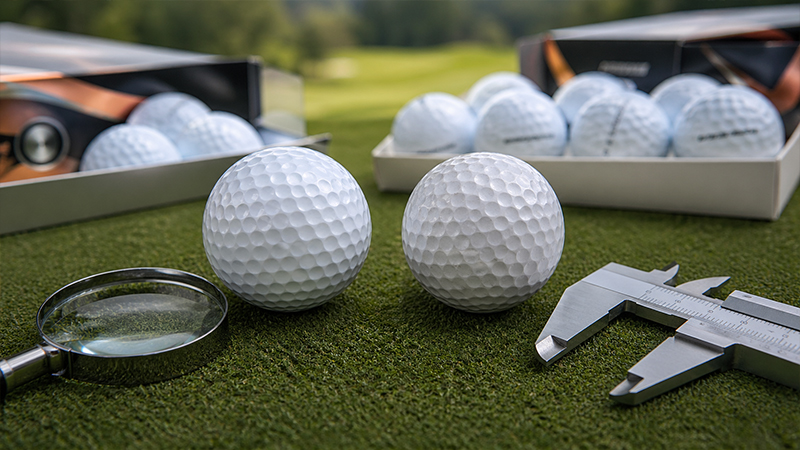
In the high-stakes world of competitive golf, the Titleist Pro V1 stands as the industry benchmark for performance, consistency, and prestige.
However, its status as the ” #1 Ball in Golf” has made it the primary target for sophisticated counterfeiting operations.
For the discerning golfer, a deal that seems “too good to be true” often is precisely that—a calculated attempt to sell inferior products under the guise of premium equipment.
This comprehensive analysis deconstructs the counterfeit market, providing you with the technical indicators and market intelligence required to distinguish a genuine Titleist masterpiece from a high-priced “Top Flite” in disguise.
The Economics of Deception: Why Fakes Exist
The Pro V1 remains the most faked ball in the world because of its high retail price and massive demand.
In online communities like Reddit’s r/golf, users frequently report “deals” where three dozen Pro V1s are offered for as low as $60—a price point that is fundamentally incompatible with Titleist’s wholesale structure and MAP (Minimum Advertised Price) policies.
Market Value Discrepancy
When analyzing a potential purchase, the first metric is price. A standard “case” or dozen of new Pro V1s typically retails between $50 and $55.
If a local or online seller offers multiple boxes for $60 total, the price per ball drops to roughly $1.66, which is significantly below the production cost of a genuine multi-layer urethane ball.
As noted by veteran players, such deals are often the result of stolen goods, liquidations from “scorned exes,” or outright counterfeits.
Technical Inspection: The Anatomy of a Counterfeit
To the untrained eye, a fake Pro V1 looks identical to a real one. However, under analytical scrutiny, the discrepancies in manufacturing quality become evident.
The “Franken-Box” Phenomenon
One of the most common scams involves the “sleeving” of inferior balls into genuine Titleist packaging. Fraudsters may take a legitimate Pro V1 box and fill the sleeves with cheaper, two-piece balls like Top Flites or Pinnacles that have been refinished.
Always inspect the individual sleeves for intact glue seals and ensure the balls inside match the description on the outer box.
Dimple Pattern Analysis
Titleist uses a highly precise, spherically tiled tetrahedral dimple design. Counterfeit balls often utilize generic dimple patterns that are less aerodynamic.
- Genuine: Dimples are crisp, uniform, and seamlessly integrated into the parting line.
- Counterfeit: Dimples may look “soft” or shallow, and the seam (the line where the two halves of the cover meet) is often visible or uneven.
Alignment and Font Precision
Titleist’s printing process is industrial-grade. On a genuine Pro V1:
- The side stamp (e.g.,
< - Pro V1 - >) is perfectly centered and uses a proprietary font. - The numbering is crisp. Counterfeiters often use slightly different fonts or thicknesses that “bleed” into the cover material. Some fakes have even been found with the “Top Flite” logo still partially visible under a thin layer of white paint.
The Performance Gap: Urethane vs. Ionomer
The primary reason golfers pay a premium for Pro V1s is the cast urethane elastomer cover, which provides exceptional “drop-and-stop” greenside control.
The “Thumbnail” Test
Urethane is a soft, reactive material. If you press your thumbnail into a genuine Pro V1, you will feel a slight “grip” or “give.”
Counterfeit balls almost always use Surlyn or ionomer covers (the material used in distance balls), which are hard, plasticky, and slide under the fingernail.
Sound and Feel
In an analytical setting, the acoustic signature of a ball tells its story.
- Genuine Pro V1: Produces a muted, “thud” sound off the putter face.
- Counterfeit/Cheap Ball: Produces a high-pitched “click” or “ping,” indicating a hard cover and a high-compression core.
Identifying High-Risk
According to community data and user experiences, the risk of encountering fakes varies by procurement channel.
Local Marketplaces (OfferUp, Facebook, Craigslist)
These are high-risk zones. While some deals are legitimate “gifts” being offloaded, many are stolen property or fakes designed to exploit the “cash and carry” nature of the transaction.
eBay and Third-Party Amazon Sellers
These platforms are often used to move high volumes of counterfeit “new” balls. If the seller is based in a region known for manufacturing exports and the price is 40% below retail, exercise extreme caution.
Found-on-Course Fakes
Surprisingly, golfers often find “horribly fake” Pro V1s in the woods or water hazards. These are balls that have likely been purchased by other golfers who didn’t realize they were playing with counterfeits until the performance failed them.
Refurbished vs. Counterfeit: A Critical Distinction
It is essential to distinguish between a fake ball and a refurbished ball.
- Refurbished Balls: These are genuine Titleist balls that have been recovered, sandblasted, and repainted with a new clear coat and logo. While they were once real Titleist balls, the refurbishing process often ruins the aerodynamics and weight balance.
- Counterfeit Balls: These were never Titleist balls to begin with; they are low-grade cores with fake logos printed on them.
Analytical Decision Matrix: Should You Buy?
If you encounter a deal like the—$60 for multiple cases—use this checklist to determine the risk:
| Metric | Red Flag (High Risk) | Green Flag (Legitimate) |
|---|---|---|
| Price | Less than $30 per dozen (New) | $45 – $55 per dozen (New) |
| Seller Story | “Found them,” “Gift,” or “Selling for a friend.” | Pro shop liquidations or reputable retailers |
| Packaging | Damaged, non-standard, or unsealed | Factory-sealed with matching serial numbers |
| Physical Feel | Hard, “clicky,” or plasticky | Soft, tacky urethane cover |
| Printing | Misaligned logos or “Top Flite” shadows | Perfectly centered, high-definition print |
Enhanced FAQ: Your Questions Answered
Q: Can a counterfeit Pro V1 actually hurt my game?
A: Absolutely. A genuine Pro V1 is designed for consistent spin and flight. A counterfeit ball often has an off-center core, leading to “wobble” in flight and unpredictable distances. You might hit a perfect 7-iron that flies 10 yards short simply because of the ball’s poor construction.
Q: Are “Left Dot” or “Left Dash” Pro V1s more likely to be fake?
A: These are specialty versions of the Pro V1. Because they are rarer, they are actually less likely to be faked than the standard Pro V1 or Pro V1x, as the counterfeiters focus on the highest-volume products.
Q: Is it worth the risk to buy cheap “local” Pro V1s?
A: Some users argue it’s “worth the risk” if the price is low enough. However, from an analytical performance standpoint, you are better off buying a legitimate $25 dozen of “B-grade” or “Value” balls from a reputable brand than playing a fake Pro V1 that will fail you on the course.
Q: How can I be 100% sure my balls are real?
A: Buy only from authorized Titleist retailers, pro shops, or the Titleist website. While you won’t get a “steal” of a price, you are guaranteed the engineering excellence that makes the Pro V1 the gold standard.
Conclusion: Protect Your Performance
The allure of a bargain is strong, especially for an expensive consumable like golf balls. But as the community analysis shows, a $60 deal for three cases of Pro V1s is almost certainly a gateway to disappointment—either through counterfeit products, stolen goods, or bait-and-switch tactics.
In golf, as in business, consistency is the foundation of success. Do not compromise your performance by introducing the variables of a fake ball. Inspect your equipment, and remember: if the deal feels fishy, your score will likely reflect it.