The evolution of golf technology moves at a rapid pace, yet certain clubs maintain a legendary status long after their initial release.
In the world of game-improvement irons, two of the most significant milestones in Ping’s history are the G30 (released in 2014) and the G410 (released in 2019).
While five years might seem like a lifetime in golf engineering, many players still find themselves at a crossroads: should they stick with the tried-and-true stability of the G30 or upgrade to the modern, refined performance of the G410?
This deep-dive comparison explores the nuances of design, technology, and on-course performance to help you determine which iron set deserves a place in your bag.
Design and Aesthetics: The Shift Toward Refinement
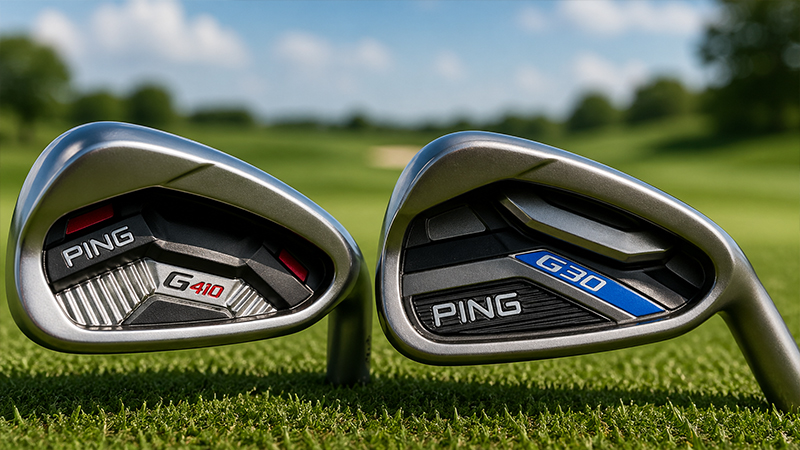
The most immediate difference you will notice when placing these two clubs side-by-side is their physical footprint.
Ping has historically been known for larger, “chunkier” game-improvement irons that prioritise confidence over sleekness, but the G410 represented a significant pivot in this philosophy.
The Compact Revolution of the G410
The Ping G410 irons offer a more compact, refined look compared to their predecessors. Engineering a club that remains forgiving while shrinking the head is a difficult feat, but Ping achieved this by giving the G410 a 10% shorter blade length.
This smaller profile makes the iron appear more like a “players’ club” at address, appealing to mid-handicappers who want the help of a cavity back without the oversized look.
Offset and Top Line Comparisons
One of the most defining characteristics of a game-improvement iron is the offset—the distance between the leading edge and the front of the hosel.
The G30 features more offset and a thicker top line, which is designed to help high-handicappers square the face and launch the ball easily.
In contrast, the G410 has less offset, providing a cleaner, more streamlined visual. This design choice is intended to offer a more appealing profile for golfers who may find excessive offset distracting or who have a tendency to miss left.
Performance and Face Technology
While aesthetics matter, performance is where the investment pays off. The five-year gap between these models allowed Ping to introduce entirely new methods of face construction.
COR-Eye Technology and Ball Speed
The G410 features COR-Eye technology, a structural design that allows the face to act like a springboard.
This results in a “hot” face for faster ball speeds across a larger area of the hitting surface. By allowing the face to flex more dynamically, the G410 generates the type of distance usually reserved for much larger irons.
Launch Conditions: G30’s High Flight vs. G410’s Control
The G30 remains a powerhouse for high-launching performance. Its design focuses on max forgiveness and getting the ball into the air as easily as possible, making it a highly usable and durable option for beginners.
The G410, however, focuses on consistent distance control. While the G30 was capable of great distance, it occasionally suffered from “hot spots”—hits that would unexpectedly fly much further than a standard shot.
The G410 was engineered to reduce these hot spots, ensuring that a well-struck 7-iron goes the exact yardage you expect every time.
Forgiveness: The Science of Weighting
Forgiveness is often misunderstood as simply “hitting it straight.” In reality, it’s about how much distance and direction you lose on off-centre hits.
Tungsten Weighting in the G410
The G410 introduced a sophisticated weighting system to compensate for its smaller head size. It features a tungsten weight located in the toe.
This high-density weight pulls the centre of gravity outward, which significantly improves forgiveness on off-centre hits compared to the G30. By concentrating weight at the extremities, Ping provides greater toe-side forgiveness in the G410.
G30: The King of Stability for Beginners
Despite the G410’s modern weighting, the G30 remains a benchmark for “easy-to-hit” forgiveness. Its larger head and wider sole provide a massive “sweet spot” that is incredibly forgiving through the turf.
For a golfer who is just starting out, the G30’s maximum forgiveness focus offers a level of confidence that is hard to beat.
Feel and Sound: A Subjective Choice
How a club feels at impact is often the deciding factor for many golfers. This is an area where the G30 and G410 diverge significantly.
- The G410 Experience: Most users report that the G410 has a firmer feel. This firmness is often associated with the “hot” face technology; it feels fast and responsive, providing immediate feedback on where the ball was struck on the face.
- The G30 Experience: The G30 offers a more traditional game-improvement feel. Because it lacks the ultra-thin, high-flexing face of the G410, many players find it has a softer or more dampened feel that some golfers still prefer today.
Identifying Your Target: Who Should Play Which?
Choosing between these two sets depends largely on where you are in your golfing journey and what you hope to achieve on the scorecard.
Who should choose the Ping G30?
- Beginners: If you are new to the game, the G30’s high ball flight and max forgiveness are your best friends.
- Budget-Conscious Golfers: The G30 is generally more affordable in the used market, offering incredible value for a club that is still highly competitive.
- High-Handicappers: If your primary goal is simply to get the ball airborne and moving forward, the G30’s design is optimized for your needs.
Who should choose the Ping G410?
- Mid-to-High Handicappers: Those looking for a mix of game improvement and more modern performance will thrive with the G410.
- The “Improving” Golfer: If you are transitioning from a high handicap to a mid-handicap and want a smaller, more appealing profile without losing forgiveness, this is the upgrade for you.
- Distance Seekers: If you want the benefits of COR-Eye technology and faster ball speeds, the G410 is the clear technological winner.
Final Verdict: Is the Upgrade Worth It?
The Ping G410 is a significant upgrade in technology over the G30, especially regarding distance control, face speed, and visual appeal.
For the golfer who wants a more “player-preferred” look with the hidden forgiveness of a tungsten toe weight, the G410 is a masterpiece of engineering.
However, the G30 remains a legendary “classic” for a reason. Its durability and ease of use make it one of the best value-for-money irons available on the secondary market.
If you aren’t bothered by a thicker top line or more offset, the G30 can still produce quality rounds of golf for a fraction of the price.
Ultimately, the choice comes down to consistency vs. simplicity. The G410 offers consistent distance and modern tech, while the G30 offers a simple, high-launching solution for the everyday golfer.