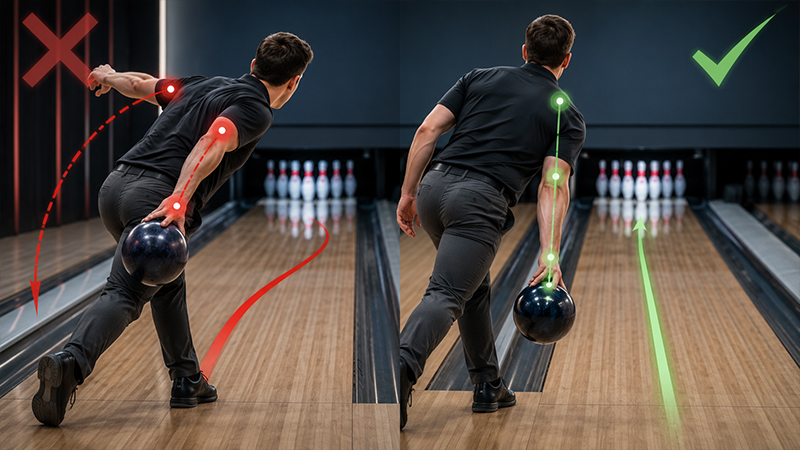
In the professional landscape of modern cricket, the integrity of a bowler’s delivery is paramount.
Maintaining a legal bowling action is not merely a matter of following regulations; it is a fundamental requirement for any athlete seeking a sustainable career at the highest levels of the sport.
Illegal elbow extension, colloquially known as “chucking,” represents a significant technical failure that can lead to disciplinary action, reputational damage, and formal bans from competition.
The following analysis provides a comprehensive framework for identifying, addressing, and correcting illegal bowling actions through biomechanical adjustments and disciplined training protocols.
Understanding the Technical Challenge: What is Chucking?
At its core, “chucking” or an illegal action occurs when a bowler’s elbow extends during the delivery phase.
According to standardized regulations, the bowling arm must remain straight or, if there is a pre-existing bend, that angle must remain constant throughout the delivery.
The primary error occurs when the elbow is straightened at the point of release to generate artificial pace or spin.
To stop this movement, a bowler must shift their focus away from jerky, arm-centric motions and toward a holistic body movement that engages the core and shoulder rotation for power.
Step I: Diagnostic Assessment and the Role of Video Analysis
Before any technical correction can begin, a precise diagnostic phase is required. It is difficult for a bowler to “feel” the exact moment an elbow straightens due to the high velocity of the action.
Implementing Video Analysis: The use of high-frame-rate video technology is the most effective way to identify technical flaws.
Analysts recommend recording the bowling action from multiple angles—specifically side-on and from behind the bowler—to pinpoint the exact moment the elbow deviates from a legal state.
Slow-motion playback allows the coach and athlete to see the transition from the load-up to the release point, providing a clear visual baseline for correction.
Step II: Fundamental Principles of Correction
Correcting a deep-seated technical flaw requires a systematic “reset” of the bowling action. This process involves three primary pillars: reducing velocity, maintaining arm rigidity, and optimizing the release point.
1. The “Slow Down and Rebuild” Strategy
One of the most common mistakes bowlers make when attempting to fix an illegal action is trying to maintain their maximum pace during the transition period.
Professional guidance suggests dropping the pace significantly to focus entirely on the legality of the movement.
Once the mechanics are stabilized at a lower speed, the bowler can gradually increase their intensity while monitoring for any return of the illegal extension.
2. Maintaining a Consistent Arm Angle
The objective is to ensure the bowling arm remains locked or straight throughout the entire arc of the delivery. This prevents the “jerky” motion associated with a thrown delivery.
If a bowler has a natural slight bend in their elbow, the key is to ensure that the “crookedness” does not change—meaning no straightening occurs as the ball leaves the hand.
3. Optimizing the Release Point
The verticality of the arm during release plays a critical role in legality. Aiming for a “12 o’clock” or “1 o’clock” release point is recommended.
Keeping the wrist high and the arm vertical at the moment of delivery helps prevent the arm from collapsing or bending at the final moment, which is a common precursor to a chucked ball.
Step III: Biomechanical Power Generation
This requires a shift in biomechanical focus toward the larger muscle groups.
- Core Engagement: The power for a legal delivery should be generated from the core and trunk rotation rather than the arm. A strong, stable midsection allows for the efficient transfer of energy from the legs through to the upper body.
- Shoulder Rotation: By emphasizing shoulder rotation, the bowler can maintain a straight arm while still producing significant force. This “large muscle” approach is more sustainable and less prone to illegal variations than a “small muscle” arm-dominant action.
Step IV: Specialized Drills for Technical Mastery
Repetition is the only way to build new muscle memory. The following drills are designed to isolate the components of a legal delivery and eliminate the reliance on elbow extension.
The Kneeling Drill
This drill is specifically designed to isolate the upper body and remove the variables of the run-up and footwork.
- Execution: The bowler kneels with their bowling-side knee on the ground.
- Objective: From this stable position, the bowler is forced to use their shoulder and core to rotate and deliver the ball. Without the momentum of the run-up, any attempt to generate speed through the elbow becomes immediately apparent, allowing the bowler to focus on a straight-arm rotation.
One-Armed Side-On Drills
Side-on mechanics are often more conducive to a legal action than “front-on” actions for many bowlers.
- Execution: The bowler stands in a side-on position and practices the arm circle in isolation.
- Objective: This drill emphasizes the role of the shoulder in guiding the ball through the arc while holding the arm in a locked, straight position.
Side Net Practice
“Falling away” during the delivery—where the bowler’s head and body move laterally—often leads to a “thrown” or “pushed” delivery.
- Execution: Practicing in a narrow lane or close to a side net.
- Objective: This forces the bowler’s momentum to move directly forward toward the target. By preventing lateral collapse, the bowler is less likely to use an illegal arm extension to compensate for lost balance.
Step V: Physical Support and Equipment
In some cases, physical cues are necessary to overcome long-standing habits.
The Use of Elbow Braces or Bandages
Wearing a stiff elbow brace or a heavy bandage during training sessions can provide immediate physical feedback.
A brace physically prevents the elbow from bending or straightening beyond a certain point, which helps the brain and muscles adapt to the sensation of a straight-arm delivery.
This is intended as a training tool to build muscle memory, rather than a permanent fixture in competition.
The Importance of the Follow-Through
A short, jerky action is often associated with illegal deliveries. By focusing on a full, fluid follow-through down the pitch, bowlers can encourage a smoother, more continuous motion.
A complete follow-through helps dissipate energy safely and ensures that the delivery phase was a result of a full-body rotation rather than an isolated arm snap.
Organizational Implementation: A Checklist for Coaches and Athletes
To ensure these principles are applied effectively within a professional or high-performance environment, the following checklist should be followed:
- Baseline Screening: Conduct a slow-motion video review of the current action from three angles.
- Immediate Velocity Reduction: Mandate a 50% reduction in bowling speed until the arm remains locked through 50 consecutive deliveries.
- Core-Centric Conditioning: Implement a strength program focused on trunk rotation and shoulder stability to replace arm-based power.
- Daily Isotopic Drills: Incorporate the Kneeling Drill and Side Net Practice into every warm-up routine.
- Technical Reinforcement: Use an elbow brace during “skill sets” (specific practice blocks) to solidify the straight-arm sensation.
- Progressive Loading: Gradually increase intensity (10% increments) only when the action remains 100% legal at the current speed.
Frequently Asked Questions (FAQ)
What exactly constitutes a “straight arm” in bowling?
The arm does not necessarily have to be perfectly straight (180 degrees), as some bowlers have natural hyperextension or permanent bends.
The legal requirement is that the angle of the arm must not change—specifically, it must not extend or straighten—during the delivery phase.
Why does slowing down help fix a “chuck”?
Chucking is often a subconscious compensation for a lack of pace or a way to generate extra “snap” at the end of the action.
By slowing down, you remove the urge to “cheat” for speed and can focus on the pure mechanics of the shoulder and core.
How long does it take to rebuild a bowling action?
The timeline varies depending on the severity of the issue and the athlete’s dedication to the drills.
However, it generally requires several weeks of daily, disciplined practice before the new mechanics become instinctive. Consistent use of video analysis is necessary to ensure no regression occurs as pace is added back.
Can an elbow brace be used in a match?
While training aids like braces are invaluable for building muscle memory in practice, they are typically restricted or regulated in competitive matches depending on the league’s rules.
The goal of the brace is to train the body so that it no longer needs the physical restriction to bowl legally.
How does the release point affect legality?
A low, “slingshot” style release point often makes it easier for the elbow to bend and straighten horizontally. A high, vertical release point (the 12 o’clock position) utilizes gravity and a more natural shoulder arc, which naturally encourages a straighter arm.
Conclusion: The Path to Sustainable Performance
Mastering a legal bowling action is a technical necessity that requires an analytical approach to biomechanics and a disciplined commitment to training.
By shifting the focus from the arm to the core, utilizing diagnostic tools like video analysis, and employing specific drills such as kneeling and side-net practice, bowlers can eliminate illegal extensions.
The transition from a “thrown” action to a “bowled” action is often a challenging period of reduced performance and technical frustration.
However, for those who prioritize long-term career viability and the integrity of the game, this systematic rebuilding process is the only path forward.
Through the application of these principles, athletes can ensure their actions stand up to professional scrutiny while maintaining the power and precision required to compete at the highest level.