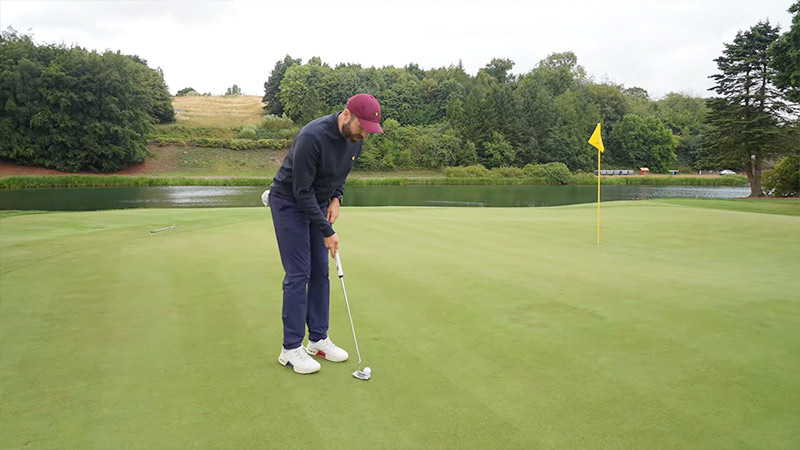
Golf is a sport defined by numbers, but not all numbers are created equal. If you are accustomed to traditional “stroke play”—where the goal is to have the lowest total score at the end of 18 holes—stepping into the world of match play can feel like learning a whole new language.
One of the most common final scores you will see on a professional leaderboard is “3 and 1.”
But what does it actually mean? Why does the match stop before the 18th hole? And how does the math of the 17th green dictate the winner? This comprehensive guide breaks down the mechanics of “3 and 1” to help you master the nuances of match play scoring.
The Core Definition: What is “3 and 1”?
In the simplest terms, “3 and 1” (often written as 3&1) indicates that a player has won the match by being 3 holes up with only 1 hole left to play.
Unlike stroke play, where every golfer must complete all 18 holes to post a final score, match play is a head-to-head competition where the goal is to win individual holes.
Once it becomes mathematically impossible for one player to catch up to the other, the match ends immediately—regardless of how many holes are left on the course.
When a match ends “3 and 1,” the following facts are true:
- The Winner’s Lead: The winning player has won three more holes than their opponent.
- The Conclusion Point: The match officially ended on the 17th green.
- The Final Hole: The 18th hole was never played because the outcome was already decided.
The Mathematics of the 17th Green
To truly understand why “3 and 1” is a final score, you have to look at the math involved during the final stretch of a round.
Imagine two golfers, Player A and Player B, reaching the 17th tee. If Player A is “3 up,” it means they have a three-hole lead. As they play the 17th hole, there are only two holes remaining in the round (the 17th and the 18th).
If they “halve” (tie) the 17th hole, or if Player A wins the 17th hole, Player A’s lead remains at 3 (or grows to 4). At that specific moment, there is only one hole left to play (the 18th).
Because Player B is trailing by 3 holes and there is only 1 hole left, Player B cannot possibly win or even tie the match. Even if Player B were to win the 18th hole, they would still be down by 2 holes.
Since the trailing player cannot make up a 3-hole deficit with only one hole remaining, the match is declared over on the 17th green.
Match Play vs. Stroke Play: A Fundamental Shift
To appreciate the “3 and 1” result, it is helpful to understand the broader context of how match play differs from the golf most amateurs play on the weekend.
1. Scoring by Hole, Not by Stroke
In stroke play, if you take a 10 on a par-4, that “blow-up hole” could ruin your entire tournament. In match play, if you take a 10 and your opponent takes a 4, you simply lose that one hole. You start the next tee box “1 down,” and your previous score no longer matters.
2. The Concept of “Holes Up” and “Holes Down.”
Match play tracking is always relative. You are either “Up” (leading), “Down” (trailing), or “All Square” (tied). A “3 and 1” victory is the culmination of maintaining a lead throughout the back nine until the math forces a conclusion.
3. Concessions
In match play, players can “concede” strokes or even entire holes. If your opponent has a one-foot putt, you can tell them to “pick it up,” counting the stroke as made.
This spirit of sportsmanship and gamesmanship often leads to matches ending quickly once a lead like “3 up” is established late in the round.
Why “3 and 1” is a Decisive Victory
A “3 and 1” score is generally considered a “comfortable” win in the professional world. While it isn’t a “blowout” (like a 5&4 or 8&7 finish), it demonstrates that the winner was in control of the match.
When a player wins 3 and 1, they have effectively “closed the door” on their opponent. They didn’t need the pressure of the 18th hole to secure the point.
By securing the win on the 17th, the winner proves they had enough of a cushion to withstand any late-game surges from the opposition.
The Strategy of Closing a Match on the 17th
The 17th hole is often where the most drama in match play occurs. For the player who is “3 up” entering the 17th, the strategy shifts:
Play for the Halve
The leading player does not need to win the 17th hole to win the match. They only need to avoid losing it. By tying (halving) the hole, they maintain their lead and end the match “3 and 1”.
Conservative Play
You will often see the leader play to the middle of the green, avoiding dangerous pin placements, because a par is usually sufficient to end the match.
The Trailing Player’s Desperation
Conversely, the player who is “3 down” must win the 17th hole just to keep the match alive. If they win the 17th, the match moves to the 18th hole (where the score would then be “2 up” with 1 to play).
Other Common Match Play Scores
While “3 and 1” is a frequent result, understanding other scores helps put it into perspective. (Note: These additional score examples are based on general golf knowledge and are not in the provided source).
- 1 Up: The match went all 18 holes, and the winner finished one hole ahead.
- 2 and 1: The winner was 2 holes up with only 1 hole left. This also ends on the 17th green because the trailer cannot catch up.
- 5 and 4: A dominant win where the player was 5 holes up with only 4 holes left to play. This match would end on the 14th green.
- 2 Up: This means the match went to the 18th hole. The leader was 1 up going into the 18th and won the final hole to finish “2 up.”
Frequently Asked Questions (FAQ)
Does “3 and 1” mean they played 31 holes?
No. The numbers refer to the status of the match at its conclusion: 3 holes up with 1 hole remaining in the standard 18-hole round.
What happens to the 18th hole?
In a “3 and 1” scenario, the 18th hole is not played for the competition. In some casual rounds, players might play it anyway for fun, but in a tournament setting, they shake hands on the 17th green and head back to the clubhouse.
Can a match end earlier than the 17th?
Yes. If a player is “4 and 3,” the match ends on the 15th green. If a player is “10 and 8” (which is extremely rare), the match would end on the 10th green. The match ends the moment the lead is greater than the number of holes remaining.
Why is it sometimes called “3&1”?
This is simply a shorthand notation used by sports journalists and on leaderboards. It carries the exact same meaning as “3 and 1.”
Conclusion: The Beauty of the Early Finish
Understanding “3 and 1” is essential for any golf fan who wants to enjoy formats like the Ryder Cup, the Solheim Cup, or the Presidents Cup. It represents the moment of ultimate realization in a match—the point where the math takes over and a winner is crowned.
The next time you see a score of “3 and 1,” you’ll know exactly what happened: one player put on a dominant performance, built a 3-hole lead, and slammed the door shut on the 17th green, leaving their opponent with no mathematically possible way to return. It is a decisive, clean victory that highlights the unique intensity and pressure of match play golf.