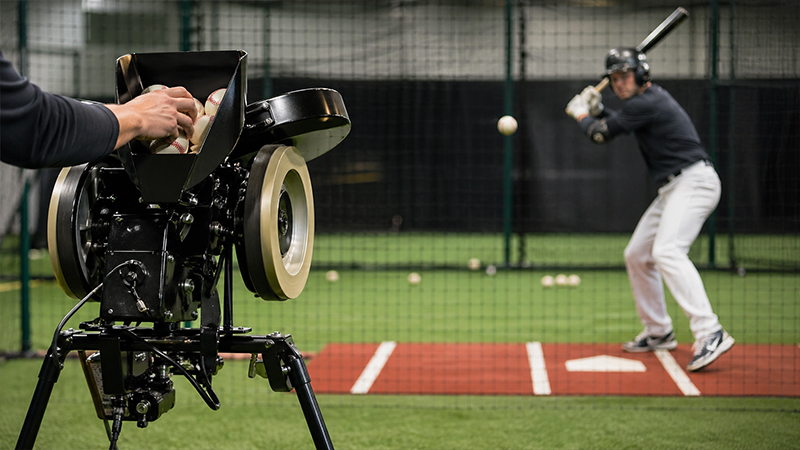
In the high-stakes environment of competitive baseball and softball, the difference between a championship-winning program and an average one often comes down to the quality of their practice repetitions.
However, a growing debate within the coaching community suggests that improper machine usage can be more detrimental than beneficial.
We analyzed the intersection of mechanical precision and human biomechanics to provide this comprehensive guide.
We will explore how to transform the pitching machine from a simple “ball thrower” into a sophisticated tool for elite timing, rhythm, and swing efficiency.
The Paradox of the Pitching Machine: Timing vs. Repetition
One of the most persistent challenges in modern coaching is the “timing gap” created by mechanical pitching.
Traditional insights from veteran coaches reveal that while players need high-volume repetitions to prepare for elite velocities, the random or inconsistent use of machines can exacerbate fundamental flaws.
The Stutter-Step Syndrome
Coaches frequently observe players struggling with timing when transitioning from live pitchers to machines.
This often manifests as a “stutter step,” in which the hitter struggles to get their front foot down at the right moment.
When a hitter walks away from the cage shaking their head in frustration, it is usually not a lack of skill but a breakdown in the synchronization between the machine’s release and the hitter’s internal clock.
The Human Element
The primary criticism of machine-based training is the loss of the “human hand” visual. Elite hitters at every level rely on seeing the ball come out of a pitcher’s hand to initiate their loading sequence.
To mitigate this, world-class operators must act as more than just “feeders”—they must become simulators of the human pitching motion.
Standard Operating Procedures (SOPs) for Elite Operation
The Art of the Feed: Establishing a Routine
The operator’s primary goal is to provide a predictable, rhythmic experience for the hitter.
- The Signaling Phase: Never feed a ball blindly. Always signal the batter before a feed by holding the ball high in the air. This serves as the “wind-up” and alerts the hitter to begin their mental preparation.
- The Loading Sequence: Use a smooth, deliberate, and fluid motion when placing the ball into the machine. Avoid any jerking or hesitation, as these “minuscule delays” disrupt the hitter’s timing and cause pauses in their rhythm.
- Consistency of Intervals: Maintain the same timing between every pitch. This allows the hitter to develop a “solid rhythm,” which is the foundation of a repeatable swing.
Technical Precision and Ball Flight
The physical setup of the machine dictates the quality of the “rep.”
- The 4-Seam Advantage: For the most accurate and straightest pitches, always place the ball into the chute using a four-seam grip. This stabilizes the ball’s flight path and reduces erratic movements that can confuse hitters.
- Velocity Calibration: A common mistake is feeding the ball before the machine has reached its target RPM. Always ensure the wheels are fully up to speed before the first pitch is delivered.
- Trajectory Management: If the ball begins to cut or drift—for example, cutting to the right—operators should be trained to make micro-adjustments, such as increasing the top-left motor speed to correct the flight path.
Strategic Training Applications: Beyond the Standard Cage
High-level coaching involves using the pitching machine to solve specific mechanical issues. It is not just about “taking hacks”; it is about targeted intervention.
The “Short-Box” Velocity Drill
For teams preparing for national tournaments or facing elite-level speed, veteran travel coaches recommend a “shortened distance” approach.
By setting the machine approximately 25 feet from home plate and increasing the speed, you force the hitter to shorten their swing.
This eliminates “hitches” and “casting” in the swing path, as the reduced reaction time requires maximum efficiency. When hitters get into a groove at this distance, their confidence skyrockets, allowing them to handle the fastest live pitching with ease.
The Multi-Station Ecosystem
Elite programs rarely rely on the pitching machine in isolation. A more effective strategy is a multi-station setup:
- Tee Stations: To work on pure swing mechanics and eliminate casting through “one-arm” drills.
- Front Toss Stations: Using a human tosser to work on pitch identification and timing.
- The Machine Station: For high-velocity reps and “distance feel”.
- Bunt Stations: Using the machine’s consistency to perfect the “dead-ball” technique.
Safety and Risk Management
In any professional athletic environment, safety is the ultimate “Trust Signal.” Operating spinning-wheel machinery carries inherent risks that must be managed with absolute discipline.
- Authorized Personnel Only: Only mature, authorized individuals should be permitted to operate the machine to prevent catastrophic injury from high-speed wheels.
- Equipment Integrity: Regular inspections are mandatory. Damaged wheels or worn-out balls are the leading causes of erratic pitches, which pose a danger to both the hitter and the operator.
- Ball Standardization: Never mix different types of balls. Use only recommended baseballs or softballs to ensure predictable trajectories.
Frequently Asked Questions (FAQ)
Q: Can a pitching machine actually ruin a hitter’s timing?
A: Yes, if used improperly. Without a human-simulated feed (signaling the ball), hitters often develop a “stutter step” because they lack the visual cues needed to time their load.
Q: How can I make machine practice feel more like a real game?
A: Operators should simulate a pitching motion by raising their arm before feeding the ball. Additionally, integrating the machine into a multi-station rotation that includes live front toss helps bridge the gap between mechanical reps and game-speed reactions.
Q: What is the best way to improve accuracy on a two-wheel machine?
A: Ensure you are using a four-seam grip when placing the ball in the chute. Also, check for wheel wear and ensure the machine is on a stable, level surface.
Q: Are automated feeders better than human operators?
A: Automated feeders provide excellent consistency and “internal timing” for long sessions, but they cannot provide a “visual wind-up” unless the system includes a light-based signaling sequence.
Conclusion: The Path to Elite Performance
The pitching machine is a powerful tool, but like any sophisticated piece of equipment, its effectiveness is determined by the skill of the operator.
By prioritizing rhythm, human-simulated signaling, and technical precision, coaches can ensure their hitters are not just swinging, but evolving.
For facilities looking to reach the pinnacle of player development, the transition from “random reps” to “rhythmic precision” is non-negotiable.
Whether you are preparing for a local JV game or a national showcase, mastering the art of the machine is your competitive advantage.