Five red lights go out, and twenty Formula 1 cars leave the grid in a single heartbeat. In that instant, almost everything depends on a component most fans never see: the clutch.
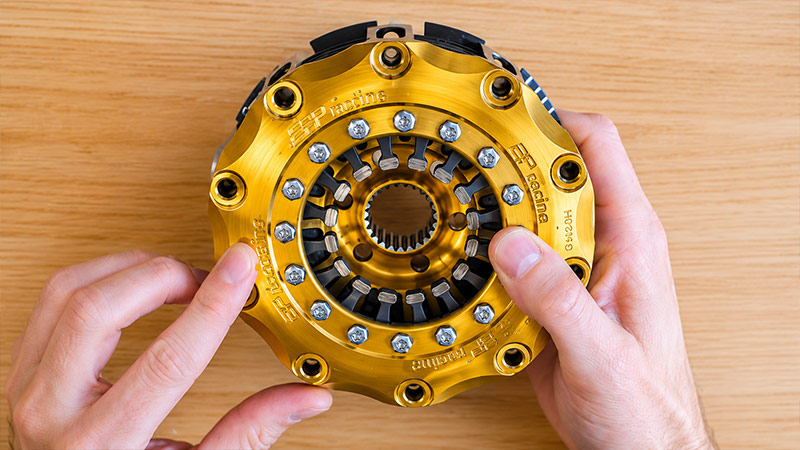
An F1 clutch is small enough to sit in the palm of your hand. Yet it must deliver the output of a hybrid power unit worth around 1,000 horsepower at peak. And it must do so without stalling the engine or turning the rear tires into smoke.
Get the launch right and a driver can gain several places before the first corner. Get it wrong and the race can slip away before it has truly begun. That is why teams obsess over a part that weighs little more than a bag of sugar.
This guide explains F1 clutch size, function, and technology in clear, practical terms. You will learn why the clutch is so small, what it actually does during a race, and how carbon materials and steering-wheel paddles make it work. You will also see how the same ideas have reached the cars we drive every day.
F1 Clutch at a Glance
An F1 clutch is a fraction of the size and weight of a road car clutch, yet it works at far higher speeds and temperatures. Teams and suppliers guard exact specifications closely, so the figures below are approximate, typical ranges.
| Feature | F1 clutch | Typical road car clutch |
|---|---|---|
| Diameter | About 100–140 mm | About 200–250 mm |
| Weight | Around 1–1.5 kg | Around 5–8 kg (clutch assembly) |
| Friction plates | 3–4 carbon-carbon plates | 1 organic or ceramic-lined disc |
| Operation | Steering-wheel paddles, clutch-by-wire | Foot pedal, cable or hydraulic |
| Engine speed | Well above 10,000 rpm | Around 6,000–7,000 rpm |
| Heat tolerance | Can exceed 500°C | Linings fade when overheated |
| Main job | Standing starts and pit exits | Every stop and gear change |
What Is an F1 Clutch?
An F1 clutch is a compact, multi-plate friction coupling that connects the power unit to the gearbox. When it is engaged, engine and transmission turn together. When it is open, the engine can keep running while the car stands still.
It sits at the rear of the internal combustion engine, between the crankshaft and the gearbox input shaft. The engine is a stressed member of the chassis and the gearbox bolts straight onto it, so the clutch lives in a tight space with almost no room to grow.
The power path is simple to follow: combustion engine and MGU-K, then crankshaft, clutch, gearbox, differential, and finally the rear wheels. Because the MGU-K feeds its energy into the crankshaft, the clutch must handle combined combustion and electric torque.
The biggest difference from a road car is how often it works. In a family hatchback the clutch is a constant companion, used at every junction and gear change. In an F1 car it is a specialist, called on for a few critical moments and otherwise left fully closed.
F1 Clutch Size: Why Smaller Is Faster
The F1 clutch is small by design, not by compromise. Shrinking it cuts rotating mass, lowers the car’s center of gravity, and frees precious space at the back of the car.
How a Small Clutch Holds Huge Torque
A clutch transmits torque through friction. Its capacity depends on four factors: clamping force, the friction coefficient of the material, the mean radius of the plates, and the number of friction surfaces.
T = μ × F × rₘ × n
Here T is torque capacity, μ is the friction coefficient, F is the clamping force, r_m is the mean plate radius, and n is the number of friction surfaces.
A smaller diameter shrinks r_m, so engineers win that capacity back elsewhere. They stack several plates to multiply the friction surfaces, and they use carbon-carbon material that grips strongly at race temperatures.
A typical pack of three or four driven plates offers six to eight friction surfaces in a unit lighter than many road car flywheels.
Less Inertia, Sharper Response
Rotational inertia grows with the square of a part’s radius. For a solid disc of fixed thickness, mass also grows with area, so inertia rises roughly with the fourth power of diameter. Halving the diameter of such a disc cuts its inertia by more than 90 percent.
Low inertia lets the engine rev up and down almost instantly. That matters for the gearbox, which must match engine speed to each new gear in milliseconds. It also sharpens throttle response every time the driver feeds in power out of a corner.
Packaging and Center of Gravity
A smaller clutch lets designers mount the crankshaft lower in the car. A lower crankshaft means a lower center of gravity, which improves cornering balance and helps the tires work evenly.
Today’s rules control crankshaft height closely, but the long push for compact clutches helped shape the low, tightly packed rear end of every modern F1 car. The space saved also gives designers more freedom around the gearbox, rear suspension, and the airflow feeding the diffuser.
F1 Clutch Function: What It Does and What It Doesn’t
An F1 clutch has a narrow job description. Once the car is rolling, the driver rarely touches it. Its real work happens in a handful of high-pressure moments.
Standing Starts
The race start is the clutch’s main event. The driver must slip the clutch with great precision, keeping engine revs in the right window while the tires find grip. Too little slip and the engine bogs down; too much and the rear tires spin away the advantage.
Pit Stop Exits
Every pit stop ends with a mini standing start. Top crews change four tires in around two to three seconds, and a clean getaway from the box protects the time they have just saved. A hesitant launch here can undo the best stop of the season.
Anti-Stall Protection
If the car spins or engine speed drops too low, an anti-stall system opens the clutch automatically. This keeps the engine running so the driver can rejoin the race. Without it, a simple spin could stall the power unit and end the afternoon.
Why It Isn’t Used for Gear Changes
Modern F1 gearboxes use seamless-shift technology. The next gear engages before the current one fully lets go, so drive to the wheels is barely interrupted. On the move, upshifts and downshifts typically happen in milliseconds with the clutch closed, handled by electro-hydraulic actuators.
This is a major reason F1 cars can shift dozens of times per lap without losing time. A conventional clutch-and-lever shift would cost precious tenths at every gear change.
Inside F1 Clutch Tech
Three technologies make the F1 clutch work: carbon friction materials, electronic actuation, and steering-wheel paddles. Together they turn a tiny part into one of the most precise components on the car.
Carbon-Carbon Friction Plates
F1 clutch plates are made from carbon-carbon, the same family of material used in F1 brake discs. It is extremely light, stays strong at temperatures that would ruin steel or organic linings, and keeps its grip when hot.
The plates sit inside a compact basket, typically machined from high-strength alloys, and are clamped by a diaphragm spring. The trade-off is temperature sensitivity: carbon works best inside a set window, so a cold clutch can bite unpredictably.
Clutch-by-Wire and Hydraulic Actuation
There is no mechanical link between the driver’s fingers and the clutch. The paddle sends an electronic signal to the car’s standard control unit, which commands a hydraulic actuator to open or close the clutch.
Electronic control gives precise, repeatable movement measured in fractions of a millimeter. However, the regulations strictly limit how much the software may help the driver, so the system translates input rather than taking over.
Steering-Wheel Clutch Paddles
The foot clutch pedal disappeared from F1 long ago, leaving drivers with just throttle and brake pedals. The clutch now lives on paddles behind the steering wheel, usually below the gearshift paddles.
Many wheels carry two clutch paddles, one on each side, so the driver can use either hand. Teams once used the pair to preset the bite point on one paddle and drop the other at lights out. Rule changes have since limited how much of that can be pre-programmed.
Heat and Wear Management
A standing start generates intense heat in a fraction of a second. Teams monitor clutch temperature closely and run bite-point calibration before the race, because wear and heat shift the point where the clutch begins to grip.
Drivers also rehearse launches in practice, using a marked area near the pit exit. These runs help engineers tune settings to each circuit’s grip level and to the condition of the starting grid.
How an F1 Race Start Works, Step by Step
A perfect F1 launch is a sequence of small, precise actions completed in a few seconds. Here is how the clutch fits into each stage.
- Bite-point preparation. Before the race, the car runs a calibration routine so the system knows exactly where the clutch starts to transmit torque. Wear and temperature move this point, so it is checked fresh on race day.
- Formation lap. Drivers warm their tires and brakes and bring the clutch into its working temperature range. A clutch that is too cold or too hot will not bite consistently.
- Grid slot. The driver pulls the clutch paddle fully, selects first gear, and holds engine revs at the target the team has planned for that track.
- Ready position. The driver brings the clutch to the edge of the bite point, so it is poised to engage the moment the lights go out.
- Lights out. The driver releases the clutch progressively through the bite point while balancing throttle. The goal is a narrow band between wheelspin and engine bog.
- Clutch fully closed. Within the first few car lengths the clutch locks up completely. From there, the seamless-shift gearbox handles every gear change for the rest of the stint.
The whole process rewards feel and repetition. Small differences in reaction time and clutch release often decide who leads into the first corner.
Rules That Put Starts Back in the Driver’s Hands
F1’s rule makers have steadily removed electronic help from the start. Their aim is simple: the driver, not the software, should decide who gets away best.
Launch control was banned from the 2004 season. From 2008, every car has run a standard electronic control unit, which makes hidden driver aids far harder to build in.
In 2016 the FIA went further. It tightened how clutch paddle movement may relate to clutch torque, and it restricted radio messages, so engineers could no longer coach drivers through clutch settings before the start. Good and bad getaways became a sharper test of pure driver skill.
The 2026 power units added a fresh twist by dropping the MGU-H, which once helped keep the turbo spinning. Without it, preparing the engine for a launch is harder, and precise clutch control matters even more than before.
From the Grid to Your Driveway
F1 clutch thinking has shaped how millions of people drive. The link is not always direct, but the ideas are easy to spot.
- Paddle shifters: F1 popularized steering-wheel paddles at the end of the 1980s. Today they appear on everything from supercars to family crossovers.
- Dual-clutch transmissions: These gearboxes preselect the next gear on a second clutch, delivering fast, smooth shifts. They share F1’s obsession with keeping drive flowing to the wheels without interruption.
- Electronic clutch actuation: The clutch-by-wire principle used in F1 underpins today’s automated manual and dual-clutch gearboxes, where software controls engagement for smoothness and efficiency.
- Compact multi-plate clutches: Some high-performance road cars use small-diameter, multi-plate clutches with advanced linings. Their goals mirror F1’s: lower inertia, quicker response, and tighter packaging.
There is one irony worth noting. Launch control, banned in F1 for more than two decades, is now a common feature on performance road cars.
Conclusion
The F1 clutch proves that in motorsport, size and importance are not the same thing. Roughly palm-sized and weighing little more than a kilogram, it must deliver around 1,000 horsepower without stalling the engine or spinning the tires.
Its multi-plate carbon design keeps inertia low and the center of gravity down, while clutch-by-wire paddles give drivers precise control.
Seamless-shift gearboxes handle gear changes, yet every start and pit exit still rests on this small part and a driver’s fingertips. Rules have stripped away electronic help, making each launch a genuine test of skill.