Five red lights. Twenty cars. Roughly 1,000 horsepower each, waiting to be unleashed. When the lights go out, the first few seconds can shape an entire Grand Prix, and one small component sits at the center of it all: the clutch.
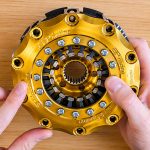
An F1 clutch is a multi-plate carbon unit less than 100 mm across, controlled by paddles on the steering wheel. It barely works during a lap, yet a poor release at the start can cost several places before the first corner.
This guide explains how F1 clutches work, from the carbon plates inside the bellhousing to the fingertip technique drivers use on the grid. You will see why the clutch sits idle for most of the race, how teams find the perfect bite point, and how the rulebook keeps the launch in the driver’s hands.
Whether you are a new fan, a sim racer or an engineering student, you will finish with a clear picture of one of motorsport’s most underrated parts.
At a Glance
- Size: under 100 mm in diameter, less than half the width of a typical road car clutch.
- Material: stacked carbon-carbon plates, from the same family of materials used for F1 brake discs.
- Control: hand paddles behind the steering wheel, linked electronically to a hydraulic actuator.
- Main jobs: race starts, pit exits and stall prevention. Gear changes happen without it.
Why a Formula 1 Car Still Needs a Clutch
An F1 car needs a clutch for the same basic reason your road car does: an engine cannot turn at zero rpm, but the car must sometimes stand still. The clutch is the bridge between a spinning engine and stationary wheels.
In Formula 1, that bridge has three core jobs:
- Getting the car moving from a standstill, on the grid and in the pit box.
- Disconnecting the drivetrain when the car stops, spins or needs to sit in neutral.
- Protecting the power unit from stalling, which can end a session or a race on the spot.
What the clutch does not do is help with normal gear changes. Once the car is rolling, the gearbox shifts on its own while the clutch stays fully engaged. For almost the entire lap, the clutch simply clamps shut and passes torque through.
That makes it one of the most unusual parts on the car. It is actively used for only a few seconds per race, yet those seconds are some of the most decisive in the sport.
Inside the Unit: Anatomy of an F1 Clutch
An F1 clutch is a dry, multi-plate design built almost entirely from carbon-carbon composite. Instead of one large friction disc, it stacks several small ones to carry the power unit’s torque in a tiny package.
The main parts are:
- Friction plates: alternating plates are splined either to the clutch basket on the engine side or to the hub on the gearbox input shaft. Clamped together, they lock engine and gearbox as one.
- Clutch basket and hub: lightweight metal carriers that hold the plates and transfer torque in and out of the stack.
- Spring: a compact spring clamps the plate stack together, so the clutch is engaged by default.
- Release bearing and hydraulic actuator: these push against the spring to separate the plates when the driver pulls the paddle.
The whole assembly measures under 100 mm in diameter and weighs roughly a kilogram or a little more. Teams and suppliers keep exact specifications confidential, so treat these figures as approximate.
Why So Many Plates?
A clutch’s torque capacity depends on four things: friction coefficient × clamping force × effective radius × number of friction faces. Shrinking the diameter cuts the radius, which cuts capacity. Adding plates multiplies the friction faces and wins that capacity back.
Why So Small?
The clutch bolts directly to the rear of the crankshaft, inside the bellhousing between engine and gearbox. A small clutch lets designers mount the crankshaft lower, which drops the car’s center of gravity. It also reduces rotating mass, a benefit explored in the next section.
Why Carbon-Carbon Is the Material of Choice
Carbon-carbon wins because it handles extreme heat, weighs very little and keeps its strength under huge clamping loads. No conventional clutch material offers all three at once.
Heat tolerance
A race start dumps an enormous amount of energy into the plates in a fraction of a second. Carbon-carbon keeps working at several hundred degrees Celsius, where organic road car linings would fade badly.
Low mass and inertia
The clutch is bolted to the crankshaft, so it spins with the engine on every lap. Lighter plates mean less rotating inertia, letting engine revs rise and fall faster through each gear change.
Strength and stability
Carbon-carbon stays dimensionally stable under the high clamping force needed to transmit F1-level torque through such small plates.
The material has trade-offs too. Like carbon brakes, a carbon clutch behaves best inside a temperature window, so teams warm it up before the start.
Its engagement can also feel abrupt, which makes precise paddle control essential. It is also expensive and slow to manufacture, as carbon-carbon parts take weeks or months to produce.
From Fingertip to Friction: How the Clutch Is Actuated
An F1 clutch is controlled by wire, with no pedal at all. The driver’s left foot works only the brake, while the clutch is operated by hand.
Here is the chain of events every time the driver uses it:
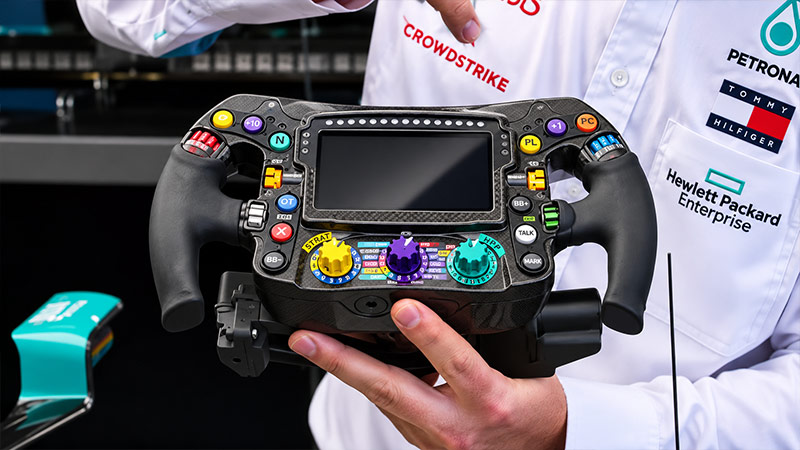
- The driver pulls a clutch paddle mounted low on the back of the steering wheel, below the gearshift paddles.
- A sensor measures paddle position and sends that signal to the car’s control electronics, built around the FIA-mandated standard ECU.
- The electronics command a hydraulic valve in the car’s high-pressure hydraulic system, the same system that drives the gearshift.
- Pressurized fluid moves the actuator, which pushes the release bearing against the spring and reduces the clamping force on the plates.
- Releasing the paddle reverses the process, restoring clamping force so torque flows to the rear wheels again.
Most steering wheels carry two clutch paddles, one for each hand. Either can operate the clutch, which gives the driver flexibility and enables the two-paddle start technique explained below.
This by-wire setup gives precise, repeatable control and simplifies packaging in a cramped cockpit. It also allows safety functions such as anti-stall. What it cannot do is launch the car automatically, because the regulations prohibit that.
The Race Start: Where the Clutch Earns Its Keep
A great F1 start depends on finding the bite point, the exact paddle position where the plates begin to transmit torque. Get it right and the car leaps forward cleanly. Get it wrong and the race can unravel in seconds.
The margin for error is tiny. Release too little clutch and the car bogs down, revs drop out of the power band, and anti-stall may intervene. Release too much and the rear tires spin, burning time and rubber.
The Start Sequence, Step by Step
In broad terms, a modern F1 launch follows this pattern:
- Calibration in practice. Drivers perform practice starts at the end of the pit lane during sessions. Engineers study the data and help set the bite point before the race.
- Preparation on the formation lap. Drivers warm the rear tires and clutch with burnouts and practice getaways, bringing both into their working window.
- Set-up on the grid. The driver pulls both clutch paddles fully, selects first gear and holds the engine at the target revs.
- Lights out. The driver releases one paddle completely. The other stays held at the bite point, so the clutch transmits only part of the available torque.
- Progressive release. As speed and grip build, the driver feeds out the second paddle while balancing throttle and wheelspin. Within moments the clutch is fully engaged and the driver shifts up.
The whole process takes only a few seconds. Yet track temperature, grip at each grid slot and clutch heat can all shift the ideal bite point, which is why even the best drivers occasionally get it wrong.
How the Rulebook Shapes Every Launch
The FIA writes the rules so that the driver, not software, controls the start. Over two decades, the regulations have steadily stripped away electronic help.
- No launch control. Automated launch systems were banned in the mid-2000s. The standard ECU, mandatory since 2008, also outlawed traction control, closing the door on electronic wheelspin management.
- A predictable paddle. The rules require a straightforward, consistent relationship between paddle travel and clutch torque. Teams cannot program a hidden map that shapes the launch for the driver.
- Limited coaching. Restrictions on radio communication limit how much engineers can guide a driver through start settings once the car leaves the garage.
The result is that starts reward feel, preparation and nerve. Variation in getaways is now part of the show, and a strong launch is a genuine driver skill.
The 2026 power units add a fresh layer. They drop the MGU-H, the motor-generator that once helped keep the turbo spinning. Managing turbo response on the grid is now part of the launch puzzle, placing even more weight on a precise clutch release.
Gear Changes Without the Clutch: The Seamless-Shift Gearbox
F1 drivers change gear without touching the clutch, thanks to a seamless-shift gearbox. The car uses an eight-speed sequential unit operated by paddles, and each shift takes just milliseconds.
In a conventional manual gearbox, the clutch must open to interrupt drive while one gear disengages and the next engages. A seamless-shift design overlaps those two events. The next gear begins to engage as the current one releases, so drive to the rear wheels is barely interrupted.
The control electronics briefly manage engine torque during each shift to keep it smooth and protect the gearbox internals. Downshifts work the same way, with the clutch staying closed throughout.
This is why the clutch spends most of a race fully clamped. Its active work is concentrated into a handful of short, extreme moments, and it must survive every one without fail.
Pit Stops, Stalls and the Anti-Stall Safety Net
Outside the race start, the clutch matters most in the pit box and whenever the engine is at risk of stalling.
- Pit stops: As the car stops in its box, the driver pulls the clutch and holds first gear while the crew works. When the release signal comes, the driver performs a mini launch, often in under three seconds from arrival. A clumsy getaway can waste the time the crew just saved.
- Anti-stall: If engine revs drop below a set threshold, the anti-stall system automatically opens the clutch to keep the power unit running. This often happens during a spin or after an overly aggressive release.
Anti-stall is a safety net with a cost. At the start, a release that triggers it can leave a car bogged down while rivals stream past. Mid-race, it can be the difference between rejoining after a spin and retiring in the gravel.
F1 Clutch vs Road Car Clutch
An F1 clutch is smaller, lighter and far more heat-resistant than a road car clutch, but it is built for a much shorter life. The table below compares typical figures; all values are approximate.
| Feature | F1 clutch | Typical road car clutch |
|---|---|---|
| Diameter | Under 100 mm | Around 200–250 mm |
| Plates | Several carbon-carbon plates | Usually one organic friction disc |
| Control | Hand paddles, electro-hydraulic | Foot pedal, hydraulic or cable |
| Used for gear changes | No | Yes, on manual gearboxes |
| Working temperature | Several hundred °C | Far lower; fades if overheated |
| Service life | Measured in race weekends | Often 100,000 km or more |
The contrast shows the design philosophy behind each part. A road car clutch is built for comfort, low cost and longevity. An F1 clutch is built for peak performance, minimal mass and a few seconds of perfect work.
The Engineering Trade-Offs Teams Manage
Every F1 clutch is a balance of competing demands, and teams use data to keep that balance right across a season.
- Size vs capacity. A smaller clutch lowers the center of gravity and rotating mass. It also needs more plates and higher clamping force to carry the same torque.
- Feel vs durability. Carbon’s friction behavior is not perfectly smooth. Engineers tune the spring and actuation, within the rules, to give drivers a consistent feel at the bite point.
- Heat vs repetition. Each practice start adds heat and wear. Teams track clutch temperatures and limit unnecessary starts to keep the unit healthy.
- Wear vs reliability. Plate thickness is checked between sessions. A clutch failure on the grid usually means a retirement before the race has begun.
Data drives every one of these decisions. Teams log clutch slip, actuator pressure, temperature, reaction time and wheelspin on every launch. Comparing that data across sessions lets engineers refine bite point targets and give drivers clear, evidence-based guidance before the race.
Conclusion
The F1 clutch proves that the smallest parts can carry the biggest consequences. Measuring less than 100 mm across and built from stacked carbon-carbon plates, it survives heat and loads far beyond what a road car clutch could handle.
Yet it works for only a tiny share of each race. Seamless-shift gearboxes handle every gear change, leaving the clutch to master the race start, the pit exit, and stall recovery.
Its control runs from a fingertip paddle through electronics and hydraulics, while strict rules keep the launch in the driver’s hands. That is why race starts still reward skill, preparation, and nerve.